9th May 2016
With the National Collegiate Athletic Association (NCAA) Division I National Championships just around the corner I thought a United States (U.S.) College golf briefing was in order.
So from the beginning….
There are c.1,300 colleges and universities across the U.S. Each one is different in terms of student numbers, sports facilities, budgets and scholarship packages.
In Year 1 a U.S. student is referred to as a ‘Freshman’, in Year 2 a ‘Sophomore’, in Year 3 a ‘Junior’ and finally in Year 4 a ‘Senior’.
Non-profit Athletic Associations organise competitive men’s and women’s sport for the US colleges. It is big business too. The better men’s football and basketball teams play in front of huge crowds, matches are televised and these sports generate millions of dollars of revenue for their institutions. However, most of the other sports, of which golf is one, whilst prestigious to differing degrees, are unprofitable to run for their colleges and therefore have to be subsidised.
The primary Association is the NCAA. This body focuses on the larger colleges and as such means that the other Associations can largely be ignored. It has history too – the first men’s golf event being staged in 1897.
Each Athletic Association is split into Conferences based on geographic regions. The Colleges are then split into different Divisions – normally I, II and III. Generally, the larger schools compete in Division I and smaller schools in II and III. In recent years some Colleges have started to switch Conferences for financial or performance reasons.
The NCAA, as it deals with the larger colleges with the most resources, is at the pinnacle of US college golf. In turn the Division I colleges attract the best golfers as they offer the best coaches and practice facilities and compete in the elite competitions. Division I of the NCAA is therefore the area that the interested observer should focus their attention on.
Only Division I and Division II schools can offer sports scholarships to athletes. In Division I there are currently c.280 colleges offering men’s golf scholarships and c.250 offering financial support for women. The NCAA allows 4.5 men’s and 6 women’s scholarship per college golf program. It is difficult to track everyone but I estimate there are c.150 Great British and Irish (GB&I) students playing golf on scholarships in the U.S. currently. In recent years, and for the financial reasons noted above, some colleges have been cutting golf from their list of sports programs.
Larger colleges run squads of between 7-12 players normally. This can be problematic – particularly after the settling-in Freshman year – as most events are five person affairs, meaning some players struggle to get selected and therefore don’t get to play competitively.
The NCAA supports 31 regional Conferences for college’s that play men’s golf – 28 of them support women’s golf. These are: – American Athletic; America Sky; Atlantic Coast; Atlantic Sun; Atlantic 10; Big East; Big South; Big Ten; Big 12; Big West, Colonial Athletic Association; Conference USA; Horizon League; Ivy League; Metro Atlantic Athletic, Mid-American; Mid-Eastern Athletic; Missouri Valley; Mountain West; Northeast; Ohio Valley; Pacific-12; Patriot League; Southeastern; Southern; Southland; Southwestern Athletic; Summit League; Sun Belt; Western Athletic; and West Coast. The Conferences in bold above have provided the strongest golf teams in recent years.

Eugene Country Club, Oregon – Host of the 2016 NCAA DI Championships
The Conferences and Divisions hold various regional and a few select national competitions throughout the Fall and Spring seasons. Five man teams compete for each college with additional team members playing individually sometimes. It’s normally four scores from five to count in 54 hole team events.
From October onwards GolfStat – the main provider of college golf scores and statistics – and GolfWeek/Sagarin publish Divisional rankings for the Teams and Individuals based on that season’s performances.
These events and rankings are followed closely and set the scene for the NCAA finals series – Conference championships precede four Women’s and six Men’s Regionals that are then followed by a National Championship – the latter taking place annually in May. Different courses are used each year by the NCAA.
Finals are held for each Division but the Division I events are clearly the US College Majors. The NCAA Division I Championships are now given TV coverage by the Golf Channel in the USA.
The winners of each Conference are granted automatic entry to the Regional Championships.
The GolfStat and Golfweek/Sagarin rankings are then used by the NCAA Golf Committee to select the other Teams and Individuals that will participate in the Regionals.
The 2016 Women’s NCAA Regionals were completed between 5th – 7th May. The six leading teams at each Regional qualified for the National finals. The three leading Individuals, not in one of these teams, at each one also advanced. Four leading GB&I players, three of whom have been selected for next month’s Curtis Cup are safely through to the National Finals – Bronte Law (UCLA), Leona Maguire (Duke), Elizabeth Mallett (North Carolina) and Charlotte Thomas (Washington). Two other Curtis Cup players, Meghan MacLaren (FIU) and Alice Hewson (Clemson), failed to progress either with their teams or individually.

Eugene Country Club, Oregon – Host of the 2016 NCAA DI Championships
The NCAA Committee announced their 2016 Men’s participants on 5th May, allocating 81 teams to this year’s six NCAA Division I Regional Championship venues. The College Teams are seeded so that the better ones are largely separated out from each other. Going into the 2016 Regionals the highest ranked Men’s Teams are Stanford, USC, Illinois, Georgia, Texas and Oklahoma State.
The 2016 Men’s Regionals will be played between 16-18th May at the following courses with the allocated number of Teams / Individuals as shown: –
Gallery GC, Tucson, Arizona – 14 / 5
UNM, Alberquerque, New Mexico – 14 / 5
Blackwolf Run, Kohler, Wisconsin – 13 / 10
Ol’Colony Golf Complex, Tuscalossa, Alabama – 13 / 10
Vanderbilt Legends Club, Nashville, Tennesse – 13 / 10
Karsten Creek, Stillwater, Oklahoma – 14 / 5
The five teams with the lowest team scores at each of the Men’s Regional qualifiers progress to the National championships. The player, not affiliated with one of the successful Teams, with the lowest score at each qualifier also advances to the Championship and plays in the Individual event. If you do the maths you will calculate 30 teams of five players plus six individuals means a total field of 156 players compete in the Men’s Finals.
In 2015 the Finals were played at the Concession Golf Club in Bradenton, Florida. For the first time the women’s event preceded the men’s on the same course. This year the two Championships are being played at Eugene Country Club in Eugene, Oregon. The Women’s between 20th – 25th May and the Men’s between 27th May – 1st June.
Both Championships consist of 54-holes of stroke play before a cut is made. Thereafter the top 15 teams and nine individuals not on an advancing team play a final 18 holes. The results from these 72-holes will determine both the Individual Champion and the top eight teams that will advance to the Team match play stage. The Team Champions, which is the primary focus of the NCAA, is then finalised on the final two days of competition.
Stanford and Louisiana State University won the Division I Women’s and Men’s Championship’s respectively in 2015.
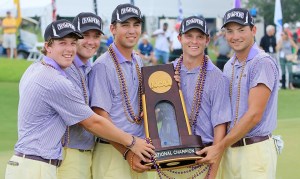
LSU Men’s Team Celebrate Their 2015 NCAA DI Victory
Emma Talley (Alabama) and Bryson DeChambeau of Southern Methodist University (SMU) won the 2015 Individual stroke play titles.
I will once again be doing my best to follow and report on the Women’s Nationals and the Men’s Regionals and Nationals in the coming weeks.
ME
Copyright © 2016, Mark Eley. All rights reserved.

