31st December 2014 (Last Updated 7th May 2025)
There are few people who have made a more significant contribution to the game of golf than Sir Michael Francis Bonallack, Kt, OBE. He was an outstanding amateur golfer who became a highly respected administrator.
He was born in Chigwell, Essex, England on 31st December 1934 and died on 26th September 2023 in St. Andrews.
Michael first picked up a golf club when he was 10 whilst on holiday in North Devon, playing on the beach with his brother. Taking to it well the boys were enrolled by their parents at the local Chigwell G.C. shortly afterwards. Michael quickly started to win junior competitions and saw his handicap tumble.
Michael’s younger sister Sally (Barber) was also a very accomplished player. She was the English Ladies Champion in 1968 and played for both England (1960-72) and Great Britain & Ireland (GB&I) in the Curtis Cup (1962). She turned professional in 1979 before having her amateur status re-instated in 1982.
After just a few years at Chigwell Michael joined Thorpe Hall G.C. and it is this club, near Southend-on-Sea in Essex, that he represented throughout his amateur career. Thorpe Hall is a tight tree-lined course with small greens and this contributed to Bonallack becoming a straight-hitter with an exceptional short game.
Educated at Haileybury, Michael achieved a scratch handicap at 16 and quickly made a name for himself; regionally, winning the Essex Boys title in 1950 and 1951, and then nationally, winning the British Boys Championship in 1952, beating Alec Shepperson on the 37th hole of the final at Formby GC.
He went on to win the Amateur Championship five times; the last three being in successive years: –
1961 v. Jimmy Walker 6&4 at Turnberry
1965 v. Clive Clark 2&1 at Porthcawl
1968 v. Joe Carr 7&6 at Troon
1969 v. Bill Hyndman (USA) 3&2 at Hoylake
1970 v. Bill Hyndman (USA) 8&7 at Newcastle, County Down
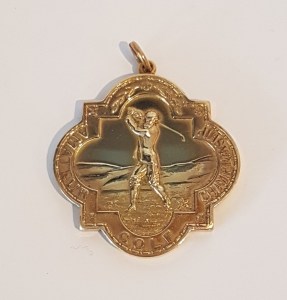
Michael Bonallack’s 1968 Amateur Gold Medal (Photo: British Golf Museum)
His favourite Amateur win was the 1965 one at Porthcawl against Clive Clark. “I was six down after 12 holes of the 36 hole final but got it back to three down by lunch when, just to pass the time, I started sticking sixpences into the fruit machine. On about the fifth pull I won the jackpot. I made sure Clive knew about it. ‘Must be my lucky day’ I told him”. Famous Scottish caddie Willie Aitchison, who helped Roberto De Vicenzo and Lee Trevino to their Open wins, also caddied Bonallack to all of his Amateur wins.
Nationally he also won the English Amateur Championship five times (1962, ’63, ’65, ’67 and ’68) and the English Open Amateur Stroke Play Championship (Brabazon Trophy) four times (1964, ’68, ’69 (tied with Rodney Foster) and ’71).
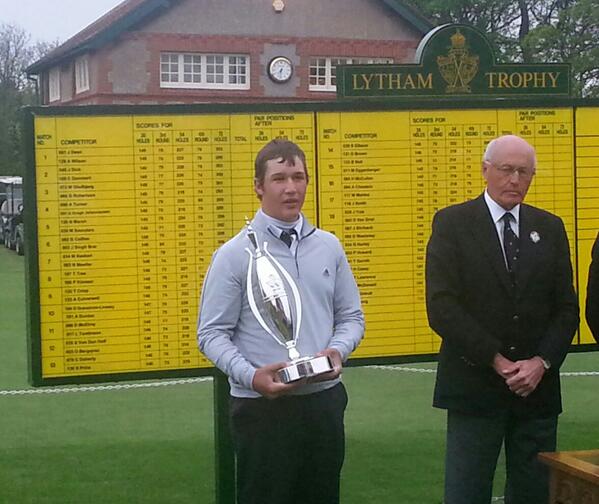
Other notable victories came in the Lytham Trophy (1965T and ’72), Berkshire Trophy (1957, ’61, ’65, ’68, ’70, ’71T), St. George’s Grand Challenge Cup (1965, ’68, and ’81), H.R.H. Prince of Wales Challenge Cup (1967), Hampshire Hog (1957 and 1979) and the no longer contested Golf Illustrated Gold Vase (1961T, ’67T, ’68, ’69T, ’71 and ’75). Second Lieutenant MF Bonallack (Royal Army Service Corps.) also won the Army Championship in 1955 at Muirfield. He captained the Army Team between 1962-67. Finally, he also won the Sunningdale Foursomes in 1959 playing with Doug Sewell and The Antlers at Royal Mid-Surrey in 1964, playing with Dr. David Marsh – Sewell and Marsh both being first class amateurs themselves.
Since 1959 the Philip Scrutton Jug has been awarded to the player with the lowest aggregate scores in the each year’s Brabazon and Berkshire Trophies. Given his record in both competitions Sir Michael won the jug in 1961, ’64, ’66, ’68, ’69, ’70 and ’71.
Unsurprisingly he dominated men’s golf in Essex winning the Essex Amateur Championship a record 11 times, in 1954, ’57, ’59, ’60, ’61, ’63, ’64, ’68, ’69, ’70 and ’72. Sir Michael also won the 1969 Essex Open Championship in 1969 and East Anglian Open Championship in 1973.
He represented GB&I in nine Walker Cup teams, two as playing Captain (in 1957, ’59, ’61, ’63, ’65, ’67, ’69, ’71 and ’73). He played 25 individual games, more than any other GB&I player in the history of the match and is only beaten by Jay Sigel’s 33 on the USA side. His record reads won 8, lost 14 and halved 3. The highlight for Bonallack was contributing to the victorious side in 1971 where GB&I won the cup for the first time in 33 years. “I was playing captain that year when we won over the Old Course at St. Andrews, and it does not get, cannot get, any better than that,” he later recalled.
Bonallack, representing GB&I at the time, also played in seven World Amateur Team Golf Championships, for the Eisenhower Trophy, the last three as playing Captain (1960, ’62, ’64, ’66, ’68, ’70 and ’72). In 1968 he tied for the Individual title with Vinny Giles from the USA. He also represented GB&I in biennial matches against The Rest of Europe between 1958-72.
Sir Michael represented England in the Home International Matches on 17 occasions (1957-72, ’74). He captained the team between 1962-1967. His record was played 131; won 79, halved 15 and lost 37. He also played in the British Commonwealth Team in 1959, 1963, 1967 and 1971, captaining the team in 1971 and 1975 (non-playing).
He played in 13 Open Championships. His best finish coming in his first when he tied 11th at Muirfield. He didn’t win the Silver Medal that year but secured it in 1968 (Carnoustie – T21) and again in 1971 (Royal Birkdale – T22). He considered these results his main golfing disappointment, reflecting in later years: “I wish I had done better in The Open”.
Bonallack had little overseas success. He played in the U.S. Amateur six times between 1957 and 1973, his best finish T11 coming at Scioto CC in 1968. He also played in the US Masters three times, 1966, ’69 and ’70, missing the cut on each occasion. However, he did have the pleasure of sitting next to his hero Bobby Jones at the traditional Amateurs’ Dinner in 1966 and then playing alongside the legendary Ben Hogan, whom he described as “the finest ball-striker I ever saw”.
Bonallack was not long off the tee and had an unconventional putting stance but he certainly got the job done. Peter Alliss described him as “a remarkable player. He had a wonderful short game, which was of his own making. Big wide stance, nose sniffing the ball, short jabby swing, but all the putts went in the hole. He had the most wonderful temperament. He appeared calm and yet he had that steely something that all great champions have.”
Good friend Donald Steel, writing for Country Life in July 1983, upon Bonallack’s competitive retirement, described him as a “fierce competitor” before adding “I have never seen anyone hole more critical putts than he did or impose the same magical touch on a whole variety of wedge and bunker play.”
Bonallack’s playing pre-eminance came just before the establishment of the European Tour and the growth in tournament purses. The transition from amateur to professional was more cumbersome in those days – the PGA prevented amateurs from taking prize money for two years – and with a lack of conviction that he was really good enough little time appears to have been spent worrying about doing so. It simply made more sense for him to work in sales for the family business which was involved with refrigerated trucks and container bodies. This earned him a salary whilst affording him the flexibility to practice (normally in his lunch breaks) and play on the weekends as he wished.
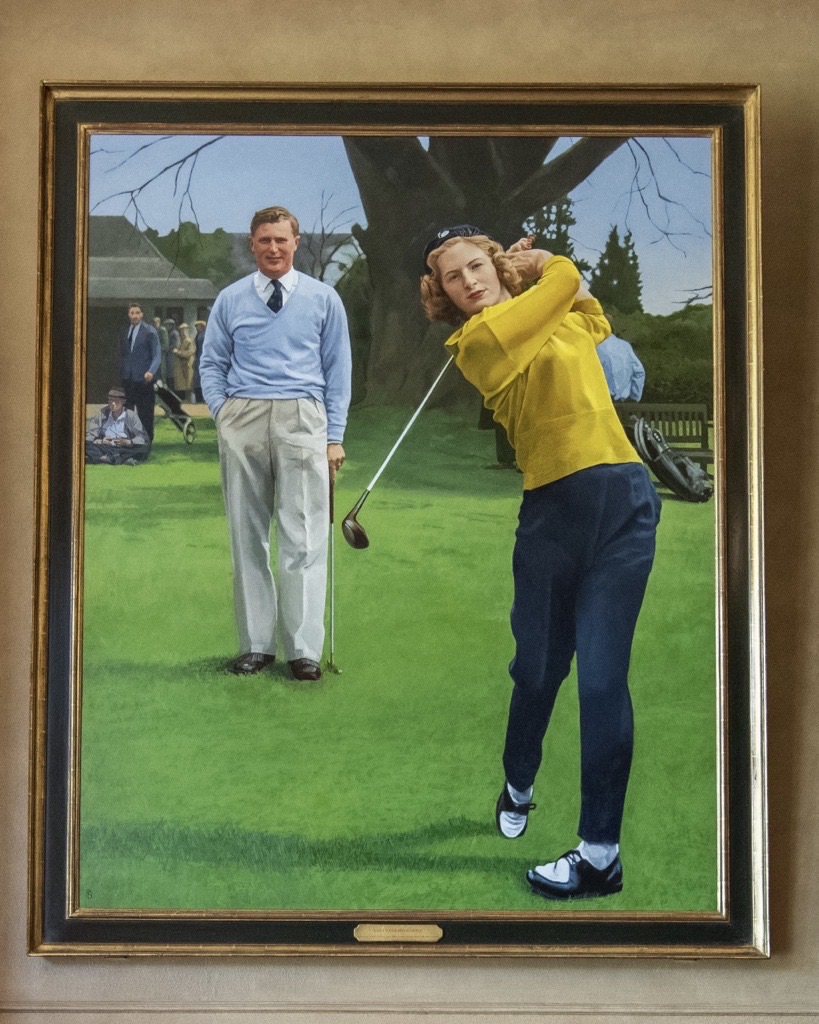
Sir Michael Bonallack and Lady Bonallack R&A Portrait (Photo: The R&A)
He married Angela Ward in 1958. A celebrity couple of the day the announcement of their earlier engagement made the front page news of almost every daily newspaper. Angela was the British Girls Champion in 1955 and English Ladies Champion in 1958 and 1963. Lady Bonallack was also runner-up in the British Ladies Amateur in 1962 and 1974. She played in six Curtis Cup teams (1956, ’58, ’60, ’62, ’64 and ’66). Playing together Angela and Michael won the Worplesdon Mixed Foursomes in 1958. In February 2015 Lady Bonallack became one of the first women ordinary members of The Royal & Ancient GC of St. Andrews.
A new portrait (see above), painted by Paul Branson, of the couple was unveiled in the Big Room of the R&A Clubhouse on 2nd May 2025. It replaced the individual portrait of Sir Michael shown further down this article.
The couple have four children, Glenna, Jane, Sara and Robert and many grand children. Unsurprisingly golf still runs through the family’s veins with Glenna, Jane and Robert all very good players. Jane (Baker – known as “JB” to her friends) went her own way preferring horses and riding. Angela and Glenna won the well known Royal Mid-Surrey Mothers and Daughters Competition in 1979 and 2000. In 2013 Glenna won it with her own daughter, Harriet.
Michael Bonallack joined The Royal and Ancient Golf Club of St. Andrews in 1960. Over these years he was Chairman of the Amateur Status Committee (1975-79) and of the Selection Committee (1975-79) and a Member of the Rules of Golf Committee (1979-83), the General Committee (1975-1978 and 1999-2000) and the Heritage Committee (2006-10). At the Club’s Autumn Meeting in September 2013 he become the 16th Honorary Member of The Royal and Ancient. He had previously been made a Life Member in 1999. The portrait below was for many years displayed in the Big Room of The Royal and Ancient Clubhouse. Sir Michael said at the time: “I am extremely proud. I feel privileged to have been so closely involved with the Club for so much of my life and both it and the town of St Andrews are incredibly dear to me. It has been an honour to serve the Club.”
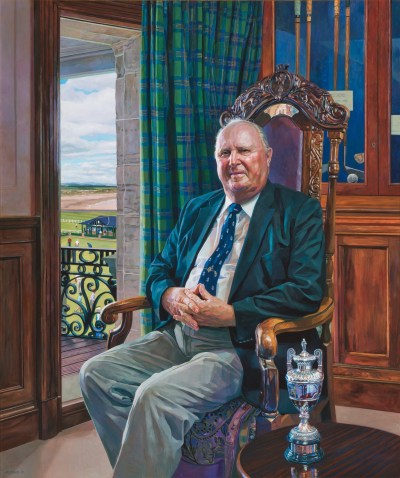
Sir Michael Bonallack’s R&A Portrait (Photo: British Golf Museum)
Sir Michael was appointed Secretary of the Royal & Ancient Golf Club of St. Andrews in 1983, succeeding Keith Mackenzie. In the early 1980s Bonallack was running the Leisure Division of construction and property developer company Miller Buckley based in Rugby, albeit the family still lived in Essex. Among his roles was Chairman of Cotton Pennick & Lawrie, the Golf Course Architect company (1978-83), that had been acquired by Miller Buckley. Upon his appointment he left Miller Buckley to take on the Secretary’s role and moved with Angela up to Fife.
As Secretary of the R&A, Bonallack helped to guide the game into the 21st Century. “He has bridged the gap between the history and heritage and tradition of The Open Championship and golf in general as it moved into the commercial age globally and internationally and he’s done it with great taste and tact and really stands almost alone as someone who has handled that crossing.” said the late Mark McCormack, chairman of International Management Group. Bonallack himself said: “It’s one continual satisfaction to see the way in which golf is developing. Obviously, the expansion of The Open, and the fact that we can generate this money to put back into the development of the game is very satisfying”.

Sir Michael Bonallack – 1999/2000 Captain Of The Royal & Ancient
He retired as Secretary in 1999 after 16 years and was succeeded by Peter Dawson. He was immediately nominated for the Captaincy of the Club for the millennium 1999-2000 year. There were two themes that he sought to bring to the role during his term of office: “…maintaining behavioural standards and ensuring that amateur golf is not destroyed by over-commercialism and ridiculously large prizes”.
The Bonallack Trophy, a biennial amateur competition played between teams from Europe and Asia-Pacific, was first played in 1998. The teams consist of 12 amateur golfers with no more than two players coming from the same country. The competition named in honour of Sir Michael continues to grow in importance and helps to raise the profile of the game, particularly in the Far East, Indian and Australasia areas.
Other golfing competitions and trophies have been named after Sir Michael too. In 2007 the Essex Golf Union established The Sir Michael Bonallack Trophy, a 36-hole scratch men’s stroke play competition, in honour of their Life Vice-President. Finally, 2014 has seen the commencement of The Concession Cup, a match between teams of mid, senior and super-senior amateurs from the USA and GB&I, and the commissioning of the Bonallack Campbell (William) Trophy for the winners.
He enjoyed many other golf club memberships, notably Pine Valley and Elie, as well as many honorary memberships offered in recognition of his service to the game, including Augusta National G.C.
Sir Michael held many important positions in the golfing world and over the years has received numerous honours and awards. Some of these are detailed below: –
Honours
Officer of the Order of the British Empire (OBE) (1971)
Knight Bachelor awarded by Queen Elizabeth II (1998). Sir Michael became the third ‘golfing knight’ after Sir Henry Cotton and Sir Bob Charles. Sir Nick Faldo subsequently joined the select group in 2009. The other three all being Open champions.
Awards
Association of (British) Golf Writers – Golf Writers’ Trophy Award (1968)
United States Golf Association – Bobby Jones Award (1972)
American Society of Golf Course Architects – Donald Ross Award (1991)
England Golf – Gerald Micklem Award for Outstanding Contribution to Amateur Golf in England (1991)
Northern Ohio Golf Charities – Ambassador of Golf (1995)
Golf Association of Philadelphia – Arnold Palmer Lifetime Service Award (1997)
Spanish Golf Federation Golf – Medal of Honour (1999)
Association of (British) Golf Writers – Award For Outstanding Services To Golf (1999)
World Golf Hall of Fame entry – Lifetime Achievement in Golf (2000)

Sir Michael Bonallack Introduces Allan Robertson To The World Golf Hall Of Fame in 2001
Czech Republic – Golf Shield of Honour (2000)
Metropolitan Golf Association – Lifetime Service Award (2000)
GOLF EUROPE legend award (2004)
BIGGA Lifetime Achievement Award (2005)
Honoree at The Memorial Tournament (2006)
England Golf Hall of Fame Inductee (Feb. 2024)
Other Golf Positions
President, Golf Club Managers’ Association (1974-1984)
Chairman, PGA of Great Britain and Ireland (1976-1982)
Chairman, Golf Foundation (1977-1982)
President, English Golf Union (1982)
President, British and International Golf Greenkeepers Association (BIGGA) (1999-2016)
President, The Society of One Armed Golfers (1995-2023)
Chairman, Golf Foundation (2000-2003)
Non-Executive Director of the PGA European Tour (2000-2015)
The Professional Golfers Association of Europe (2002-2004)
President, PGAs of Europe (2003-2004)
Chairman of the Official World Golf Rankings Governing Body (2004-2016)
Vice President, Association of (British) Golf Writers (N/k)
Patron, Artisan Golfer’s Assocation (2007-2023)
President of the National Association of Public and Proprietary Golf Courses (NAPGC) (2008-2023).
Patron, British and International Golf Greenkeepers Association (BIGGA) (2016-2023)
In August 2018 The R&A published ‘Par Excellence’, a biography of Sir Michael written by Donald Steel. On 21st February 2019 the USGA announced that the book was to be the recipient of their Herbert Warren Wind Book Award for 2018, in recognition of its outstanding contribution to golf literature.
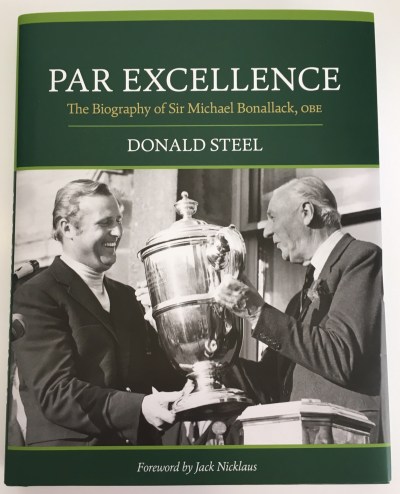
‘Par Excellence’ Book (Photo: GolfBible)
Lady Bonallack died on Friday 1st July 2022 at the age of 85. She had been in poor health for a few years and finally succumbed to the COVID-19 virus.
Clearly in poor health Sir Michael was a very welcome guest at the opening ceremony of the 49th Walker Cup match played at St. Andrews at the start of September 2023.
Sir Michael’s was a life well lived and he leaves a legacy to the game that can only be matched by a handful of others.
ME.
Copyright © 2014-2025, Mark Eley. All rights reserved.
 Golf Bible
