Lieutenant F. G. Tait

10th January 2016

Lieutenant F.G. (Frederick Guthrie) Tait was a leading golfer at the end of the 19th Century. A hugely charismatic man he starred alongside Johnny Ball, Harold Hilton, Harry Vardon and J.H. Taylor. At a time when amateurs and pros played together a lot their combined popularity helped to grow the game in Great Britain and Ireland.

So why haven’t most people heard of him ? Well sadly he only played competitive golf for 9 years before he was tragically killed aged 30 serving his country in the Second Boer War. Despite this his happy demeanour, good sportsmanship and attacking, winning play made him a national hero and left a golfing legacy that endures to this day.
img_3561

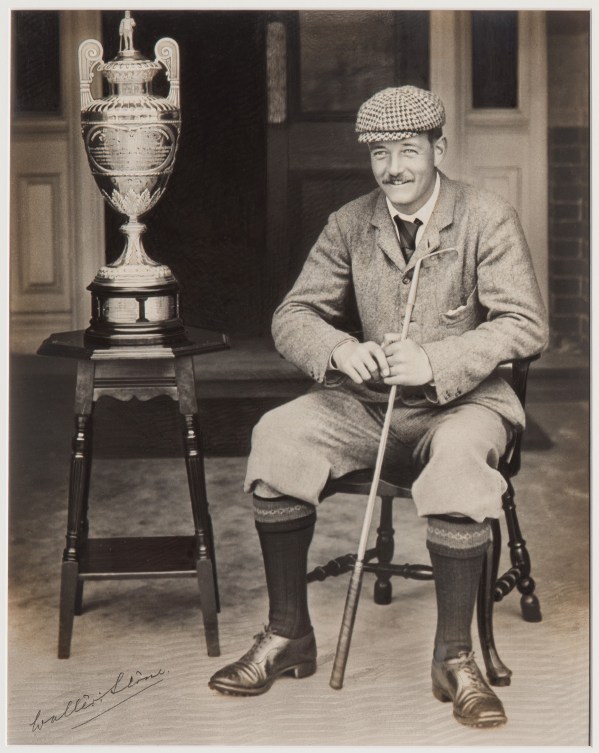
Freddie Tait with The Amateur Championship Trophy in 1898

So let’s take a look at the life of this important historical figure: –

1. Freddie Tait was born just under 150 years ago in Edinburgh, Scotland on 11th January 1870.

2. His father, Peter, was an Edinburgh University professor and fanatical golfer. As such the family spent most of their summer holidays in nearby St. Andrews. He started playing golf aged 5 and along with his three brothers learned to play the game on the Old Course. The family would often play up to five rounds a day starting at 6.00am. Professor Tait, known as ‘The Governor’ by Freddie, undertook many of the earliest experiments on the physics of golf using his son to produce the ball striking data he required.

3. After completing his education at the Edinburgh Academy he joined the Royal Military College at Sandhurst – where it is said he introduced golf – and became an infantry soldier, eventually serving with the 2nd Battalion of The Black Watch (Royal Highlanders). He clearly had some flexibility with his employment and when he was not guarding Queen Victoria during her Balmoral stays he appears to have been able to play golf at will, be it friendlies, competitive matches or tournaments.
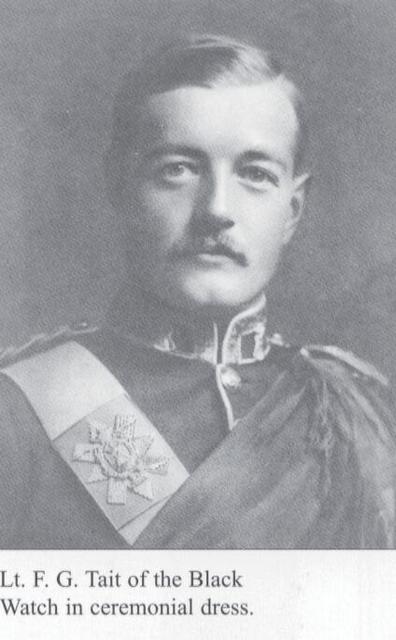
Freddie Tait Black Watch

4. He became a member of the Royal & Ancient G.C. of St. Andrews in early 1890 just after he had turned 20. Thereafter he repeatedly set new Old Course scoring records. A 77 in 1890, a 72 in 1894 and then in 1897 a remarkable 69.  From an early age he kept detailed records of all his matches, detailing his scores and play as well as the course conditions and his opponent’s play.

5. He was a 6 foot tall powerful man and one of the longest hitters of his era. He became famous nationwide when on 11th January 1893 he produced a record breaking drive of 341 yards on the 13th hole of the Old Course. His gutta-percha ball flew 250 yards and ran a further 91 yards on the frozen fairway.  This more than exceeded his Father’s “scientifically proven” maximum drive distance.

6. In total he won 28 tournaments between 1893 and 1899, many of them on the Old Course in Royal & Ancient Golf Club competitions. He also won three St. George’s Challenge Cups at Royal St. George’s. In his final 1899 season he won the Prestwick Silver Medal, the St. George’s, the three major Medals at the Royal & Ancient, the Calcutta Cup and was runner-up in the Amateur. In July 1899 he shot a new course record 63 at the old Archerfield Links. This was clearly a man at the top of his game come the turn of the century.

7. His greatest golfing achievements were his two Amateur Championship victories. Having reached the semi-finals in 1893, 1894 and 1895 his first victory came in 1896 when he beat Harold Hilton 8&7 in the final at Royal St. George’s. This was the first year the final was played over 36 holes and Tait went into the Championship as favourite having won the stroke play St. George’s Challenge Cup played immediately before it. Nevertheless his first win was hard fought; the draw seeing him have to beat John Laidlay, John Ball and Horace Hutchinson, all previous multiple Amateur champions, before facing Hilton.
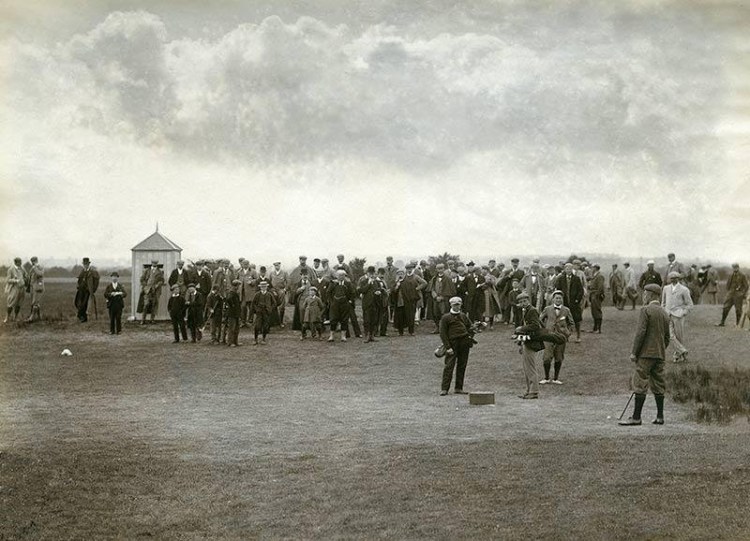
Freddie Tait & Harold Hilton

Freddie Tait tees off against Harold Hilton in The Amateur Championship of 1896

In 1898 Tait beat S. Mure Ferguson 7&5 at Hoylake.  In the fourth round Tait found himself up against local favourite Harold Hilton. The ‘match of the week’ turned into an anti-climax with Tait easily winning 6&5. In the next round he played another Hoylake member, Jack Graham, whose family he happened to be staying with. Tait was fortunate to win by 1 hole, Graham missing two late putts, one of which Hilton kindly described as “about the shortest I have ever seen missed in a Championship”. He was equally lucky in the semi-final where his mixed play saw him taken to the 20th hole.  Despite a comfortable win in the final he endeared himself to the locals with his humble victory speech: “Thank you for the way in which you have received my fluky win. I ought to have been beaten twice yesterday, but I got off. I played better today but I really don’t deserve the Championship”.

Tait’s record in the Amateur is the second best of those who have played 30 or more matches, beaten only by American Frank Stranahan. Between 1892 and 1899 he played in 8 Amateurs competing in 36 matches. He won 30 and lost 6 giving him a win percentage of 83.3% (Stranahan’s being 86%).

8. In what Bernard Darwin later described as “the greatest, most prostratingly exciting” match he ever saw Freddie Tait lost the final of the 1899 Amateur Championship, his last of course, to Johnny Ball. Played at Prestwick G.C. Tait again beat Hilton, this time by 1 hole in the quarter finals, on the way to the final. It was the final everyone wanted – Scotland versus England with the two most popular and respected figures in amateur golf going head to head. Tait led by 3 holes after the morning 18, albeit he had been 5 Up after 14.  Ball was level by the 6th in the afternoon and went 1 Up with just two holes to play.  On the 17th, the ‘Alps Hole’, Tait failed to carry the sandhills and ended up in the large cross bunker short of the green.  Due to heavy rain the bunker was full of water (see below). However, Tait managed to get the floating gutta-percha ball out of the water and half the hole; Ball having been just short of the green in two himself.  Tait then won the 18th to take the final to extra holes. Sadly for Tait Ball holed out for birdie on the 1st from seven feet whilst he missed from a similar distance.

9. He competed in eight Open Championships between 1891 and 1899. He missed the 1893 Open at Prestwick. He was the leading amateur six times with his best finish being third, which he achieved in both 1896 and 1897.

10. In 1898 he made a legendary bet that he could play from Royal St. George’s G.C. in Sandwich, Kent to the neighbouring Royal Cinque Ports G.C. 3.2 miles (5,652 yards) away in less than 40 teed strokes with the same ball. The two courses do not abut so some rough scrubland between the two also had to be overcome. It was agreed that when his ball struck the Cinque Ports clubhouse the cross-country shot count would end. With a gallery, some ball spotters and his dog ‘Nails’ helping him Tait achieved the feat in just 32 shots. Unfortunately his final shot went through a clubhouse window and as a result much of his winnings were paid over in compensation to the Club. Unusually he chose not to record the challenge in his diary but it was recorded for posterity in the R&A’s Golfer’s Handbook for many years.

11. Tait was well known for celebrating his golfing victories by playing his bagpipes loudly and marching up and down clubhouses and town centres across the country.  It was his friendliness and mischievous nature that the people of Scotland came to love.

12. His last competitive golf match took place at Royal Lytham & St. Anne’s G.C. on 2nd October 1899. It was a 36-hole re-match against Johnny Ball, a member of Lytham. With 5 holes to play Ball was 3-Up but Tait fought back and finally won on the 18th. Just three weeks later his life would be turned on it’s head and he would off to war.

13. In October 1899 the Second Boer war broke out and on the 22nd, as a Lieutenant in the Black Watch, Tait travelled to Cape Town in South Africa to fight.  He was shot in the thigh of his left leg at the Battle of Magersfontein on 11th December. After recovering he returned to the front line in January to lead his platoon in the Battle of Koodoosburg Drift near Kimberley.  On 7th February 1900 he was shot dead leading a charge.

14. He and his fallen colleagues were ‘buried in a soldiers grave’ on the banks of the Riet River. In 1963 he was re-interred in the West End Cemetery in Kimberley by the War Graves Board. A plain marble cross simply records his name, and dates of birth and death. A memorial service was held for Tait at the Church of St. John The Evangelist on Princes Street, Edinburgh on 21st February 1900.  There is also a commemorative headstone in the church’s graveyard.
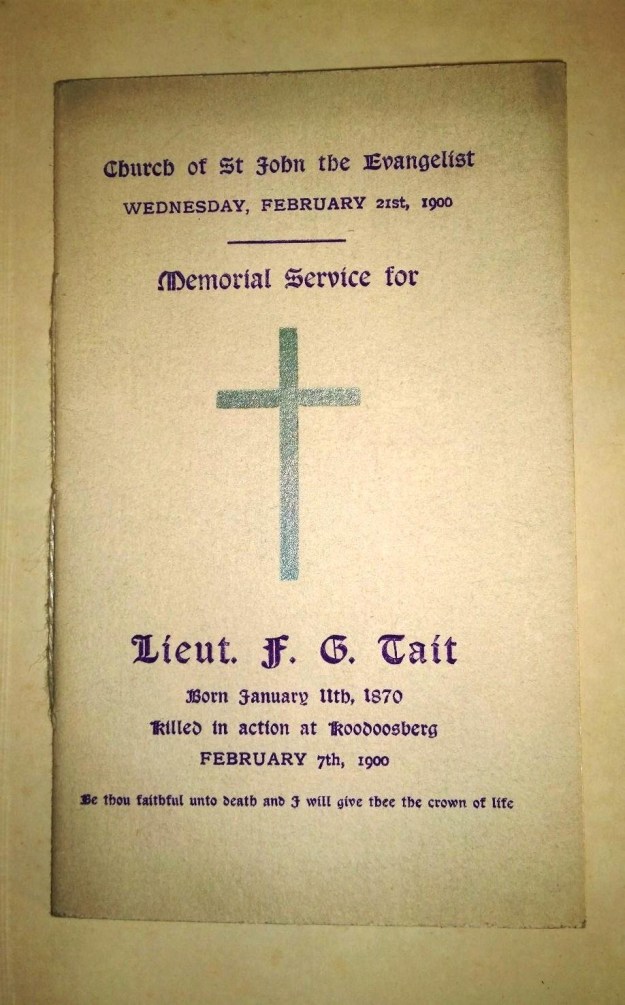
Freddie Tait Memorial Service

Freddie Tait Memorial Service Programme
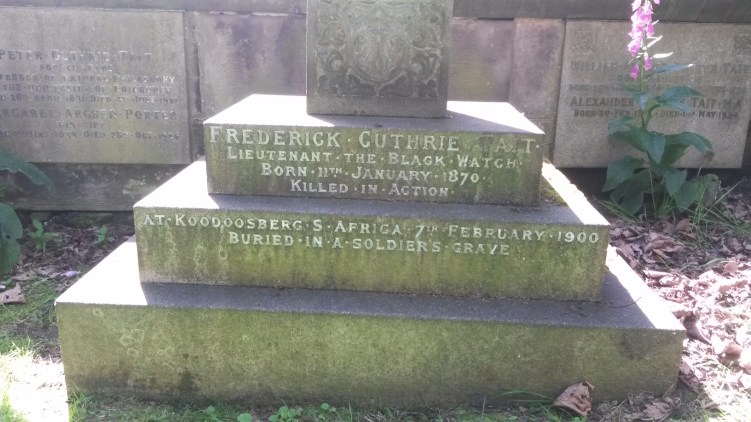
Freddie Tait Edinburgh Headstone

Freddie Tait Commemorative Headstone in the Church of St. John’s Episcopal Church in Edinburgh

15. There was a national outpouring of grief when the news of Tait’s death was received back home. Another amateur golfer of the day John L. Low was asked to put together a remembrance book. ‘F.G. Tait – A Record; Being his Life, Letters and Golfing Diary’ was published in 1900. With the full cooperation of Tait’s family and everyone who knew him it was the first golf biography ever written and without question one of the most comprehensive. All of the profits from the sale of the book were donated to the Black Watch Widows’ and Orphans’ Fund.

16. Given his status in the game and in particular at St. Andrews his fellow Royal & Ancient G.C. members commissioned John Henry Larimer, the famous Scottish artist, to paint his portrait in 1901. It still hangs in the R&A clubhouse to this day.  The 16th hole of the Jubilee Course at St. Andrews is also named ‘Freddie Tait’ after him.
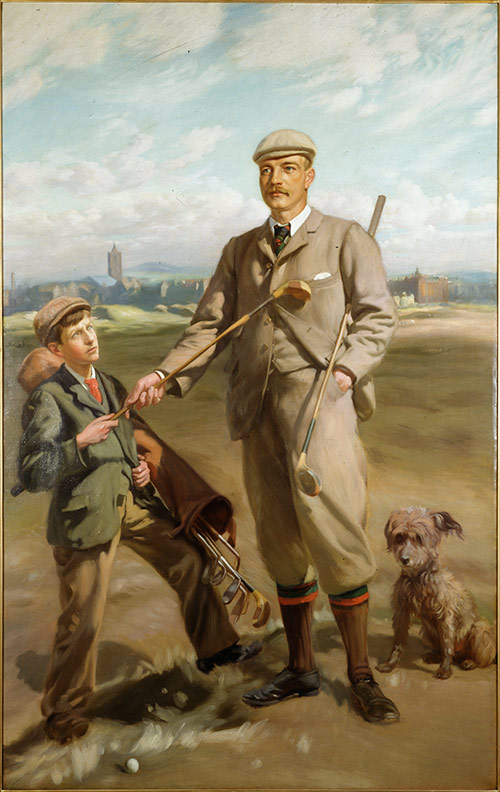
Freddie Tait R&A Portrait

Freddie Tait with his terrier dog ‘Nails’ and Boy Caddie, Dave Cuthbert (Photo: R&A)

17. The St. Andrews Memorial Hospital in Abbey Walk, opened in 1902 and closed in 2009, was largely funded by monies raised in memory of Freddie Tait.
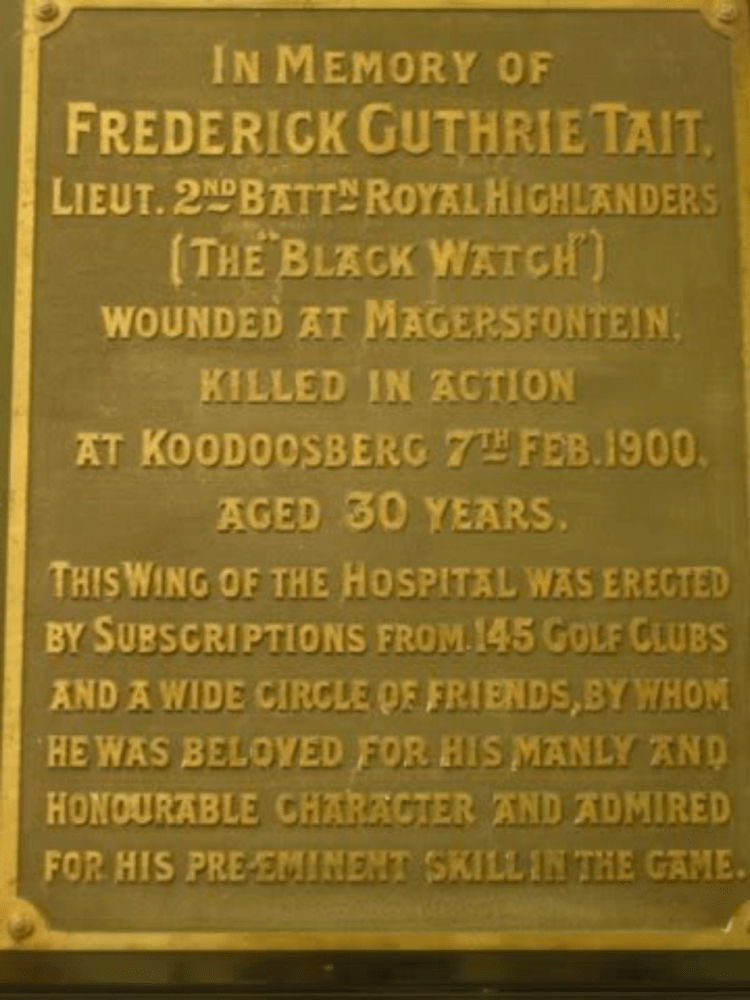
Freddie Tait Hospital Plaque

The St. Andrews Memorial Hospital Freddie Tait Wing Plaque

18. Tait was a founding member in 1894 of Luffness New G.C. in East Lothian. For many years his family allowed Luffness to display most of Freddie’s medals and other memorabilia in their clubhouse. The family tried to sell 36 of his medals in May 2009 but with an estimate of £120-180,000 they failed to sell at Convery Auctions. The National Library of Scotland acquired six Tait letters for £10,000 in the same auction. The medals were returned to their Luffness cabinet and remain there. The Club has an annual Freddie Tait foursomes stableford competition to start their season. The winners are allowed to wear some of the medals during a prize giving lunch afterwards.

19. In 1936 Lieutenant Tait’s putter was presented to the Kimberley Golf Club by J.H. Taylor who was touring with a group of UK professionals. Tait’s will had asked for his putter to be given to the club closest to the site of his death. Since 1937 the club has held an annual Freddie Tait Putter competition. In 1990, on the 90th anniversary of his death, The FG Tait Golf Museum was opened and then on the centenary in 2000 a Freddie Tait Golf Week was instigated.

20. In 1928 The Freddie Tait Cup was donated to the South African Golf Association by a touring British Amateur team who found themselves with surplus funds. From 1929 it has been awarded to the leading amateur at the South African Open, subject to them making the cut. South African greats Bobby Locke, Denis Hutchison, Dale Hayes, Ernie Els and Trevor Immelmann have all won it in the past.
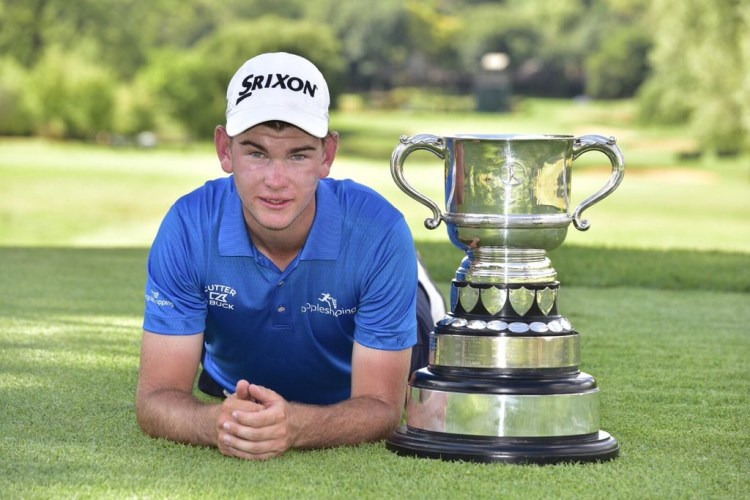
Freddie Tait Cameron Moralee 2016

Cameron Moralee with The Freddie Tait Cup in 2016 (Photo: Sunshine Tour)

Freddie Tait was a genuine national hero and a household name. Bernard Darwin, reflecting in 1933 said “I do not think I have ever seen any other golfer so adored by the crowd – no, not Harry Vardon or Bobby Jones in their primes.” He was clearly a superb golfer and a fans favourite. One can only wonder at what he may have achieved in the game if his life hadn’t been so cruelly ended by a shot through the heart when he was just 30 years old.

ME.

Copyright © 2014-2025, Mark Eley. All rights reserved.
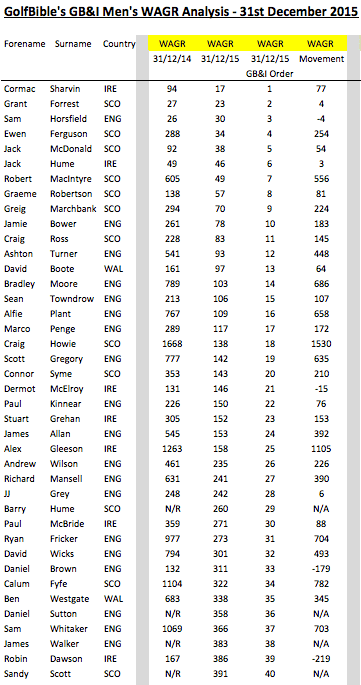
The 2015 Year End GB&I Men’s Amateur Golf Rankings

6th January 2016

The following tables review the current World Amateur Golf Rankings (WAGR™) and the Scratch Players World Amateur Rankings (SPWAR) of the Top 40 Great British & Irish (GB&I) men’s amateur golfers.

These tables highlight the significant progress that a number of GB&I players made last year.  Craig Howie (SCO), Alex Gleeson (IRE), Robert MacIntyre (SCO), Alfie Plant (ENG), Bradley Moore (ENG), Scott Gregory (ENG) and Jimmy Allan (ENG) all stand out and are clearly ones to watch this year, along with the more established and familiar names.

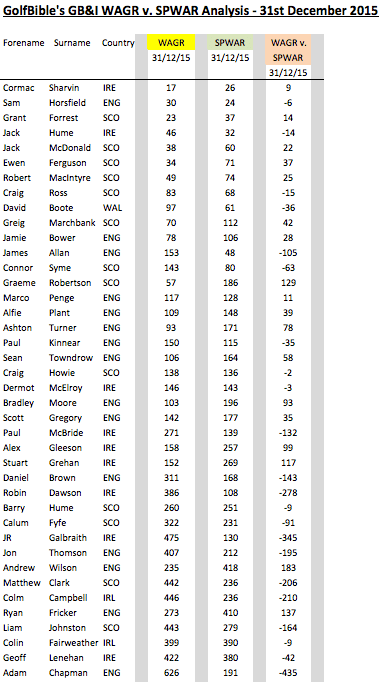
This first table analyses the 2015 year end WAGR™ rankings and the movements seen during the year.  Ireland’s Cormac Sharvin ended the year as the highest ranked GB&I player.

Screen Shot 2016-01-07 at 20.08.03

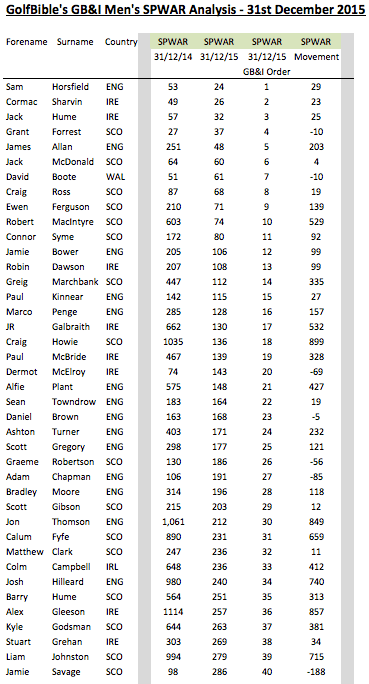
This table analyses the 2015 year end SPWAR rankings and the movements seen during the year.  England’s Sam Horsfield ended the year as the highest ranked GB&I player.

Screen Shot 2016-01-07 at 20.11.46

It is always interesting to look at the difference between the player rankings attributed by the WAGR™ and the SPWAR.  You will see some players appear on one of the two lists above but not the other.  The explanation for the difference normally lies in the different periods covered by the respective rankings.  The WAGR™ covers a rolling 52 week period whilst the SPWAR rates players over a longer 2 year period.  The table below shows the difference between the two rankings at the end of 2015.

Screen Shot 2016-01-07 at 19.33.46

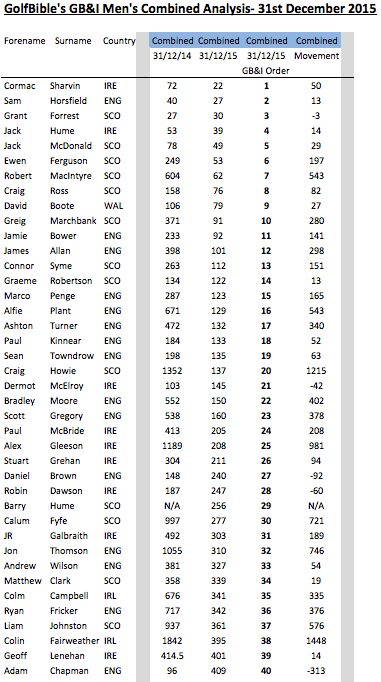
I started to produce a Combined Ranking last year to create a new ranking based on both of the above lists.  To achieve this I simply use an average of each player’s WAGR™ and SPWAR ranking.  The table below analyses the 2015 year end Combined Ranking and the movements seen during the year.

As we look ahead to 2016 the Combined Ranking Top 40 is made up of 15 English players, 13 Scottish, 11 Irish and 1 from Wales.

Screen Shot 2016-01-07 at 19.40.16

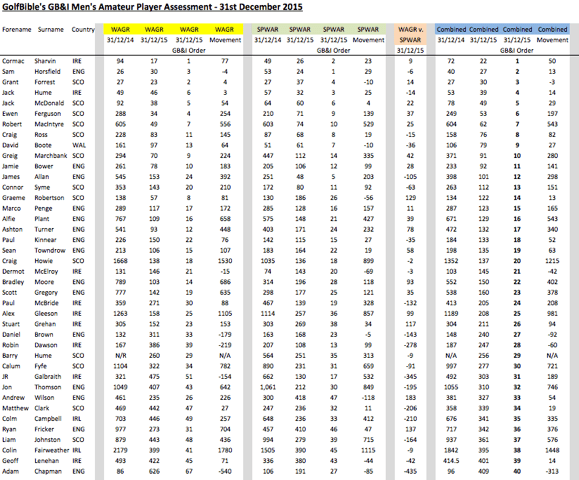
Finally, here is the full analysis showing all of the above information in one spreadsheet.  I have used my Combined Ranking to list the players here.

Assessment

Notes

1. The WAGR™ was established by the R&A and is now managed by R&A Championships Ltd in St. Andrews.  It uses a rolling 52 week period as the basis for it’s ranking and is updated every Wednesday at 12 noon GMT.  The WAGR™ is the most quoted due to the legitimacy given to it by the support of the R&A and USGA (who accepted it in February 2011).  Unfortunately the current WAGR™ ranking includes three players who have turned Pro.  They have been removed from the above analysis as has Daniel Young (SCO), who will be turning pro on Monday 11th January.

2. The SPWAR was established by and is still managed by Fred Solomon in San Francisco. It uses a longer 2 year period for its listing with points depreciated over time.  It is the preferred ranking of most amateur golf events in the United States.  For what it is worth I believe it is the best and most accurate ranking.  This is due to the inclusion of many more events and its almost daily updating (or at the conclusion of an amateur event).

3. Both the WAGR™ and the SPWAR were launched in January 2007.  The SPWAR beat the WAGR by 10 days.

ME.

Copyright © 2016, Mark Eley. All rights reserved.

Roger Wethered

3rd January 2016

English amateur golfer Roger H. Wethered was born in Surrey on 3 January 1899. He was probably Britain’s best golfer in the 1920’s and was a leading figure in an important period in the development of the sport across the world.

He was the only son of Herbert Newton Wethered and Marion Emmeline Lund.  H. Newton Wethered, a low handicap golfer, wrote a number of famous golf books including ‘The Architectural Side of Golf’ (1929, with Tom Simpson) and ‘The Perfect Golfer’ (1933).

Roger was also the elder brother of Joyce Wethered (Lady Heathcoat-Amory following her marriage), who was born on 17th November 1901.  Joyce was the finest female golfer of the 1920s and 1930s and one of the greatest of all time. 

The family benefited from inherited wealth up until the Wall Street Crash in 1929 and clearly enjoyed a very comfortable lifestyle.  Both Roger and Joyce were home tutored and enjoyed what can only be described as a flexible education.

Roger quickly got the golf bug from his father.  He joined West Surrey Golf Club as a boy and the family played golf on holiday at Bude in Cornwall and Royal Dornoch in the Scottish Highlands.  He recorded all of his rounds and strove for improvement from an early age.  It is said that after a game Roger would often resort to the library to try and answer and understand a technical problem he had encountered.  In later years, typically for an old school amateur, it was said that he often preferred to theorise rather than practice his golf.

In early 1917 Roger followed his father to Oxford University where he enrolled at Christ Church College to read English.  World War I intervened in his studies and he served as a Second Lieutenant in France and Belgium.  He finally completed his studies in 1921, albeit only formally received his BA when he finally attended a degree ceremony in 1963.

In an era when the amateur game was at the forefront of golf and the sport was the preserve of the wealthy Roger unsurprisingly found himself mixing amongst the best young players at Oxford.  Wethered found himself spurred on by such competition, which included Cyril Tolley, and both of them soon became two of Britain’s leading players.  Wethered was a tall, powerful man whose strength was his mid-iron play and short game.

Roger Wethered, representing West Surrey Golf Club, entered his first Amateur Championship at Muirfield in 1920.  It was the first one since 1914 due to The Great War.  Save for 1935 he played in The Amateur every year up until 1936 (which he presumably couldn’t resist as it was played at St. Andrews) when he stopped competing.  Between 1921 and 1929 inclusive all of his entries were attributed to Worplesdon Golf Club, the club he and his sister were both associated for most of their golfing lives.  After 1930 he represented the Royal & Ancient Golf Club when playing in The Amateur.

In 1921 Roger Wethered, perhaps having recently become a member at 22 repesenting The Royal & Ancient Golf Club (R&A), played in his first Open Championship at St. Andrews.  Despite incurring a penalty shot for standing on his ball in the third round Wethered and Jock Hutchinson, a Scottish-born American, ended up tied on 296 after 72-holes.  Roger had committed to play in a cricket match the following day in London and therefore found himself compromised with regard to the 36-hole play-off.  It is said that R&A officials had to work hard to persuade him to compete in the play-off.  In the end Hutchinson won the play-off easily by 9-shots, his rounds of 74 and 76 (150) beating Wethered’s 77 and 82 (159).  Had Wethered won The Open in 1921 he would have been the last British amateur to do so. As it is Harold Hilton, who won the Championship in 1897, remains the last man to do so.

Perhaps highlighting the standing of The Open in the 1920’s Wethered only played in three more Championships during his career, finishing tied 32nd in 1922 (Royal St. George’s) and missing the cut in both 1924 (Hoylake) and 1928 (Royal St. George’s).

Roger Wethered’s greatest moment came in 1923 when he won the Amateur Championship at Deal, Kent.  Wethered beat Francis Ouimet, who had taken care of Cyril Tolley in the quarters, in the Semi-Final before beating Robert Harris in the Final 7&6.  Harris had no complaints: “I couldn’t have beaten him.  He was too powerful from the tee and too good on the putting green.”  With his driver behaving better than normal this was most likely the best he ever played.

He also reached the final of the Amateur in 1928 at Prestwick and in 1930 at St. Andrews.  In 1928 he lost 6&4 to T. Philip Perkins of Castle Bromwich GC.  In 1930 – with both having just captained their respective Walker Cup teams – he lost 7&6 to Bobby Jones who thus completed the first leg of his famous ‘Impregnable Quadrilateral’ (Grand Slam).   Roger also reached the semi-finals in 1924 at St. Andrews (where he lost to Edward Storey of Cambridge University by 2 holes) and 1927 at Hoylake (where he lost to the champion Dr. William Tweddell of Stourbridge GC by 4&3) and the quarter-finals in 1922.

British Pathé Highlights Of The 1930 Amateur Championship – Bobby Jones v. Roger Wethered

His overall Amateur record is amongst the best in the Championship’s history.  Ranked 9th Roger competed in 16 Amateurs playing 71 matches – he won 56 and lost 15, giving him a win percentage of 79%.  Looking only at golfers who have played at least this number of matches his record is only really surpassed by John Ball, Joe Carr and Sir Michael Bonallack, all amateur greats.

The Walker Cup was first played in 1922 and Wethered was a key figure in it’s formative years.  He played in 1922, 1923, 1926, 1930 and 1934.  At a time when the trip had to be self-financed and Roger would also have had work commitments (see below) I assume he excused himself from the 1924, 1928 and 1932 away matches.  He would have surely played if he had made himself available.  At a time when the USA dominated the match Wethered enjoyed an impressive record, playing 9 36-hole matches, winning 5, losing 3 and halving 1.  Two of his losses came against Bobby Jones in singles.  Looking at each match in turn: –

August 1922 – National Golf Links of America – USA 8 beat GB&I 4
Wethered played with Colin Aylmer in the Day 1 foursomes and they beat Charles Evans Jr and Robert A. Gardner by 5&4. In the Day 2 singles Wethered was paired with Bobby Jones and lost 3&2.

May 1923 – St. Andrews – GB&I 5 lost to USA 6
Wethered and Cyril Tolley lost to Francis Ouimet and Jesse Sweetser 6&5 in the Day 1 foursomes before he halved with Ouimet in the Day 2 singles.

June 1926 – St. Andrews – USA 9 beat GB&I 3
Wethered paired with Ernest Holderness to beat Ouimet and Jesse Guilford 5&4 in the Day 1 foursomes and then beat Ouimet again in the singles 5&4.

May 1930 – Royal St. George’s – GB&I 2 lost to USA 10
When Wethered, GB&I’s captain, was asked prior to the match why compatriot John Beck was not playing he supposedly replied “We thought of John but no one seemed to have his address.” suggesting a more relaxed selection environment than currently exists.  Wethered paired himself with Tolley again this time winning their foursome match against George Von Elm and George Voight by 2 holes.  In the singles Wethered was drawn against Bobby Jones, the USA captain.  Jones won the match by 9&8.

May 1934 – St. Andrews – GB&I 2 lost to USA 9
Wethered’s selection for his final Walker Cup match was controversial. Bernard Darwin writing on the matter in 1944 said “It seemed to me – and I was a selector – that so fine a golfer with so fine a record must be played since he loved St. Andrews, would have plenty of room and had a gift of rising to the occasion.  Others, not selectors, thought otherwise and I suppose they were right…”   Wethered only played in the Day 1 foursomes before standing himself down for the singles.  Paired with Tolley again Wethered drove awfully and they easily lost 8&6 to John Goodman and W. Lawson Little.

Following the 1930 Walker Cup match and before the Amateur Championship started at St. Andrews a four ball that has gone down in golfing lore took place at the Old Course.  Roger Wethered paired with another leading amateur T.A. Bourn took on Bobby Jones and his sister Joyce Wethered.  Playing off the same tees the greatest male and female golfers of the day famously won.  With the game won Joyce three putted the last two greens to finish one shot higher than her playing partner.

In his playing career Roger won many other important amateur events and represented his country throughout the 1920s.  Wins included the Royal St. George’s Cup (1924), the Golf Illustrated Gold Vase (1927) and the (Oxford and Cambridge Golfing Society’s) President’s Putter five times (1926T, 1927, 1928, 1935 and 1936).  He played for GB&I in the 1921 match against the United States at Hoylake, the precursor to the Walker Cup.  He was also capped by England in nine successive years in their annual match against Scotland (1922-30).  Roger also won the Worplesdon Mixed Foursomes in 1922 (with Joyce Wethered) and 1926 (with French champion Simone Thion de la Chaume).

In 1923 Roger briefly moved into politics taking up an unsalaried position as secretary to the Hon. F.S. Jackson who was the financial  secretary to the War Office.  Jackson was a former England cricket captain and a scratch golfer.

Roger married Elizabeth Cavendish-Bentinck at St. Margaret’s Church in Westminster on 29th April 1925.  Elizabeth’s mother’s family owned the City stockbroking firm of Grenfell and Co.  Roger joined the business, after unsuccessful spells with two other city firms, and worked at Grenfell for 25 years until his retirement in 1951.  Roger and Elizabeth later divorced and Roger re-married; to a Marjorie Stratford (nee Mitford Stubbs).

In 1925 Roger joined up with his sister Joyce to write ‘Golf From Two Sides’.  Both were in their mid-20’s and still living at home with their parents at the time so this demonstrates their confidence and standing.  The book was dedicated to their mother: “In recollection of numerous games and much affectionate encouragement.”

Roger continued to be involved in golf in his later years, playing well into his 70s and administering the game.  It was reported in the papers that he shot a 74 when 74 at Royal Wimbledon Golf Club.  He held many honorary club memberships.  He was elected captain of The Royal and Ancient Golf Club of St Andrews in 1939 but due to the commencement of World War II only took up office in 1946.  He was also President of Woking Golf Club from 1961 until his death in 1983.

He died on 12th March 1983 at his home Garnet House, Wimbledon.

Roger is often remembered in the shadow of his more famous sister. However, upon further inspection of his life he was clearly an important figure in the history of the game and someone who clearly deserves to be remembered in his own right.

ME.

Copyright © 2014-2025, Mark Eley. All rights reserved.