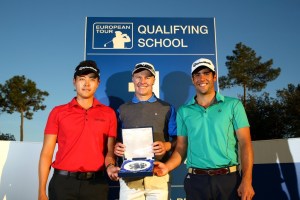
UPDATE – The 11 qualifiers from the Walton Heath IQS were Alexander Levy (-11), Shiv Kapur (-10), John Parry (-9), Alex Noren (-8), Lucas Bjerregaard (-7), Jason Palmer (-7), Marcel Siem (-6). After a play-off they were joined by Marcus Fraser, Garth Mulroy, Thomas Aiken and Tjaart Van Der Walt (-5). Wales’ Oliver Farr missed out (albeit he subsequently gained entry when an extra space was released by the USGA).
South Korea’s Byeong-Hun An, making his Wentworth debut this week, has today qualified for the U.S. Open by winning the BMW P.G.A. Championship with a record low score of -21.
The 115th U.S. Open Championship will be played between 18th and 21st June 2015 at Chambers Bay, a public course in Washington State.
My previous post on Local Qualifying contained background information on the number of entries received in 2015 and the 111 18-hole Local Qualifying competitions that have already been played in the United States earlier in May.
Nine players from Great Britain and Ireland (GB&I) successfully negotiated this Local Qualifying, namely James Heath (ENG), Steven Smith (SCO), Samuel Osborne (ENG), Thomas Curtis (ENG), Charles Bull (ENG), Daniel Keddie (A) (ENG), John Igoe (IRE), Jonathan Hewett (A) (ENG) and James Kerr (IRE).
Next up is the 36-hole Sectional Qualifying stage. This starts tomorrow morning with two International events; one at Walton Heath GC in England and the other at Kinojo GC in Japan. These final stage fields are made up of players who have progressed, or are exempt from, Local Qualifying. Again the number of qualifying spots into the U.S. Open Championship will be determined by the quality and quantity of the final fields at each location.
Walton Heath has hosted an International Qualifier since 2005, the first year the United States Golf Association introduced them. The field is always strong as the prize is great and the scheduling means it is played immediately after the BMW PGA Championship which takes place at nearby Wentworth.
Byeong-Hun An had entered but will now have Monday off. However, Padraig Harrington, Shane Lowry, Mark Warren, Matteo Manassero, Robert Karlsson, Nicholas Colsaerts, Andy Sullivan, Marcel Siem, Robert Rock, Richie Ramsay, Tyrrell Hatton, Francesco Molinari and Alexander Levy are all currently expected to be on show tomorrow. James Heath also looks like he has returned to these shores to compete in his second qualifier.
As recently as 2009 Lucas Glover won the U.S. Open having started out in Sectional Qualifying. Prior to that Jerry Pate (1976), Steve Jones (1996) and Michael Campbell (2005) all achieved the same feat. Of course Michael Campbell played at Walton Heath in that very first International Qualifier before famously going on to win at Pinehurst.
I wonder if the 2015 U.S. Open champion will be teeing it up tomorrow at the famous Surrey heathland club ?
For completeness a further ten Sectional Qualifiers are also scheduled to be held across the United States on 8th June. These are being played at: –
– Big Canyon CC & Newport Beach CC, Newport Beach, California
– The Bear’s Club, Jupiter, Florida
– Hawks Ridge GC, Ball Ground, Georgia
– Woodmont CC (North Course), Rockville, Maryland
– Old Oaks CC & Century CC, Purchase, New York
– Brookside G&CC & Lakes G&CC, Columbus, Ohio
– Springfield CC, Springfield, Ohio
– Germantown CC & Ridgeway CC, Memphis, Tennessee
– Northwood Club, Dallas, Texas
– Tumble Creek Club, Cle Elum, Washington.
Once finished the final field for the 2015 U.S. Open will be completed save for one final check on the Official World Golf Rankings on 15th June – the Top 60 on this date being assured of a starting spot. We can then look forward to the Championship proper.
The 115th U.S. Open Championship will be played between 18th and 21st June 2015 at Chambers Bay, a public course in Washington State.
The United States Golf Association (USGA) received 9,882 entries for this year’s U.S. Open. Any golfer with a handicap of less than 1.4 could apply. Entries were accepted from golfers in all 50 states of the United States and from 63 foreign countries. This is the second highest entry ever beaten only by the 10,127 received for the 2014 U.S. Open at Pinehurst.
At the start of May, just 49 players, including 11 past champions, were currently fully exempt into the final 156-player field. The number of full exemptions will rise with the inclusion of the top 60 in the Official World Golf Rankings as at 25th May and 15th June. The winners of The Players Championship (the already exempt Rickie Fowler) and the European Tour BMW PGA Championship (currently in course) also earn exemptions.
The rest of the U.S. Open field will be made up of players who have had to pre-qualify, starting their Championship in Local Qualifying or for the higher ranked Sectional Qualifying.
Local Qualifying has already been completed. It was played over 18 holes at 111 sites in the United States taking place between 4th and 21st May. The number of players who progressed to Sectional Qualifying from each Local Qualifier was determined by the size of the field at each site.
It may be a long road to the Championship from here but it is not necessarily a fruitless one. In 2014, 24 competitors made it into the field at Pinehurst No. 2 having started out in Local Qualifying. Better still Ken Venturi (1964) and Orville Moody (1969) both won the Championship having first played in Local (and then Sectional) Qualifying.
With little fanfare nine players from Great Britain and Ireland (GB&I) have progressed through Local Qualifying in the last few weeks. The full list of qualifiers can be seen here – 2015 U.S. Open Local Qualifying Results – but I have listed the successful GB&I players individually below: –
May 11, 2015 Amelia Island, Fla.Amelia National Golf & Country Club James Heath – ENGLAND 68
May 11, 2015 Lake Mary, Fla.Timacuan Golf & Country Club Steven Smith – SCOTLAND 67
May 11, 2015 Sarasota, Fla.TPC Prestancia (Stadium Course) Samuel Osborne – ENGLAND 69
May 13, 2015 Orlando, Fla.Shingle Creek Golf Club Thomas Curtis – ENGLAND 69
May 13, 2015 Williamsport, PaWilliamsport Country Club Charles Bull – ENGLAND 71
May 13, 2015 Knoxville, Tenn.Holston Hills Country Club Daniel Keddie (Amateur) – ENGLAND 68
May 14, 2015 Farmingdale, N.Y.Bethpage State Park (Red Course) John Igoe – REPUBLIC OF IRELAND 65
May 18, 2015 Flossmoor, Ill. Flossmoor Country Club Jonathan Hewett (Amateur) – ENGLAND 68 James Kerr – REPUBLIC OF IRELAND 69
Sectional Qualifying starts tomorrow, Monday 25th May, at Walton Heath GC in England and Kinojo GC in Japan with two 36-hole International events. More about this next stage shortly, which includes 10 further events in the United States on 8th June. Good luck to the nine players listed above in Sectional Qualifying – it would be great to see some of them playing at Chambers Bay next month.
The 2015 NCAA Division I Men’s Golf National Championships started on Thursday at courses across the United States. The six 54-hole Regional tournaments (Stage 1) have now been completed.
13 college teams and 10 top performing individuals (not on those teams) competed in the Regionals at Chapel Hill, Lubbock and San Diego. Meanwhile 14 teams and 5 individuals (not on those teams) played at Bremerton, New Haven and Noblesville.
The low 5 teams and the low individual (not on those teams) from each Regional have now advanced to the Championship Final. 156 players will play in the Final which is being played at the end of this month in Florida.
Just 5 of the 22 GB&I players competing in the Regionals have progressed to the Final – PaulDunne (UAB), ThomasRowland (Charlotte), David Boote (Stanford), Ryan Fricker (South Florida) and Benjamin Taylor (LSU). The Final is to be played at The Concession Golf Club in Bradenton, the home course of South Florida, between 29th May and 3rd June.
The results for the GB&I players competing at the NCAA Division I Men’s Regionals are shown below: –
Gold Mountain Golf Club – Bremerton, Washington Teams (14):
T7 Paul Dunne – University of Alabama at Birmingham – 67, 71, 72 (-6)
T28 Jamie Clare – Virginia Commonwealth University – 75, 73, 69 (+1)
Team positions – UAB (-21) 1st and VCU (+6) T9.
Individual leader – Kyle Mueller, Michigan (-9).
University of North Carolina Finley Golf Course – Chapel Hill, North Carolina Teams (13):
T4 Thomas Rowland – Charlotte – 71, 72, 67 (-6)
T13 Robert MacIntyre – McNeese State University – 70, 72, 72 (-2)
T32 David Boote – Stanford University – 75, 68, 75 (+2)
T41 Paul McBride – Wake Forest – 73, 75, 72 (+4) Individuals (10):
T23 Ryan Cornfield – University of South Carolina Upstate – 73, 70, 74 (+1)
T49 Ben Wheeler – Coastal Carolina University – 74, 75, 72 (+5)
Team positions – Charlotte (-19) 1st, Stanford (-14) 2nd, McNeese State (+3) 7th and Wake Forest (+10) 10th.
Individual leader – J.T. Poston, Western Carolina (-7, after play-off).
The Rawls Course – Lubbock, Texas Teams (13):
T33 J.J. Grey – Georgia State University – 67, 71, 77 (+2)
T39 Eamonn Bradley – Southeastern Louisiana State University – 72, 71, 73 (+3)
T66 Lawrence Allan – Southeastern Louisiana State University – 74, 77, 74 (+12)
T71 Cameron Shaw – University of California, Berkeley – 77, 76, 77 (+17) Individuals (10):
T50 Tomasz Anderson – Jacksonville State University – 75, 71, 72 (+5)
Team positions – California (-4) 7th, Southeastern Louisiana (+4) 9th and Georgia State (+19) 12th.
Individual leader – Robin Sciot-Siegrist, Louisville (-5, after play-off).
The Course at Yale – New Haven, Connecticut Teams (14):
T11 Ryan Fricker – University of South Florida – 71, 70, 67 (-2)
T17 Benjamin Taylor – Louisiana State University – 73, 73, 65 (+1) Individuals (5):
T11 George Williams – Long Island University-Brooklyn Campus – 73, 70, 65 (-2)
Team positions – South Florida (-14) 1st and LSU (+9) 5th.
Individual leader – Tolver Dozier, Troy (-4, after play-off).
The Sagamore Club – Noblesville, Indiana Teams (14):
T46 Daniel Park – Alabama State University – 77, 75, 75 (+11) Individuals (5):
10th Chris Selfridge – University of Toledo – 73, 71, 71 (-1)
Team positions – Alabama State (+47) 13th.
Individual leader – David Oraee, Colorado (-7).
The Farms Golf Club – Rancho Santa Fe, San Diego, California Teams (13):
13th Pavan Sagoo – St. Mary’s College of California – 72, 74, 70 (E)
T21 Daniel Sutton – University of Idaho – 71, 72, 76 (+3)
T36 Grant Forrest – University of San Diego – 74, 72, 77 (+7)
T40 Rhys Pugh – East Tennessee State University – 81, 73, 70 (+8)
Team positions – East Tennessee (+12) 7th, St. Mary’s CA (+18) 8th and San Diego (+25) T10 and Idaho (+25) T10.
Individual leader – Gudmundur Kristjansson, East Tennesssee State (-3).
Further Information:
Access to the full Regional lives scores / results can be found here – Golfstat
Rd. 1 NCAA DI GB&I Regional Scores can be found here – Rd. 1 Scores
Rd. 2 NCAA D1 GB&I Regional Scores can be found here – Rd. 2 Scores
An Introduction to US College can be found here – US College Golf
The 2015 NCAA Division I Men’s Golf National Championships started on Thursday across the United States. 36-holes have now been played in the six 54-hole Regional tournaments (Stage 1) with the final round to be played later today.
13 college teams and 10 top performing individuals (not on those teams) are competing in the Regionals at Chapel Hill, Lubbock and San Diego. Meanwhile 14 teams and 5 individuals (not on those teams) are playing at Bremerton, New Haven and Noblesville.
The low 5 teams and the low individual not on those teams from each Regional will advance to the Championship Final. 180 players at the Regionals will therefore be whittled down to a field of 156 for the Final which is being played at the end of this month in Florida.
Here’s how Great Britain and Ireland’s 22 players have got on on Day 2: –
Gold Mountain Golf Club – Bremerton, Washington Teams (14):
T2 Paul Dunne – University of Alabama at Birmingham – 67, 71 (-6)
T36 Jamie Clare – Virginia Commonwealth University – 75, 73 (+4)
Team positions – UAB (-11) 2nd and VCU (+16) 11th.
Individual leader – Cheng-Tsung Pan, Washington (-8).
University of North Carolina Finley Golf Course – Chapel Hill, North Carolina Teams (13):
T11 Robert MacIntyre – McNeese State University – 70, 72 (-2)
T15 Thomas Rowland – Charlotte – 71, 72 (-1)
T15 David Boote – Stanford University – 75, 68 (-1)
T48 Paul McBride – Wake Forest – 73, 75 (+4) Individuals (10):
T14 Ryan Cornfield – University of South Carolina Upstate – 73, 70 (-1)
T54 Ben Wheeler – Coastal Carolina University – 74, 75 (+5)
Team positions – Stanford (-11) 1st, North Carolina (-1) T6, McNeese State (+4) 9th and Wake Forest (+6) 10th.
Individual leader – J.T. Boston, Western Carolina (-8).
The Rawls Course – Lubbock, Texas Teams (13):
T6 J.J. Grey – Georgia State University – 67, 71 (-4)
T34 Eamonn Bradley – Southeastern Louisiana State University – 72, 71 (+1)
T67 Lawrence Allan – Southeastern Louisiana State University – 74, 77 (+9)
T70 Cameron Shaw – University of California, Berkeley – 77, 76 (+11) Individuals (10):
T51 Tomasz Anderson – Jacksonville State University – 75, 71 (+4)
Team positions – Southeastern Louisiana (-4) 5th, California (-2) 8th and Georgia State (+3) 10th.
Individual leader – K.K. Limbhasut, California (-8).
The Course at Yale – New Haven, Connecticut Teams (14):
T12 Ryan Fricker – University of South Florida – 71, 70 (+1)
T36 Benjamin Taylor – Louisiana State University – 73, 73 (+6) Individuals (5):
T21 George Williams – Long Island University-Brooklyn Campus – 73, 70 (+3)
Team positions – South Florida (-3) 1st and LSU (+21) 10th.
Individual leader – Jordan Niebrugge, Oklahoma State (-6).
The Sagamore Club – Noblesville, Indiana Teams (14):
T43 Daniel Park – Alabama State University – 77, 75 (+8) Individuals (5):
9th Chris Selfridge – University of Toledo – 73, 71 (E)
Team positions – Alabama State (+44) 13th.
Individual leader – Jonathan Garrick, UCLA (-7).
The Farms Golf Club – Rancho Santa Fe, San Diego, California Teams (13):
T11 Daniel Sutton – University of Idaho – 71, 72 (-1)
T19 Grant Forrest – University of San Diego – 74, 72 (+2)
T19 Pavan Sagoo – St. Mary’s College of California – 72, 74 (+2)
T58 Rhys Pugh – East Tennessee State University – 81, 73 (+10)
Team positions – East Tennessee (+7) 4th, Idaho (+12) 7th, San Diego (+16) 9th and St. Mary’s CA (+7) 10th.
Individual leader – Jon Rahm, Arizona State (-7).
Further Information:
Access to the full Regional lives scores / results can be found here – Golfstat
Rd. 1 NCAA DI GB&I Regional Scores can be found here – Rd. 1 Scores
An Introduction to US College can be found here – US College Golf
The 2015 NCAA Division I Men’s Golf National Championships started yesterday in the United States of America (USA).
To start with six 54-hole Regional tournaments are taking place between 14th-16th May. 13 college teams and 10 top performing individuals not on those teams are competing at Chapel Hill, Lubbock and San Diego. At the other three Regionals, being held in Bremerton, New Haven and Noblesville, 14 teams and 5 individuals not on those teams are playing.
The low 5 teams and the low individual not on those teams from each Regional will advance to the Championship Final. This year the Final will be played at The Concession Golf Club in Bradenton, Florida between 29th May and 3rd June. The Final is probably the third biggest event on the amateur golf calendar after the US Amateur and Amateur Championship. It is also now shown live on the Golf Channel in the USA.
Teams consist of 5 players with the best 4 scores counting towards the overall team score. Therefore a player can progress even if they haven’t contributed so long as their team is in the top 5. The risk of course is they may be deselected for the Finals ! Likewise if a team does poorly but a player scores well they can progress as an individual. Players who start as individuals simply have it all to do themselves.
I have identified 22 Great British and Irish (GB&I) players that have teed off in the Regionals – some within a Team and some as Individuals. I have listed them and their round 1 scores below: –
Gold Mountain Golf Club – Bremerton, Washington Teams (14):
T2 Paul Dunne – University of Alabama at Birmingham – 67 (-5)
T40 Jamie Clare – Virginia Commonwealth University – 75 (+3)
University of North Carolina Finley Golf Course – Chapel Hill, North Carolina Teams (13):
T13 Robert MacIntyre – McNeese State University – 70 (-2)
T20 Thomas Rowland – Charlotte – 71 (-1)
T31 Paul McBride – Wake Forest – 73 (+1)
T50 David Boote – Stanford University – 75 (+3) Individuals (5):
T30 Ryan Cornfield – University of South Carolina Upstate – 73 (+1)
T43 Ben Wheeler – Coastal Carolina University – 74 (+2)
The Rawls Course – Lubbock, Texas Teams (13):
T7 J.J. Grey – Georgia State University – 67 (-4)
T42 Eamonn Bradley – Southeastern Louisiana State University – 72 (+1)
T61 Lawrence Allan – Southeastern Louisiana State University – 74 (+3)
T71 Cameron Shaw – University of California, Berkeley – 77 (+6) Individuals (10):
T64 Tomasz Anderson – Jacksonville State University – 75 (+4)
The Course at Yale – New Haven, Connecticut Teams (14):
T12 Ryan Fricker– University of South Florida – 71 (+1)
T30 Benjamin Taylor – Louisiana State University – 73 (+3) Individuals (5):
T30 George Williams – Long Island University-Brooklyn Campus – 73 (+3)
The Sagamore Club – Noblesville, Indiana Teams (14):
T46 Daniel Park – Alabama State University – 77 (+5) Individuals (5):
T18 Chris Selfridge – University of Toledo – 73 (+1)
The Farms Golf Club – Rancho Santa Fe, San Diego, California Teams (13):
T6 Daniel Sutton – University of Idaho – 71 (-1)
T8 Pavan Sagoo – St. Mary’s College of California – 72 (E)
T21 Grant Forrest – University of San Diego – 74 (+2)
T66 Rhys Pugh – East Tennessee State University – 81 (+9)
Access to the full regional lives scores / results can be found here – Golfstat
Background / Notes:
Further background information on the US College system can be found here – US College Golf
In 2014 Alabama won the NCAA Division I Men’s Golf Championship beating Oklahoma State, 4-1 in the match play final. It was the second consecutive year the Crimson Tide had won the national title. Cameron Wilson of Stanford was the individual stroke play medalist which preceded the match play stage.
144 elite amateur golfers from 17 different countries will tee off tomorrow in the 51st Lytham Trophy, one of the most prestigious competitions in the men’s amateur golfing calendar.
Nowadays players compete in events across the globe, often starting their seasons in December and January. Despite this there still remains the feeling that the Lytham Trophy – at least in Great Britain and Ireland (GB&I) – is the real curtain raiser to the Men’s season. The event where things start to get serious.
The course certainly presents a stern test. Playing off the blue championship tees competitors have to meet a 7,118 yard par 70 challenge; the front nine being 3,437 yards, a par 34, and the back nine being 3,681 yards, a par 36.
This year the event takes on added importance – not only is it a Walker Cup year but September’s match against the USA is also being contested at the home of the Lytham Trophy, Royal Lytham & St. Annes, the famous Lancashire links in England. The Lytham Trophy has always been an important factor in determining the GB&I team but this year the results will surely carry even more weight with Captain Nigel Edwards and the Selection Committee.
The Lytham Trophy
Some information on this famous competition and it’s past winners is provided in an Appendix below.
The Lytham Trophy – 1st to 3rd May 2015
Entry, which costs £80, was open to golfers whose handicap does not exceed scratch (0.4) albeit the ballot again fell in negative territory. 144 players will contest the Trophy.
To see who they all are check out the 2015 start sheet for Rounds 1 and 2 by clicking – Lytham Trophy Start Sheet.
The first two rounds will be played on Friday 1st and Saturday 2nd May. A Top 40 and Ties cut will then see a reduced field playing the final 36 on Sunday 3rd May.
In the event of a tie after 72 holes a 3-hole play-off, contested on holes 1, 2 and 18, will be played. Should the remaining players still be tied a sudden death play-off will take place over the same holes.
The Leading Players in 2015(Nationality / Current SPWAR)
As always the field is packed with great players. Here’s a summary of the leading ones: –
Gary Hurley (IRE / 13) – finalist at the Spanish Amateur and 2015 Palmer Cup team member. Bradley Neil (SCO / 16) – 2014 Amateur Champion. Romain Langasque (FRA / 23) – recent winner of the Mouchy Cup and Southern Cross Invitational. Ashley Chesters (ENG / 29) – 2013 and 2014 European Amateur champion. Nick Marsh (ENG / 31) – strong 2014 and 2015 record with a 2nd in the West of England last week. Marcus Kinhult (SWE / 36) – winner of the Sage Valley Junior Invitational last week. Jack Hume (IRE / 42) – strong 2014 and 2015 record; 2nd place at Lytham in 2013. Daniel Young (SCO / 53) – has already won the South African Amateur and Battle Trophy in 2015. Gavin Moynihan (IRE / 54) – 2013 Walker Cup player but perhaps lacking form in 2015. Craig Ross (SCO / 59) – winner on the 2014 EuroPro Tour and has performed well for some time. Ewen Ferguson (SCO / 72) – outstanding start to 2015 with two wins in Scotland already. Dermot McElroy (IRE / 102) – recent West of Ireland win and strong Lytham record bodes well. Mattias Eggenberger (SUI / 104) – Good form and experience in GB&I with Stirling University.
It will also be interesting to see how some of the Juniors get on. Marco Penge (256), recent winner of the McEvoy Trophy, and Bradley Moore (370), perhaps the two best GB&I youngsters, have both chosen to compete at Lytham rather than play in the nearby Fairhaven Trophies. Penge of course won the Fairhaven Boys Trophy in both 2013 and 2014.
You may also find it interesting to look through the betting odds for the Lytham Trophy which can be found on Paddy Power’s website.
Weather Forecast(@Thurs 30th, 7.00pm)
Fri 1st May – Partly Cloudy. Wind 9 mph. Max. 12°C / Min 2°C. Sat 2nd May – Cloudy / Light Rain. Wind 18 mph. Max. 12°C / Min 7°C. Sun 3rd May – Partly Cloudy. Wind 13 mph. Temp. Max. 16°C / Min 7°C.
Appendix – History and Past Winners
The competition was first played in 1965 after the Club identified a need for another top class amateur competition and one that was in the North of England.
A date on the first weekend in May was established and a 72 hole stroke play format adopted.
Member’s subscribed to purchase a unique trophy (which does not leave the Club) with a smaller replica issued annually to that year’s winner.
As one would expect the list of past winner’s is a who’s who of GB&I and more recently world amateur golf.
Thriston Lawrence (RSA) – Winner of the 2014 Lytham Trophy
Of the older winners the most notable are: –
M.F. Bonallack – 1965(s), 1972
R. Foster – 1967, 1968
G.C. Marks – 1970(s)
C.W. Green – 1970(s), 1974
M.G. King – 1973
P. McEvoy – 1978
I.C. Hutcheon – 1980
R.M. Chapman – 1981
J. Hawksworth – 1984
P. Broadhurst – 1988
G. Evans – 1990, 1991
G. Rankin – 1997
In 2004 21 year old James Heath won with a record score of 266 (-18), recording rounds of 67, 68, 66, and 65. No one else has ever come close to this mark before or after. The next best scores being Daan Huizing’s 273 in 2013 and Richard McEvoy’s 276 in 2001. Garth McGimpsey, the then Walker Cup captain, described Heath’s performance as ‘the best amateur golf I’ve ever seen’.
In 1999 the Lytham Trophy was won by Tino Schuster, the first time a non-GB&I player had been successful. The last five winners show just how international the amateur game has become as well as the increasing attraction of the Lytham Trophy beyond these shores: –
P. Cutler – 2010 (Irish)
J. Senior – 2011 (English)
D. Huizing – 2012 (Dutch)
A. Eckhardt – 2013 (Finnish)
T. Lawrence – 2014 (South African)
All of the Past winners and their scores can be found here on the Royal Lytham website.
The Peter McEvoy Trophy is a 72-hole stroke play competition for boys played annually at Copt Heath Golf Club in Solihull, England.
Copt Heath Golf Club
Background
Peter McEvoy OBE has been a member of Copt Heath for nearly 50 years and is a famous British amateur golfer. My profile of his career can be read by clicking this link – Peter McEvoy.
Peter McEvoy – 1977 Amateur Champion at Ganton GC
Following Peter’s Amateur Championship victories in 1977 and 1978 Copt Heath invited him to suggest a way in which the Club could commemorate his achievements. He suggested a 72 hole competition for Under 18 junior boy golfers, to be held annually at Copt Heath.
Starting in 1981, The Peter McEvoy Trophy was originally held during the August summer holidays. In 1985, at the request of the English Golf Union (now England Golf), it was moved to April, where it has stayed ever since. This request was prompted by a need for an early season national competition to assist them with the selection of their team ahead of various Home Nation matches and European Championships held later in the year.
The Peter McEvoy Trophy (Photo: GolfBible)
As Peter McEvoy’s playing achievements and influence grew, culminating with him becoming a Great Britain and Ireland (GB&I) selector and Walker Cup captain, so has the prestige of the competition. The McEvoy is now the curtain raiser to the boy’s golf season and is unquestionably one of the “must enter” major competitions in the junior golf calendar. The best junior players from across GB&I, and occasionally elsewhere in Europe, are now guaranteed to be seen at Copt Heath every year.
Competition Format
Entries are welcomed from all boys aged under 18 at 00.00 hours on 1st January of the year the competition is being played. The Entry Fee was set at £40.00 in 2015.
The McEvoy Trophy is contested over 72 holes of scratch stroke play golf played over two consecutive days.
The competition is recognised as a World Amateur Golf Ranking event. In recent years it has been given a strength indicator of ‘E’. The winner receives around 10 Points Average to their total where other finishers in the Top 25 receiving a declining number of points too.
The format, limited daylight and frequently poor weather in April means the field is sensibly restricted to 72 players. A ballot based on handicap is applied to the entrants in what is always an oversubscribed event. The cut-off handicap continues to reduce annually, being +1.7 in 2001 but 0.0 in 2015. This of course illustrates the improvement in the players now coming through in GB&I, many of whom have handicaps of between -2 and -4.
The competition has always been played at Copt Heath Golf Club. Copt Heath, despite its name, is essentially a parkland course. The current course was designed and built in 1913 by Harry Colt, the famous course architect, and is predominantly flat but well protected with around 95 bunkers. A number of bunkers have been upgraded in recent years under the advice of Dutch architect, Frank Pont.
Copt Heath Golf Club – par 3 13th hole
The course measures 6,541 yards and has a par of 71, made up of 2 par 5’s, 13 par 4’s and 3 par 3’s. The front nine is shorter at 3,216 yards (par 35) but is tighter. The more expansive back nine is played over 3,325 yards (par 36).
All competitors play the first 36 holes on Day 1, playing in group’s of three. The leading 40 players (and ties) then return for the final 36-holes on the following day, which is played in two-balls. A two tee start is used on both days.
In the event of a tie the result is now decided by a sudden death play-off, utilising holes 18, 1 and 9.
The 35th Peter McEvoy Trophy, 15-16th April 2015
Over 120 entries were received for the 2015 McEvoy Trophy. As stated above the 72 successful competitors all have handicaps of 0.0 or better.
The draw for Day 1 and the first 36-holes of the competition can be viewed by clicking this link – 15th April 2015 Start Sheet.
The McEvoy Trophy is a very well run competition. A welcome addition being Live Scoring – updated after each nine on Day 1 and more frequently for the leaders on Day 2 – which has successfully been introduced in recent years.
Internationals Ben Chamberlain (Padeswood & Buckley, -1.4), Calum Fyfe (Cawder, -3.6), Harry Hall (West Cornwall, -3.1), Tim Harry (Vale of Glamorgan, -2.6), Matty Lamb (Hexham, -2.5), Jamie Li (Bath, -2.4), Kevin Le Blanc (The Island, -1.7), Bradley Moore (Kedleston Park, -2.8), Murray Naismith (Dalmahoy, -1.9), Marco Penge (Golf at Goodwood, -3.4) and Will Porter (Carnoustie, -0.4 who won the Scottish Boys Championship last Saturday) are all expected to challenge for the coveted title this year.
Past Winners
The Peter McEvoy Trophy has an enviable list of former winners, reflecting both the quality of the entry but also the fair challenge presented by the course. Two Winner Boards adorn the entrance hall to the club.
The Peter McEvoy Trophy Winner Boards at Copt Heath Golf Club (Photo: GolfBible)
The Winner receives a small replica salver and a voucher for £250. A total prize fund of around £1,000 is shared out amongst those players finishing in the Top 8 places (and ties).
A number of those listed below have gone on to play in Walker Cup teams and many more have enjoyed successful professional careers.
1981 RJ Sallis (Wollaton Park)
1982 JGS Robinson (Woodhall Spa)
1983 PA Baker (Lilleshall)
1984 W Henry (Redbourn)
1985 A Morley (Belton Park)
1986 CA Mitchell (Copt Heath)
1987 W Henry (Porters Park)
1988 P Sefton (Camberley Heath)
1989 DA Bathgate (Sandiway)
1990 PA Sherman (Ashford)
1991 LJ Westwood (Worksop)
Lee Westwood receives the McEvoy Trophy in 1991 (Photo: Copt Heath GC)
1992 B Davis (East Herts)
1993 S Webster (Atherstone)
1994 J Harris (Nevill)
1995 C Duke (Porters Park)
1996 MJ Pilkington (Nefyn & District)
1997 PJ Rowe (West Cornwall)
1998 J Rose (North Hants)
Justin Rose receives the McEvoy Trophy in 1998 (Photo: Copt Heath GC)
[In 2013 Justin Rose became the first McEvoy Trophy winner to win a Major Championship, when he won the U.S. Open at Merion GC.]
1999 DJ Porter (Stoneham)
2000 Z Scotland (Woodcote Park)
2001 B Harvey (Dudsbury)
2002 M Richardson (Pinner Hill)
2003 T Hunter (Ilford)
2004 JA Parry (Harrogate)
2005 T Sherreard (The Ridge)
2006 L Goddard (Hendon)
2007 M Haines (Rochester & Cobham Park)
2008 E Hodgson (Sunningdale)
2009 M Smith (Newbury Racecourse)
2010 R Pugh (Vale of Glamorgan)
2011 N Kimsey (Woodhall Spa)
2012 G Moynihan (The Island)
2013 B Moore (Kedleston Park)
2014 H McCullen (Delamere Forest)
Haydn McCullen with Peter McEvoy in 2014 (Photo: GolfBible)
McEvoy Trophy Records
Most Wins
2 – Wayne Henry (1984 Redbourn / 1987 Porters Bar)
Wayne Henry pictured with Seve Ballesteros at the 1984 Open at St. Andrews
Youngest Winner
Bradley Moore – 15 years, 7 months and 15 days (2013).
Best Record
Bradley Moore (Keddleston Park) – 4th (283 -1, 2012), 1st (287 +3, 2013), 2nd (281 -3, 2014), 2nd (280 -4, 2015).
Notable Former Competitors
In addition to the winners listed above many other notable golfers have competed over the years. these include: – Stuart Cage, Paul Casey, Ashley Chesters (A), Lee Corfield, Nick Dougherty, Luke Donald, Bradley Dredge, Scott Drummond, Paul Dunne (A), Simon Dyson, Greg Eason, Jamie Elson, Oliver Farr, Kenneth Ferrie, Oliver Fisher, Tommy Fleetwood, Mark Foster, Ewen Ferguson (A), Tyrrell Hatton, David Horsey, David Howell, Jack Hume (A), Simon Khan, Tom Lewis, David Lynn, Nick Marsh (A), Ross McGowan, Bradley Neil (A), Max Orrin, John Parry, Eddie Pepperell, Garrick Porteous, Robert Rock, Lee Slattery, Graeme Storm, Sam Walker, Anthony Wall, Oliver Wilson, Tom Whitehouse and Chris Wood.
UPDATE – Gunn Yang today beat Bradley Neil 3&2 in the 2015 Georgia Cup. Well done Gunn !
Gunn Yang – Winner of The 2015 Georgia Cup
—————————————————————————————-
31st March 2015
The Georgia Cup is a charity challenge match played the week before The Masters between the reigning United States (US) Amateur Champion and British Amateur Champion.
Garrick Porteous – 2013 Amateur Champion & Winner of The 2014 Georgia Cup
It was established by The Golf Club of Georgia in 1998 and is played on either their Lakeside (L) or Creekside (C) Courses in Alpharetta, GA.
The 2015 and 18th match will tee-off today at 1.00pm local time on the Lakeside Course and will be played between South Korea’s Gunn Yang and Scotland’s Bradley Neil, respectively the 2014 US and British Amateur Champions.
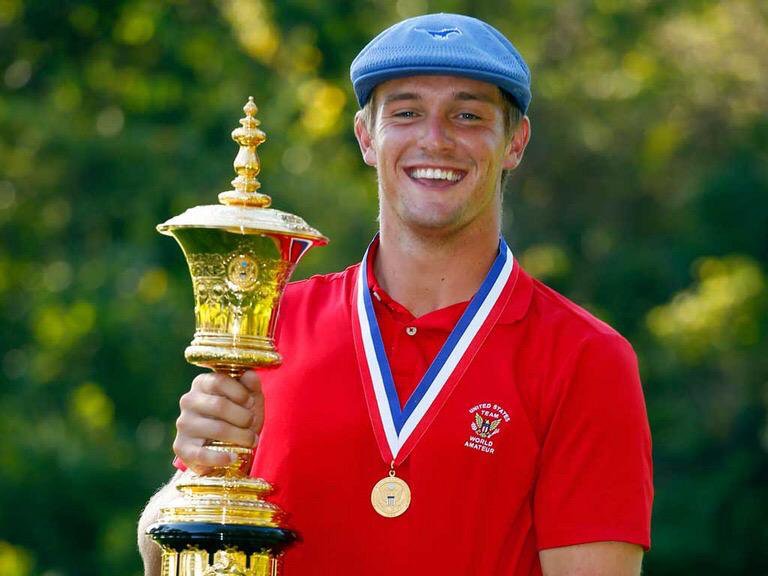
Gunn Yang – 2014 US Amateur Champion
Both contestants always move on to nearby Augusta to prepare for and take up their Masters invitations after the match.
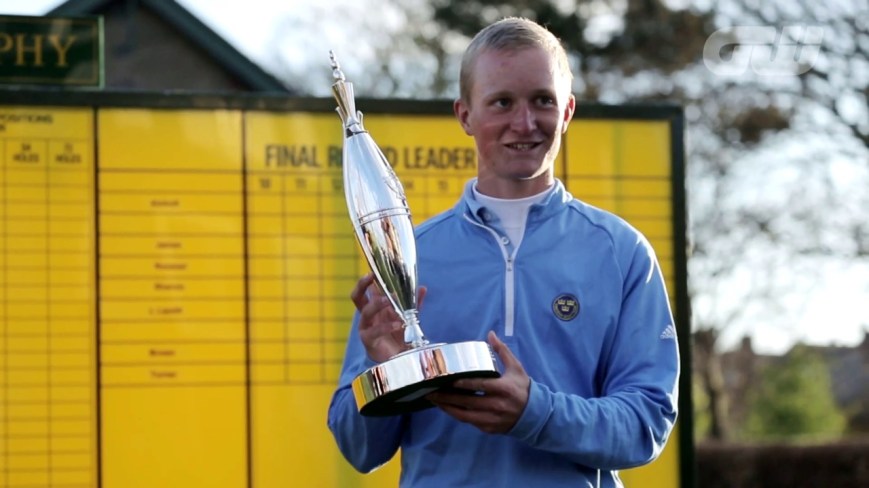
Bradley Neil – 2014 Amateur Champion
The British Amateur Champions lead their US counterparts 9 – 8 in the series, helped in no small part by victories in the last three matches.
The previous results are shown below (with the Amateur titles won shown in brackets)
Great Britain and Ireland (GB&I) has produced a number of distinguished amateur golfers in the post World War II period. Amongst a group that must include Sir Michael Bonallack, Joe Carr and Gary Wolstenholme comfortably sits Peter McEvoy OBE.
One of the most determined and competitive golfers to ever play the game Peter’s success was founded on long straight driving, well controlled approach shots (often played low) and impeccable putting. A technically sound golfer with an unflappable temperament will give most people a game – and McEvoy was certainly capable of that.
Peter McEvoy holds The Walker Cup in 2001
Peter Aloysius McEvoy was born in London on 22nd March 1953. He died aged 72 on 6th April 2025 in Alloway, Ayrshire after battling cancer over recent years.
He was brought up in Renfrewshire, Scotland and swung a club for the first time here with his father, Daniel, a doctor, and a member of the local club, Gourock, near Greenock.
His family moved to the West Midlands when he was 10 and, aged 13, he joined Copt Heath G.C. near Solihull. He ultimately became an honorary member and despite moving from Tewkesbury to Ayrshire in 2018 was still seen regularly at the Club.
Peter quickly became proficient in the game and won the 1969 Warwickshire Boys Championship. He also won the British Universities Stroke Play in 1973 – he studied Law and qualified as a solicitor – and was selected for England Youths in 1974.
Locally he also went on to win the Warwickshire Amateur Championship in 1974-76-77-80-84, the Warwickshire Matchplay Championship in 1973-75-81-83 and the Warwickshire Open Championship in 1973-74. Warwickshire were also County Champions in 1976 (held locally at Coventry GC) and 1977. Of course it was not in the Midlands that his legendary reputation was developed.
McEvoy gained national prominence when he won The Amateur Championship in both 1977 (Ganton) and 1978 (Royal Troon). Playing off a +2 handicap at the time he is the last player to successfully defend the title. Horace Hutchinson (1886-87), Harold Hilton (1900-01) Lawson Little (1934-35) and Sir Michael Bonallack (1968-69-70) are the only other players to achieve this feat. He reached the final again in 1987 at Prestwick – driven on by his non-selection for that year’s Walker Cup at Sunningdale when the team was announced in November 1986 and the matched played in late May – but lost to Welshman Paul Mayo. In total he competed in 18 Amateur Championships playing 70 matches. He won 54 and lost 16 of these giving him an impressive win rate of 77%.
He was a member of the Great Britain & Ireland (GB&I) Walker Cup team on five occasions – in 1977-79-81-85-89. With business commitments impacting on the amount of golf he was able to play he missed out on the 1983 match. McEvoy understood this decision but not his, and for that matter Garth McGimpsey’s, omission in 1987, just after they had both represented GB&I in the 4-man 1986 Eisenhower Trophy team. He would be the first to admit in later years that he was not unhappy to see the team lose 16.5 – 7.5. His first four Walker Cup matches were lost but the last one, at Peachtree, Atlanta, was won; the first time GB&I had won this historically one-sided contest on US soil. McEvoy contributed 2.5 points in that final game but his overall record was perhaps a little disappointing. He played 18 games in total, winning 5, losing 11 and halving 2. To date only Sir Michael Bonallack (25), Joe Carr (20) and Gary Wolstenholme (19) have played more Walker Cup games for GB&I.
He played in the St. Andrews Trophy for GB&I against the Continent of Europe in 1978-80-86-88. GB&I won on each occasion in what was then an event as one-sided as The Walker Cup.
Peter also played on five Eisenhower Trophy teams – in 1978-80-84-86-88. In 1988, aged 35, and a year after he hadn’t been selected for The Walker Cup he won the World Amateur Individual event and GB&I won the team event for the third time at Ullva, Sweden.
The successful GB&I 1988 Eisenhower Trophy Team
His Amateur wins inevitably led to Major Championship invitations. His strong play also enabled him to qualify for some Opens too. After something of an apprenticeship in 1976 (Royal Birkdale) and 1977 (Turnberry, where he was paired with Jack Nicklaus and Gary Player) he achieved low amateur status at The Open Championship in both 1978 (St. Andrews, 39th) and 1979 (Royal Lytham St. Annes, T17th with Lee Trevino). He also qualified for the 1984 Open at St. Andrews, making the cut for the third time but having to withdrawal due to ill health at the start of round 3.
McEvoy also played in three Masters. In 1978, paired with Tom Watson to start with, he became just the second GB&I amateur to make the cut at The Masters (after Joe Carr in 1967). He finished 53rd after rounds of 73, 75, 77 and 77, last of those that made the cut. He perhaps surprisingly remains the last GB&I amateur to make the cut at The Masters. With the Augusta course becoming longer and tougher in recent years this GB&I record may well remain intact for a few more years to come. In his other two appearances he missed the cut; in 1979 paired with Jack Nicklaus he shot 79, 79 missing out by 13-shots and in 1980 paired with Sam Snead he scored 79, 76 missing out by 9-shots.
Despite not winning the English Amateur – he lost in the 1980 final to Peter Deeble – his name unsurprisingly adorns many of the other major amateur trophies. He won the: –
Duncan Putter – 1978 (winning by 13-strokes)-80-85-87
Scrutton Jug – 1978-80
Lytham Trophy – 1979
Selborne Salver 1979-80
Brabazon Trophy (English Open SP) – 1980 (tied with Ronan Rafferty),
Lagonda Trophy – 1980
West of England Open Amateur Strokeplay Championship – 1977-80-83-85
English County Champions’ Tournament – 1984 (tied with N Briggs)
Berkshire Trophy – 1985
Berkhamsted Trophy – 1986
Logan Trophy (English Open Mid-Amateur) – 1988
Hampshire Hog – 1989
Of course prior to the 1990s amateur golf was in a completely different place to where it is now. Golfers received no individual financial support from either their National Unions or the R&A. Having to personally fund ones living and golfing expenses whilst maintaining a competitive game was clearly no mean achievement.
Peter McEvoy is England’s second most capped amateur golfer, competing in 153 matches between 1976 and 1992. Gary Wolstenholme achieved an astonishing 218 caps whilst Sir Michael Bonallack made 131 appearances for their shared country. He played in the Home Internationals of 1976-77-78-(79 not held)-80-81-83-84-85-86-87-88-89-91. England won in 1977-78-80-84-85-88-89. He went on to captain the team between 1994 and 1997, winning on each occasion. He holds the record for the highest win ratio (67.3%) of any British amateur golfer, playing 153 matches and winning 103 of them – he halved 16 and lost just 34 of the remaining ones. He amazingly lost just once in his first 30 singles matches.
He met his first wife Dorothy “Dee” Saunders at the 1978 Masters in Augusta and they married in the following December. They divorced in 1993 having had two boys, Cameron and Richard. His waning powers, the fact many of his original peers had moved on and the inevitable stress of the break-up led to Peter stepping back from top-level amateur competition in 1992. He met Helen Wilkinson, a recent divorcee herself with a daughter, Mary, shortly afterwards and they eventually re-married in 1995. They had a son Douglas.
Following his Amateur Championship victories his club, Copt Heath, invited Peter to suggest a way in which they could commemorate his achievements. He suggested a 72 hole competition – to be played over two days – for Under 18 junior boy golfers, to be held annually at Copt Heath. Starting in 1981, The Peter McEvoy Trophy, has become the traditional curtain raiser to the boy’s golf season and is now viewed as one of the “must enter” junior major competitions. Past winners include Peter Baker (1983), Lee Westwood (1991), Brian Davis (1992), Steve Webster (1993) and Justin Rose (1998). The 44th Peter McEvoy Trophy will take place on 24th – 25th April 2025 with all of this year’s contestants having a scratch or better handicap.
Haydn McCullen, 2014 Champion, receives The Peter McEvoy Trophy
Peter subsequently enjoyed huge success as a Team Captain, leading GB&I to famous Walker Cup wins at Nairn (1999) and Sea Island, Georgia (2001). Both victories came by a score of 15-9 and were the first time GB&I had recorded consecutive wins in the event. He famously engaged Saatchi & Saatchi to produce a video ahead of the 1999 match to motivate his team and in 2001 handed out each player’s sweater in the team room, re-enforcing each member’s playing record in front of them all. He also captained GB&I to victory in the 1998 Eisenhower Trophy in Santiago, Chile. He is the only person to win the individual event as a player, the team event as a player, and the team event as a captain. He also captained again in 2000, and GB&I finished in second place. In 2002, when the home nations started to compete individually he captained the first England team.
In 2002, McEvoy was named Chairman of the R&A Selection Committee, responsible for the selection of the GB&I teams competing in various international events. Between 2008 and 2015 he was responsible for the GB&I Boys Team and manager of the Jacques Léglise Trophy team. He enjoyed this role, in many respects viewing junior golf as the only true amateur game that remained.
He was appointed Captain of the Europe Team for the 2020 Bonallack Trophy men’s match against Asia-Pacific.
Whilst a message few young players wanted to here he rightly continued to caution against juniors committing all of their energies to golf too soon, saying in an interview in Golf International magazine – for which he wrote a column for many years – in 2010: “the majority of the young golfers who (turn Pro) have no chance of making any money. They get to their mid-20s only to discover they are just not good enough at golf, they have no education and they get lost to the game. It’s a vicious circle: they become disenchanted with it all, so their golf suffers, and they suffer as individuals as well”. His view, based on years of experience, is that few really appreciate the huge gulf that exists between the elite amateur game and the professional ranks. He added more recently: “There’s not much room in the pro game for youngsters coming through. You’ve got to be exceptional”. The fact anyone can turn Pro rather than being selected or passing some qualification level appeared to frustrate him as did the historically draconian rules applying to amateur status which he felt only encouraged players to make the move too early.
Peter McEvoy was also been involved with golf course design and re-modelling for over 30 years, with his own company, Sporting Concepts (originally a management agency), and in collaboration with others (such as Craig Cooke, Ricky Willison and Bruce Weller). Amongst a number of projects, many in Ireland, he originally designed Fota Island, which has hosted the Irish Open, and notably built a short hickory course, Kingarrock G.C., near St. Andrews, where appropriate clubs and balls are provided to players. He was recently involved with the acclaimed renovation of Druids Glen.
He was honoured by the The Association of Golf Writers on two occasions. In 1978 he won The Golf Writers’ Trophy, “awarded each year to the individual, born or resident in Europe, or the European team, who have made the most outstanding contribution to golf in the preceding 12 months”. In 2001 the same award was given to the victorious 2001 Walker Cup team which he captained. More recently in 2009 he received the prestigious Association of Golf Writers’ Award for his outstanding services to the game.
The English Golf Union (now England Golf) named Peter McEvoy the winner of their 1999 Gerald Micklem Award. This honour is given to those who have “made an outstanding contribution to further the interests of amateur golf in England”.
Peter McEvoy was also named an Officer of the Order of the British Empire (OBE) in the 2003 Queen’s New Year’s Honours List, for “services to golf”.
In 2006 Peter McEvoy published his excellent and somewhat self deprecating autobiography ‘For Love or Money’ (HarperSport). The book was written with the assistance of Sunday Telegraph journalist Mark Reason and is well worth a read. It was rumoured that the R&A questioned his amateur status following its publication but in the end nothing appeared to come of this.
‘For Love Or Money’ – Peter McEvoy
In February 2008, McEvoy helped devise and launch PowerPlay Golf alongside David Piggins, a shortened version of golf in a bid to create golf’s version of Twenty20 cricket. The format was simple: nine holes with two flags on each green, one hard (Black) and one easy (White) with a modified stableford scoring system. Each player had to take on three Black hole locations in their first 8-holes with an extra one available on the final hole. Despite appearing to tick all of the boxes in terms of fun and speed of play – matters which have taken on greater importance in recent years as golf participation in the UK has fallen – the format failed to take off and is now rarely heard of or seen.
In February 2024 McEvoy was included amongst a group of 12 golfers inducted into the new England Golf Hall of Fame.
Peter McEvoy clearly loved the game of golf and the amateur game in GB&I was fortunate to have him as a leading figure for many years. Golf was at the centre of his life for over 50 years and his contribution as an elite player, captain (perhaps the best golf captain, pro or amateur, ever), administrator, coach, course designer and journalist / writer is almost without parallel.
On the anniversary of his birth I thought I should record the career of Ireland’s best ever amateur golfer, Joe Carr.
Here are 20 facts you should know about the great man: –
1) Joseph Benedict Carr was born on 18th February 1922 in Inchicore, near Dublin.
2) He was the fifth of seven children born to George and Margaret Waters. When he was just 10 days old he was adopted by his maternal Aunt Kathleen and her husband James Carr. The Carr’s had recently been appointed steward and stewardess of Portmarnock GC so Joe was brought up with practice facilities literally on his doorstep.
3) It was not possible for him to join Portmarnock given his parent’s positions so he joined nearby Sutton Golf Club. Sutton was his golfing home for his entire career and he spent much of his life living in Suncroft House, overlooking the course’s 2nd green. He was an aggressive, big hitter and quickly developed into a fearless competitor. The Joe Carr Room at Sutton Golf Club today houses much of his memorabilia.
Joe Carr Portrait at Sutton GC (Photo: John Hanna)
4) He won three British Amateur Championships in 1953, ’58 and ’60. He was also runner-up to Michael Bonallack in 1968. He competed in 26 Amateurs in total playing 119 matches. He won 96 and lost 23 of these giving him a superb 81% win rate. He was determined to win at St. Andrews in 1958 – “With all the practice shots I hit by way of preparation for St Andrews, I almost wore through the blades of my eight and nine irons,” he recalled. He later estimated that he had hit 47,000 shots in preparation for that championship.
5) He was prolific in Irish amateur golf despite strong competition at the time, winning six Irish Amateur Close Championships (1954, ’57, ’63, ’64, ’65 and ’67), four Irish Amateur Open Championships (1946, ’50, ’54 and ’56), 12 West of Ireland Championships (1946, ’47, ’48, ’51, ’53, ’54, ’56, ’58, ’60, ’61, ’62 and ’66), 12 East of Ireland Championships (1941, ’43, ’45, ’46, ’48, ’56, ’57, ’58, ’60, ’61, ’64, and ’69) and three South of Ireland Championships (1948, ’66 and ’69).
6) He also won the Gleneagles Saxone (1955), Golf Illustrated Golf Vase (1951), Berkshire Trophy (1959), Formby Hare (1962) and Antlers Royal Mid Surrey (1970) in Great Britain.
7) He played in a record (for both sides) 10 Walker Cup teams (1947, ’49, ’51, ’53, ’55, ’57, ’59, ’61, ’63 and ’67). He was a non-playing captain in 1965 and the playing captain in 1967. He played 20 matches but surprisingly has a relatively poor record; W5 L14 H1, perhaps worn down by the heavy responsibility he personally carried throughout this era. GB&I lost every match in which he competed but halved the 1965 contest in Baltimore.
8) The Eisenhower Trophy started in 1958 and Joe played in the first two at St. Andrews (’58) and Merion (’60). He was non-playing captain of the GB&I team in 1964 (Rome) and ’66 (Mexico City).
9) He also played for GB&I in the first St Andrews Trophy match against Europe in 1956, ’64 (playing captain) and 1968. He was non-playing captain of the team in 1966. All of these matches were won by GB&I.
10) He played international golf for Ireland for an astonishing 22 years, from 1947 to 1969 inclusive, earning 157 caps. He played 138 games, accumulated 166 points and had a 56.5% win percentage (W 78, H 10 and L 50). The European Team Championships started in 1959 and Joe represented Ireland in this competition in 1965, ’67 and ’69, the team winning the first two of these. As captain in later years he brought an organisation to the international team that had previously not been seen and that perhaps only he could deliver.
11) He was the leading amateur at the Open Championship, winning the Silver Medal, in both 1956 (73 77 79 77 / T36) and 1958 (70 74 77 77 / 37th). Surprisingly he only played in four Opens, often because the dates clashed with Irish amateur events he wished to enter. His first Open was at Royal Portrush in 1951 (75 76 73 76 / T24) and the last at St. Andrews in 1960 (72 73 67 73 / 8th), his best finish, albeit one beaten by Guy Wolstenholme (6th).
12) He was also the leading amateur at the Irish Open in 1946, ’48, ’50 and ’53.
13) Joe played in many professional events during his career. His best finish coming in the 1959 Dunlop Masters, played at Pormarnock, where he was second to Christy O’Connor Snr.
14) Joe was the first Irishman to play in the US Masters Tournament, competing in 1967, ’68 and ’69. In 1967 he was paired with the defending champion Jack Nicklaus. Carr made the cut but Jack missed it. In 1968 he played with Arnold Palmer; again he made the cut, finishing 52nd, whilst Arnie missed it. In 1969 he played with Sam Snead but this time both players failed to make the final two rounds.
15) Joe was made Captain of The Royal & Ancient Golf Club of St. Andrews in 1991-92, the first Irishman to be afforded this honour.
16) He won numerous awards during his lifetime, including the Association of Golf Writers’ Award (1953), the Bobby Jones Award (1961), for distinguished sportsmanship in golf, and the Walter Hagen Award (1967) for his contribution to Anglo-American goodwill.
17) He was inducted into the World Golf Hall of Fame posthumously in 2007. Jack Nicklaus gave the induction speech for his old friend. He was again the first Irishman to have this golfing honour bestowed upon them.
18) He ran a successful clothing business for many years. Joe was also a keen gambler and certainly enjoyed a wager on the course and elsewhere. This approach to life was also reflected in his approach to the game, where he often took on brave recovery shots. In 2002 Irish golf writer Dermot Gilleece wrote a biography on Joe Carr, ‘Breaking 80: The Life and Times of Joe Carr’.
Joe Carr
19) His first wife Dorothy (‘Dor’), died in 1976. They had six children, Jody, Roddy, Sibeal, John, Gerry and Marty. He married for a second time to Mary.
20) Joe died on 3rd June 2004 near Portmarnock, aged 82. His golfing achievements and gentlemanly charm made him one of the most famous and popular Irishmen of the 21st Century.