Harold Hilton

16th November 2017

Harold Hilton was born on 12th January 1869 in West Kirby, near Liverpool in England’s North West.

Following in the footsteps of his father he joined the nearby Royal Liverpool Golf Club in Hoylake when he was 8 years old. The Club, which received its patronage in 1871, is the one he was associated with all of his life and where his collection of medals are still proudly displayed to this day.
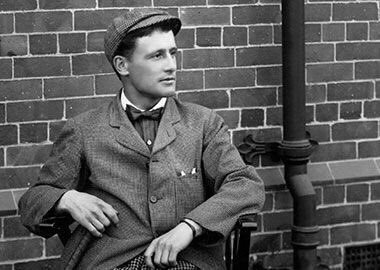
Harold Hilton (Photo: Royal Liverpool Golf Club)

It was fellow Hoylake junior member Willie More that helped him most in his formative years, encouraging him to watch better players and practice as much as he possibly could. He was of course fortunate that Johnny Ball, 8 years older than him and arguably Britain’s greatest ever amateur, was a fellow member of Royal Liverpool and clearly someone to aspire to and learn from.

Harold Hilton was one of the very best players for the 25 years between 1890 and 1915. Freddie Tait was the only player of this era he rarely got the better of. Whilst Hilton did beat Tait in stroke play he never beat him in a match play game and this drew a lot of comment at the time. Tait to a lesser degree had the same problem with Ball in match play.

His outstanding golfing achievement was winning both the 1911 Amateur Championship and the U.S. Amateur Championship. He was the first player to complete this double and he did so at the age of 42. Until Matthew Fitzpatrick won in 2013 Hilton had been the last Englishman to win the U.S. Amateur.

The 1911 U.S. Amateur has gone down in history for two reasons; firstly the manner of the victory and secondly the impact it had on the growth of the game in the United States.
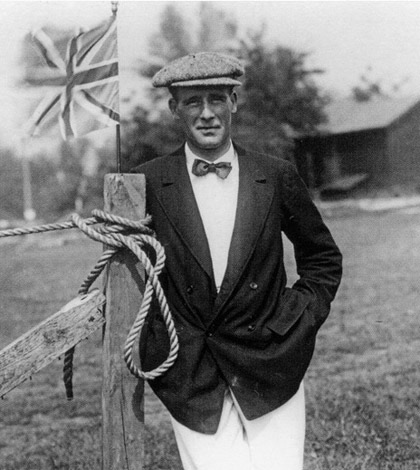
Harold Hilton at Apawamis CC (Photo: The Ron Watts Collection)

The 1911 U.S. Amateur took place at Apawamis Country Club in Rye, New York State. Hilton won the stroke play by two shots (76+74=150) leading 32 qualifiers into the match play stage. He then reached the 36 hole Final where he faced Brooklyn-born Fred Herreshoff (24). At lunch Hilton led 4Up and he quickly extended this to 6Up early in the afternoon round. Herreshoff fought back bravely and managed to draw level after 34-holes. The American had chances to win on both of the final two holes but putts just missed for him as Hilton struggled for halves.

Playing their 37th hole (the par 4 1st), with both players having driven into the fairway, Hilton sliced his 3-wood approach. What happened next remains uncertain. The ball either hit the rocky outcrop to the right of the green (in those days surrounded by trees and rough) or benefitted from a kind bounce on the slope before it. Either way from looking dead off the club face it ended up in the middle of the green 20 feet from the hole. In shock Herreshoff – no doubt thinking he had one hand on the trophy just moments earlier – topped his own approach short and then proceeded to take three more to get down. Despite his experience Hilton nervously two-putted for par, in the end having to hole a 3 footer to secure the Havemeyer Trophy.

Herbert Warren Wind described the ‘rock shot’ many years later in his The Story of American Golf (1948) as “the most discussed single shot ever played in an American tournament.” He went on to explain why it had motivated the next generation of U.S. golfers so much: “Americans were not at all pleased over the idea that a foreigner had carried one of our championship cups out of the country, and that men who had never cared about golf before now wanted to know the real inside story.”

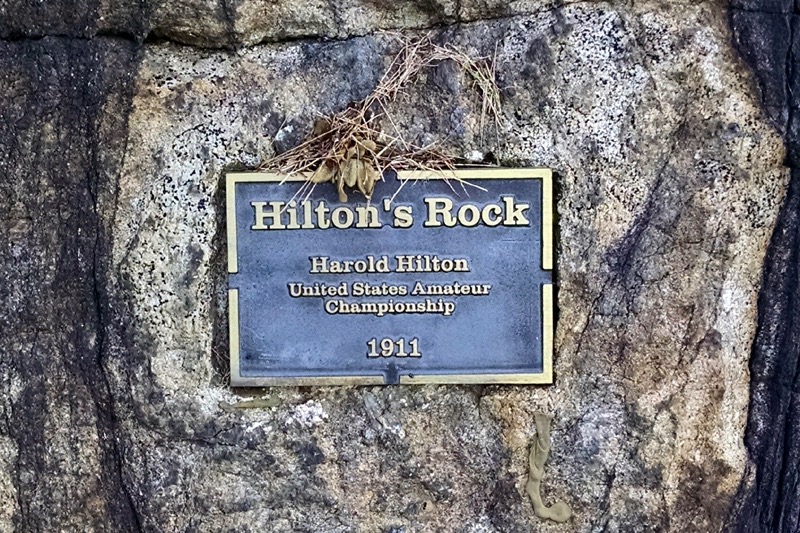
img_8595

Hilton’s Rock on the 1st Hole of Apawamis CC in 2015
(Photos: Dave Donelson, Westchester Magazine)

In total Harold Hilton won four Amateur Championships:-
1900 – at Royal St. George’s GC v. James Robb SCO (8&7)
1901 – at St. Andrews v. John L. Low SCO (1 Up)
1911 – at Prestwick v. Edward Lassen ENG (4&3)
1913 – at St. Andrews v. Robert Harris SCO (6&5)

It was perhaps no coincidence that his success in the Amateur started in 1900, the first year that both Tait (who had been killed that February in the Second Boer War) and Ball (who was still serving in South Africa) were both absent.

Hilton also lost three Amateur Finals; in 1891 to John Laidlay (19th hole), 1892 to Johnny Ball (3&2) and 1896 to Freddie Tait (8&7).

He achieved an impressive Won 95, Lost 29 (76.6%) overall Amateur Championship record. Between 1887 and 1927, he appropriately started and finished at Royal Liverpool, he played more Championships (33) and matches (124) than anyone else has in history. World War I deprived him of 5 Amateurs between 1916-1919 too.

Harold Hilton also won the Open Championship in 1892 (Muirfield, 305 – 66 entrants) and 1897 (Royal Liverpool, 314 – 86 entrants). The 1892 Open was the first played over 72 holes.

Just Johnny Ball (the first to do so in 1890), Bobby Jones (1926, 1927 & 1930) and Hilton have achieved this feat as amateurs. All three were members of Royal Liverpool GC.

It is in some respects surprising that Hilton won both of his Opens before he had secured an Amateur Championship but he was a renowned stroke player. In total he played in 20 Open’s between 1891 and 1914.

It’s worth noting that Hilton also finished tied third in the 1911 Open Championship at Royal St. George’s with Sandy Herd, one shot behind Harry Vardon, who won the subsequent play-off, and Arnaud Massy. What a hat trick of wins that would have been !
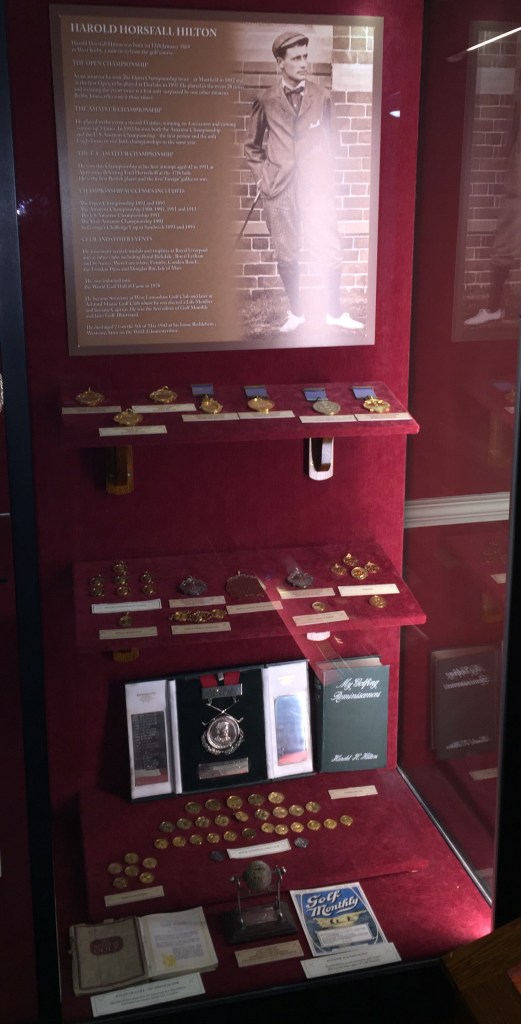
img_5512-1

Harold Hilton’s Medals at Royal Liverpool GC (Photo: GolfBible)

It is easy to forget that many equipment changes took place around the the turn of the century. Hilton dealt reasonably well with the transition, coping better than many of his peers with new clubs such as the Driver and the rubber-cored Haskell ball which replaced the old gutta-percha one. Interestingly of the seven Majors Hilton won the first four saw him use the more exacting gutty whilst the final three were with the easier rubber-core ball.

He also won the St. George’s Challenge Cup in 1893 and 1894, a major amateur competition back in the day.

He won the Irish Open Amateur Championship three years in a row and in some style too. In 1900 he beat S.H. Fry 11&9 at Newcastle, in 1901 P. Dowie 6&5 at Dollymount and in 1902 W.H. Hamilton 5&4 at Portrush.

In October 1910 Hilton (41) played Miss Cecil Leitch (19), a future women’s champion golfer, in a two day 72 hole exhibition match at Walton Heath and Sunningdale. Hilton had publically said he or for that matter any other first class male golfer could give 9 shots to an equivalent women over 18 holes. The Ladies’ Field magazine wanting to see if he could deliver on his word arranged the match and the publicity drew large crowds to the famous courses. Helped by the 18 shots she received Leitch ended up winning 2&1 but Hilton had largely made his point particularly as had been 2 Up after the first day’s play at Walton Heath.

Hilton’s last major win came in 1914 when he won the Golf Illustrated Gold Vase at Sunningdale with a 151 total. As one of the organisers of this event he paired himself with Francis Ouimet, the reigning U.S. Open champion, and proceeded to comprehensively out play him over the 36 holes.

Hilton’s swing was ungainly and notable for the fact he started by moving onto his toes before then very noticeably re-gripping the club at the point of transition. He almost always played whilst smoking too although it is said he limited himself to 50 cigarettes a day. However, like all the greats he practiced hard and honed his style. As he said himself “(I) served a long apprenticeship in the art of learning how to control the club in the upward swing.”

As Robert Harris, the runner-up in the 1913 Amateur, said: “His cap used to fall off his head at the end of full swings, as if jerked off, but this did not indicate if the swing was pure if unduly forceful. He was a small man with a powerful physique; it was exhilarating to watch his perky walk between shots. His assiduity was his greatness.”
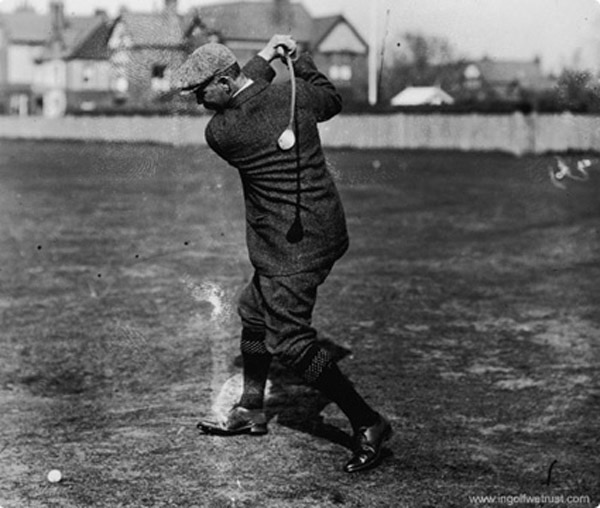
Harold Hilton’s Swing (Photo: ingolfwetrust.com)

Hilton also spent a lot of time thinking about the mental side of the game. He believed it was “possible to develop the habit of concentration” and believed “that the majority of good match players are inclined to be very silent men” and tend to be those that play the game “without allowing any outside influence to affect them in any way whatever.”

Hilton was also a member of West Lancashire Golf Club and was this club’s first paid Secretary in the early 1900’s. He was also Secretary of Ashford Manor Golf Club later in his life.

In 1912 he played a leading role in designing the highly regarded Old Course at Ferndown Golf Club in Dorset. The 16th hole is still named ‘Hilton’s’ in memory of his involvement with the Club.

He turned his hand to writing about the sport as he came to the end of his playing career. As well as a frequent contributor he was the first editor of Golf Monthly magazine (from 1911) before taking on the same role at Golf Illustrated, then a weekly paper (from 1913).

He wrote three books My Golfing Reminiscences (1907), The Royal and Ancient Game of Golf (with Garden C. Smith, 1912) and Modern Golf (1913). The fact that he wrote his autobiography in 1907 is probably down to opportunity but also reveals that at 38 he probably thought his best playing days were behind him. It was in 1903 that he also started to suffer with rheumatism and sciatica. His confidence in his own game was such that he chose not to even enter The Open in 1906, 1907 (at Hoylake), 1908 or 1910. History of course shows how wrong he was to nearly retire from competitive golf.
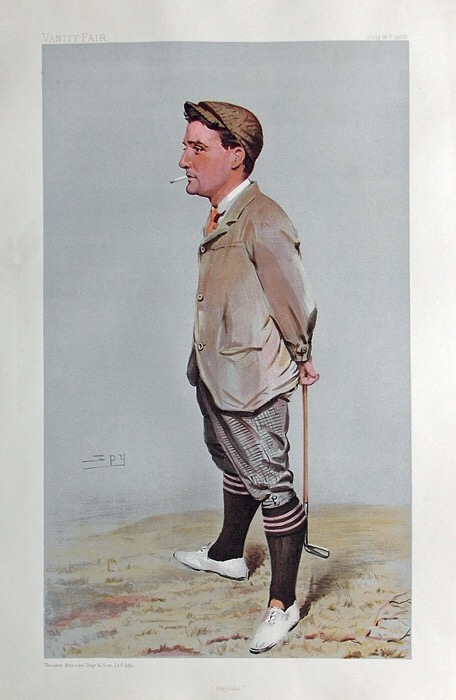
‘Hoylake’ – the chain smoking Harold Hilton depicted by ‘Spy’ (Sir Leslie Ward)

Hilton died aged 73 on 5th May 1942 at his home in Westcote, near Stow on the Wold in Gloucestershire. He had a heart attack but had been suffering with Parkinson’s Disease for some time prior to this.

Harold Hilton was admitted to the World Golf Hall of Fame in 1978 in recognition of his outstanding contribution to the game.

In 1992 John L.B. Garcia wrote Harold Hilton His Golfing Life and Times. It was published in a limited edition of 750 copies by Grant Books.

Royal Liverpool Golf Club inaugurated the Harold Hilton Medal for amateur golfers over the age of 30 in 1997 to commemorate the 100 year anniversary of their member’s famous home Open Championship victory. It is played in early June annually.
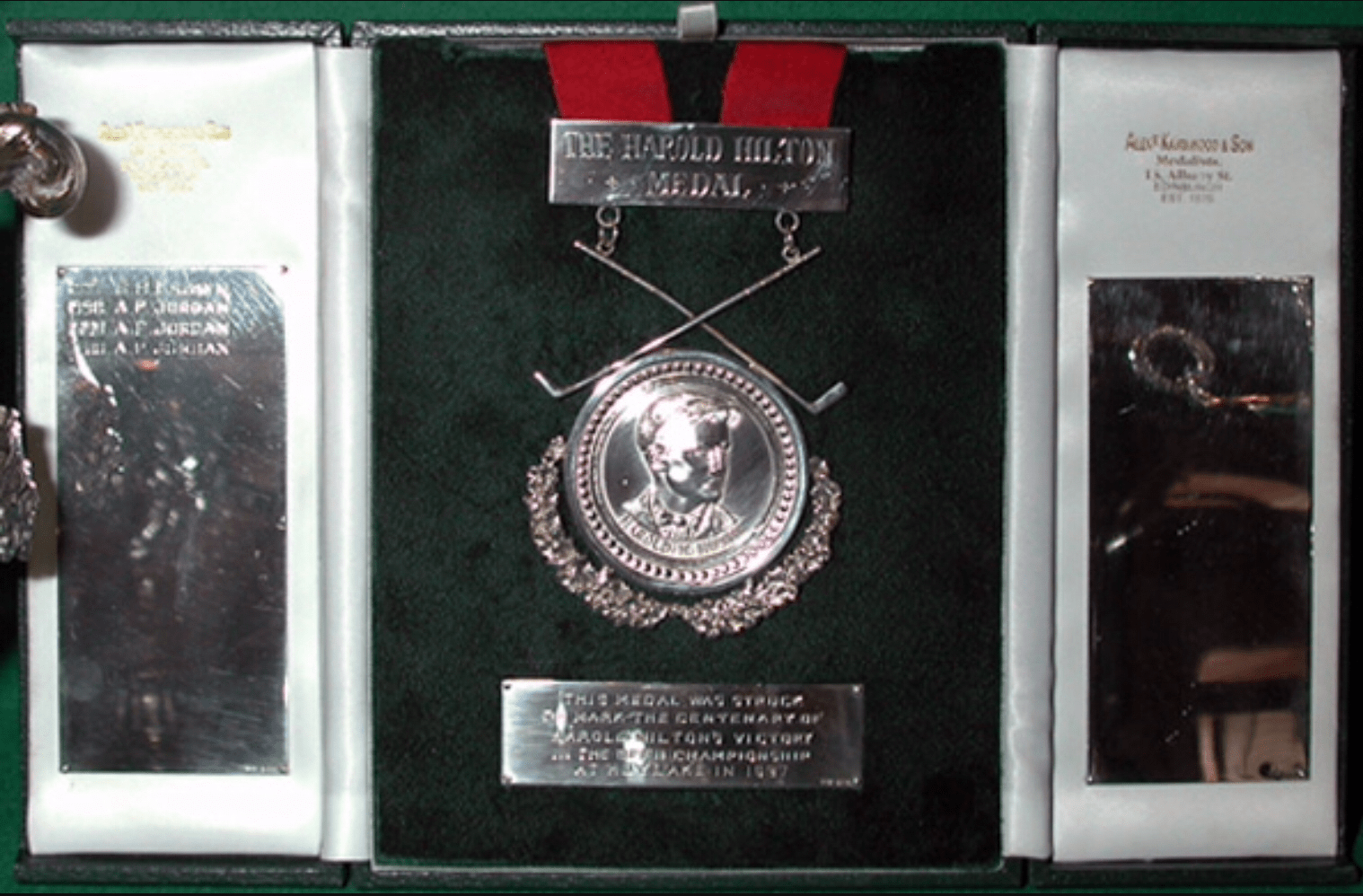
The Harold Hilton Medal (Photo: Royal Liverpool Golf Club)

Whilst small in stature, he was just 5 foot 6 inches tall, Harold Hilton is unquestionably one of the giants in the history of British golf.

It is amazing that Royal Liverpool produced first Johnny Ball and then just a short while afterwards Harold Hilton, two of the leading players of the time and looking back a 100 years later two of the biggest names in the history of amateur golf.

ME.

Copyright © 2014-2025, Mark Eley. All rights reserved.
Ronnie White

26th March 2017

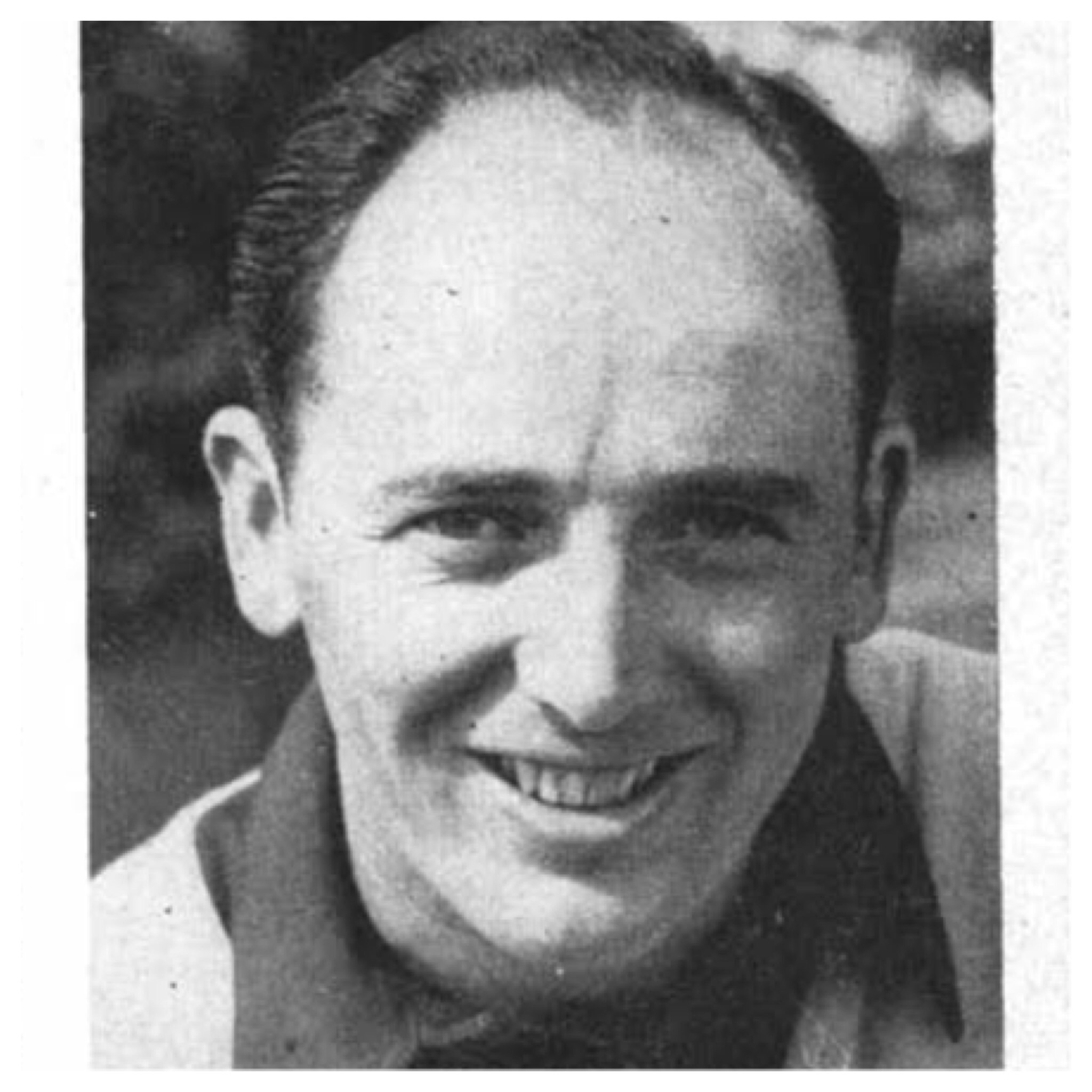
Great Britain & Ireland (GB&I) lost all four Walker Cup matches between 1947 and 1953 securing a disappointing total of 12 points in the process. It may therefore come as surprise to learn that one of our player’s achieved a record of P8 W6 L1 H1 during this same period.

That player was Ronnie White. His loss and a half both coming in foursomes matches played with Joe Carr. All four of his singles were won.

A name rarely mentioned by anyone nowadays White was arguably the best amateur golfer in the world in the initial post World War II period.

Ronnie White

Ronald James White was born on 9th April 1921 in Wallasey on The Wirral in England to James and Edith White (née Johnstone).

When Ronnie was 5 he started accompanying his Dad, a member of Southport & Ainsdale GC, to golf, quickly picking up the game and it’s etiquette. Inevitably it wasn’t long before he started playing himself.

Ronnie attended the Merchant Taylors’ school in Crosby and soon developed into one of the country’s leading Juniors. In 1936 he played in the Boys Amateur Championship held at Birkdale. the club he had joined aged 12 three years earlier. He lost 5&3 in the fourth round to William Innes of Lanark. Innes went on to lose the final 11&9 to the famous Irish player Jimmy Bruen.

White fared better in 1937 when he won the U18 Boys’ Carris Trophy, in those days played exclusively at Moor Park, with rounds of 72 and 75.

Fortunately for young Ronnie the Ryder Cup came to town in 1937 and he had the opportunity to see his hero Sam Snead up close. In an interview in 2001 he said “Snead was my role model. I was there for every moment of practice and competition, and was greatly impressed both by the way in which he and the other Americans played, and their style”.

His golf continued to improve and between 1936 and 1938 he was selected for the English Boys Team for their annual match against Scotland. He captained the team in 1938. He played six games winning four, halving one and losing the other.

In 1939 the English Amateur Championship was played at Birkdale and the 18 year old White reached the Quarter Finals before losing to Sydney Banks by 3&2.

Ronnie had just started a law degree at Liverpool University when Great Britain entered World War II. He volunteered for the Royal Air Force and was first stationed, somewhat fortuitously, at RAF Leuchars for his initial 3 months of training. This enabled him to carry on practicing his golf at nearby St. Andrews. His intelligence and leadership skills saw him selected for flying instructor training. He qualified as a pilot at the British Flying Training School in Texas and appears to have seen out the War well away from the front line.

Understandably very little competitive golf was played whilst the country was at War so just as White was coming into his peak years all of the major championships and events were cancelled (1940-45). The world was a different place after the war too with families devastated, food and petrol rationing in place and responsibilities altered. As Britain tried to rebuild itself as quickly as it could golf was certainly well down the list of most people’s priorities.

White was demobilised in 1946 and moved back to the Birkdale area of Southport where he would stay for the rest of his life. Now aged 25 he re-commenced his law studies and qualified as a solicitor in London in 1949.

White’s commitment to his family and the law meant he was a true amateur playing only a limited schedule, often as close to home as possible. However, he practiced regularly at Birkdale and was ambitious for himself – “the ladder of fame was empty” after the War and I was determined “to reach the top in amateur golf.”

After the 1946 season came to a close White set about remodeling his swing. “Experience had made me appreciate that if I were to achieve success my ambition must be consistency. The star players were all consistent”. He therefore set about gaining more knowledge, used photography and mirrors and practiced hard to create a ‘grooved’ swing. Whilst he never reached his unattainable aim of being as consistent as a golf ball testing machine he was to reap the benefits of this effort in the years that followed.

Unusually at the time he also aimed to spend at least an hour a day on his physical and mental fitness, normally early in the morning. He would run along the shoreline at Birkdale as well as skip and weight lift at home. “Tired legs are the death knell of a competitive golfer, because when the legs get tired concentration lapses follow, and I was always determined to avoid this, particularly towards the end of a championship. I felt as good at the end of a 36-hole match or 72 holes over a weekend as I did at the beginning” he reflected in later life. He sought to manage his nerves by regularly practicing his breathing and by strengthening his stomach muscles.

According to Leonard Crawley his mechanical approach enabled White to become “the most accurate hitter of a ball between tee and green since Henry Cotton” although he went on to say he was a “comparatively poor putter”.

Surprisingly during his career White only played in two Amateur Championships, in 1946 and 1949. He lost in the fourth and fifth rounds respectively in close matches. He was perhaps a victim of his own success. In those days the Amateur was often scheduled around the Walker Cup (trials and match – in 1947, 1951 and 1955) or the Home Internationals (1948 and 1952). With a family to support he was simply unable to take extended leave from his studies and later work as a solicitor and thus sacrificed his own individual competition entries. Of course White was criticized by frustrated onlookers at the time for consistently missing our major amateur Championship.

White did play in many other national events although many of these, certainly his victories, appear to have been in close proximity to home and work. In addition to his starring role in the Walker Cup it was his performance in these that secured his standing in the game.

He won the Lancashire Amateur championship (1948 Birkdale), the English Amateur (1949 Formby), the Golf Illustrated Gold Vase (1949 Birkdale) and the Brabazon Trophy (the English Open Stroke Play title) in both 1950 (by 8 shots after rounds of 75, 72, 75 and 72 at Birkdale) and 1951 (by 4 shots after rounds of 77, 69, 73 and 74 at Formby).

His 1951 Brabazon victory summed up his approach to golf. It was widely reported that both before and after each round White was seen rushing off to his office or to Wigan Magistrates’ Court.

White also had some success in the Daily Telegraph Amateur-Professional Foursomes Tournament. He won it in both 1947 with Charlie Ward at Formby and in 1949 with Reg Horne at Moortown. “With a partner like Ronnie White, you just can’t lose” said Horne at the prize giving ceremony.

He represented England in the Home Internationals of 1947-48-49-53-54 and in matches against France in 1947-48.

After the 1953 Walker Cup White largely stopped playing competitively not that he was overly active beforehand. He was therefore surprised to be called up by England in 1954 for the international matches at Porthcawl.

He performed well enough in Wales to merit a final selection for the 1955 Walker Cup match at St. Andrews. This proved controversial as White had declined an invitation to attend the pre-match trials. It was also a shame because he lost both matches and these failures took the edge of his superb overall Walker cup record. Playing first in both the foursomes and singles he came up against E. Harvie Ward in both, who had won the Amateur in 1952 and went on to win the US Amateur in both 1955 and 1956. Ward a full time amateur with a superb game simply had too much for White by then.  White never played an international match again.

White couldn’t resist a final outing when the Open Championship came to Birkdale in1961. Rounds of 71, 79, 80 and 76 were good enough for him to secure the low amateur Silver Medal in tied 38th place. He had previously only played in one other Open, at St. Andrews in 1946, where he finished tied 30th and fourth best amateur.

In March 1953, somewhat unusually for an amateur but reflecting his standing in the game, White published an instructional book entitled ‘Golf As I Play It’. Given the rules on amateur status the book caused something of a furore at the time. Unsurprisingly, given his legal background, it transpired that White had obtained the prior written approval of the Secretary of The R&A before embarking on the project. In this regard a note was included at the beginning stating “the author wishes to make it clear that he is not a teacher of golf.”

‘Ronnie White’s Golf As I Play It’ Book

One question I haven’t been able to answer concerns Ronnie’s club attachment. He joined Birkdale as a Junior, lived virtually opposite the course for most of his life and subsequently became an Honorary Member of this Club. Yet despite this all of his competition entries from 1947 onwards listed him as representing Royal Liverpool. Even his book states ‘by Ronnie White, Royal Liverpool GC and the 117 photos were all clearly taken at Hoylake too. Matters are made more confusing when one looks through Royal Liverpool’s club histories and find’s not a single reference to Ronnie White.

Ronnie won the R&A British Seniors for over 55’s in 1978 and 1979. In 1978, playing out of Caldy GC, at Formby White shot rounds of 76, 74 and 75 to win by 1-shot. He retained the Championship at Royal St. David’s, this time representing Royal Birkdale GC, after a play-off with HD Moseley and LL Shelley.

When asked, as all great amateurs are, if he regretted not turning professionally White said: “It crossed my mind on a few occasions but the risks were too great. Winning a professional event in the 1950s meant a few hundred pounds in your pocket, not the hundreds of thousands today. I had a family to take care of, and professional golf was too uncertain.”

He died in 2006 aged 85 to little fanfare in the golfing world. This is a shame because for a brief spell he was one of the best golfers in the world, a highly respected (true) amateur on both sides of The Atlantic. Given his approach to the game it was remarkable that he maintained his competitiveness for so long.

______________________________________________________________

APPENDIX 1 – SELECTED QUOTES ON RONNIE WHITE

Tom Scott on the 1949 Amateur Season: “The first national title, the English Amateur Championship (Formby April 25-30), went to R.J White, as we all expected it would. White played superlative golf and won the title with comparative ease by the margin of five and four. White’s victory was most comforting to all of us, for quite clearly he was at peak form, which meant he was the equal of any amateur in the world, British or American. Here was our No. 1 against the Americans and one who could be relied on to hold his own”.

“There are many who unhesitatingly describe him as the outstanding British amateur of golfing history, and some Americans call him the best unpaid striker of the golf ball since the incomparable Bob Jones.” – New Zealand Golf Illustrated , 5th January 1952

“Ronnie White is a genuine week-end golfer who intends to stay that way and considers it a pleasant accident that nature endowed him with the golfing ability of a world champion.” – New Zealand Golf Illustrated , 5th January 1952

“Many of the highest authorities in American golf today are of opinion that he is the soundest British amateur of the last thirty years. That, of course, is just a matter of opinion, but since he is blessed with the three greatest attributes of a golfer – style, physique and temperament – he is unquestionably a tremendous player”- Leonard Crawley, A History of Golf In Britain (1952).

Leonard Crawley in the Foreword to ‘Golf As I Play It’ (1953) said:

“He has become a famous player and even in America they talk of him as the best amateur in the world today. I think ‘they’ are right, since if ever there was a real amateur he is one. As I know him he is a kindly but hardheaded Lancashire man with certain obvious tracks to his mind from which no one can shake or divert him. He has as his first object a life to live with his family, as his second a living to earn for his family, and as his third, and only when time permits, his golf to play as his hobby.”

“A very keen golfer from the South of England who had never seen him in action recently asked me what type of player he was ? I replied ‘He has a classical but fully modern style. He is as a strong as a horse, and he fears no one.’”

Reflecting on golf in 1953 Pat Ward-Thomas said “Had it been necessary at that time to examine an amateur golfer’s character to the limit he would have been sent to play Ronnie White over 36 holes on his own course at Birkdale with much at stake. I still think that White was one of the finest amateurs ever to emerge in Britain, certainly as a striker of the ball. His swing was so solid and true that there was a sense of the inevitable about his shots. The ball flew from the clubface with an unerring flight that few professionals, apart from Cotton, and no amateur could consistently match, and what is more, in any conditions.”

Peter Alliss described Ronnie White as ”the most professional-looking amateur I have seen” – ‘Golf Heroes’ (2002)

APPENDIX 2 – RONNIE WHITE’S DETAILED PLAYING RECORD

WALKER CUP MATCHES

1947 St. Andrews – 16th and 17th May – GB&I 4 USA 8
F4. RJ White and C Stowe v. RD Chapman and FR Stranahan WON 4&3
S6. RJ White v. AF Kammer WON 4&3

“Charlie was the ideal partner for me to have, never a dull moment, always able to see the humour of life and yet a dogged competitor” recalled White in 2001.

Fred Kammer was a semi-finalist in the US Amateur of 1946.

1949 Winged Foot GC – 19th and 20th August – USA 10 GB&I 2
F1. JB Carr and RJ White v. W Turnesa and R Billows WON 3&2
S1. RJ White v. W Turnesa WON 4&3

Willie Turnesa was the 1938 and 1948 reigning US Amateur champion and runner-up in the Amateur championship; arguably the best player on either side.

Henry Longhurst said “(The team) managed to get just two points – and without Ronnie White, whose form in the warm, windless conditions of American summer golf was so consistent that his team-mates christened him ‘One Height White’ (because every shot he hit, whatever the club, was the same height), we should assuredly have come home without a point at all”.

“Everything about his game has the same professionally polished air – the safe and sound driving, the long iron shots that look as good as Cotton’s the immaculate short game, the confident putting. With half a dozen White’s we would have won that Walker Cup with the greatest ease”.

1951 Birkdale – 11th and 12th May – GB&I 3 USA 6
F1. RJ White and JB Carr v. FR Stranahan and W Campbell HALVED
S3. RJ White v. CR Coe WON 2&1

Watching the Foursomes match with a crowd estimated at 10,000, GB&I 3Up and playing well, Bernard Darwin reported: “Poor Joe Carr had a bout of missing short putts and the holes melted away.” Nevertheless it took a 10-footer by Campbell at the last green to deny the GB&I pair a full point.

In his singles White trailed 3 down after six holes against Charles Coe, but he rallied to win, 2 and 1.

In his post match report Darwin said: “Ronnie White’s record of five wins and one halved match in three Walker Cup matches is certainly one of the finest achievements of British amateur golf for many years. No wonder the Union has taken so much trouble – and given other people so much trouble – in order to give him the sole representative of a plus two handicap.”

1953 Kittansett – 4th and 5th September – USA 9 GB&I 3
F2. JB Carr and RJ White v. S Urzetta and K Ventura LOST 6&4
S6. R Chapman v. RJ White WON 1 HOLE

White still playing a restricted schedule gained selection in 1953 after reaching the English Amateur final in 1953, a match he surprisingly lost at Birkdale to teammate Gerald Micklem.

“When Carr and White are a little older it will dawn on them that young successful partnerships are apt to wear out” wrote Leonard Crawley in 1954 having watched them struggle on Day 1. The opposition was tough though; Sam Urzetta was the 1950 US Amateur champion and Ken Venturi went on to win the 1964 US Open.

On Day 2 according to Crawley “White lunched two down having taken 77 to go round (the first 18). At the 30th hole…he was 3 down with 6 to play. He finished 3-3-4-4-3-4 (to) beat his adversary on the last green. It was a tremendous performance”. Bobby Jones, by now quite ill and using his buggy, came to the match and chose to follow the White game. He later praised White for putting on a “great performance.”

1955 St. Andrews – 20th and 21st May – GB&I 2 USA 10
F1. JB Carr and RJ White v. EH Ward and DR Cherry LOST 1 HOLE
S1. RJ White v. EH Ward LOST 6&5

In the foursomes Carr and White were 1Up with three holes to play. On the 34th hole they three putted whilst Cherry chipped in from off the green. More poor play around the Road Hole green cost the GB&I pair before the last was halved. Both players were gutted and criticised heavily in the press. It was no surprise then that they both lost their Single matches heavily the following day.

HOME INTERNATIONAL MATCHES

1947 Royal Liverpool – 24th, 25th and 26th September – England won
Ireland
F1. RJ White and J Rothwell v. J Burke and C Ewing WON 2&1
S3. RJ White v. C Ewing LOST 2&1

Wales
F1. RJ White and J Rothwell v. SB Roberts and JV Moody WON 3&2
S3. RJ White v. AA Duncan LOST 4&3

Scotland
F2. RJ White and J Rothwell v. H McInally and JG Campbell WON 4&3
S3. RJ White v. AT Kyle WON 2&1

E. Harvie Ward went on to play in two further matches and finished with a 100% win record from his 6 games played.

1948 Muirfield – 22nd, 23rd and 24th September – England won
Scotland
F2. PB Lucas and RJ White v. JC Wilson and H McInally HALVED
S3. RJ White v. JC Wilson WON 3&2

Ireland
F2. PB Lucas and RJ White v. JB Carr and BJ Scannell LOST 1 DOWN
S3. RJ White v. W O’Sullivan WON 4&3

Wales
F2. PB Lucas and RJ White v. RM de Lloyd and JV Moody WON 6&4
S2. RJ White v. SB Roberts LOST 2&1

1949 Portmarnock – 16th, 17th and 18th May – England won
Wales
F1. RJ White and C Stowe v. SB Roberts and JL Morgan WON 4&3
S1. RJ White v. AA Duncan WON 5&3

Scotland
F1. RJ White and C Stowe v. AT Kyle and JM Dykes WON 2UP
S1. RJ White v. JC Wilson HALVED

Ireland
F1. RJ White and C Stowe v. J Bruen and SM McCready HALVED
S1. RJ White v. C Ewing WON 3&2

1952 Troon – 24th, 25th and 26th September – Scotland Won
Results unknown.

“England were without R.J. White the best golfer of his generation and regarded even in America as one of the finest amateurs in the world. His absence was deplorable” – Leonard Crawley, 1953 EGU Golf Annual

1953 Killarney – 10th, 11th and 12th June – Scotland won
Ireland
F1. RJ White and D Rawlinson v. BJ Scannell and J Glover WON
S2. RJ White v. WM O’Sullivan LOST

Scotland
F1. RJ White and D Rawlinson v. DA Blair and JR Cater LOST
S2. RJ White v. JC Wilson LOST

Wales
F1. RJ White and D Rawlinson v. JL Morgan and SB Roberts LOST
S2. RJ White v. JL Morgan WON

“For most of the week, White’s golf was very poor, and until he faced John Morgan in the Welsh match, he was but a shadow of the great player we know him to be” wrote Crawley.

1954 Porthcawl – Dates Unknown – England
Results unknown.

ENGLAND v. FRANCE MATCH
1947 Wentworth 21st July – England 8 France 1
F1. C Stowe and RJ White v. M Carlihan and J Leglise LOST 3&1
S3. RJ White v. J Leglise WON 3&1

1948 St. Cloud 5th and 6th June – England 5 France 3 (Halved 1)
F1. GH Micklem and RJ White v. M Carlihan and J Leglise HALVED
S2. RJ White v. M Carlihan WON 7&6

BOYS INTERNATIONAL MATCHES

1936 Birkdale – Scotland 8.5 England 3.5
F4. TS Foggett and RJ White v. DG O’Brien and WH Gibson WON 2 HOLES
S7. RJ White v. DG O’Brien WON 5&3

1937 Bruntsfield Links – Scotland 9.5 England 2.5
F1. P Hunt and RJ White v. RG Inglis and DB Fraser HALVED
S2. RJ White v. C Gray LOST 2 HOLES

1938 Moor Park – Scotland 7.5 England 4.5
F1. RJ White and T Hiley v. C Gray and W Smeaton WON 3&1
S1. RJ White v. C Gray WON 5&4

AMATEUR CHAMPTIONSHIP

1946 Birkdale – 4th Rd lost to Frank Stranahan by 1hole.

“The round between RJ White and FR Stranahan took three hours and forty minutes which is farcical and monstrous. Golf is not a funeral, although both can be sad things” – Bernard Darwin.

Stranhan has the best Amateur Championship record of any player winning 43 of his 50 matches between 1946-54. He won the Amateur in 1948 and 1950 and was runner up in 1952.

1949 Portmarnock – 5th Rd lost to Ernest Millward by 1 hole.

In the 2nd Rd White beat Dr. W Twedell 3&2 and in the 3rd Rd PB ‘Laddie’ Lucas on the 20th hole. Millward won the English Amateur Championship in 1952.

OPEN CHAMPIONSHIP

1946 St. Andrews – 76 79 84 77 (T30)
1961 Birkdale – 71 79 80 76 (T38) – Silver Medal winner for leading amateur.

ME.

Copyright © 2014-2025, Mark Eley. All rights reserved.
Rodney Foster

13th October 2016

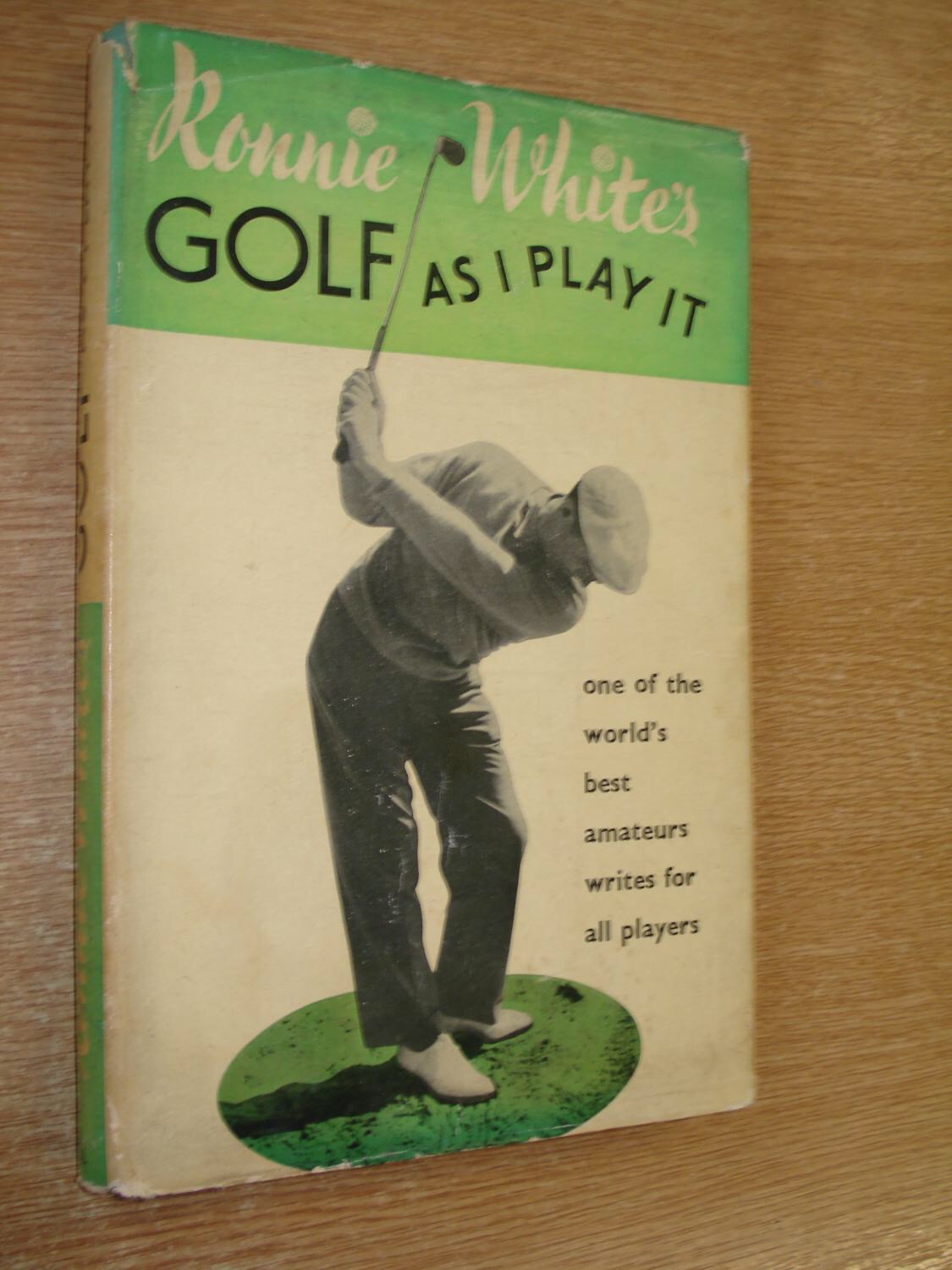
Rodney Foster is one of England’s and for that matter Great Britain’s best ever amateur golfers. After years of international representation this career amateur became a much respected and well liked ambassador for the game of golf.

As Rodney is 75 today I thought I would produce ‘an everything you need to know ‘list to record his more notable achievements in the amateur game.

1. He was born in Shipley on 13th October 1941. A lifelong Yorkshireman he was educated at Bradford Grammar School, before embarking on a career in insurance locally and living in the area to this day. He plays most of his golf at Ilkley nowadays.

2. His mother and father were both members of The Bradford Golf Club, his father being Captain in 1956. It was therefore inevitable that Rodney and his brother George would take up the game and quickly become proficient at it – both became scratch players, representing The Bradford club during their careers. It was at Bradford that Rodney developed his very upright swing for which he was known.

3. He won the Yorkshire Amateur Championship five times, in 1963, ’64, ’65, ’67 and ’70. Locally he is also known for his dominance of the Bradford Open, which he won a record 10 times between 1960 and 1982.

4. He was capped for both England Boys (1958) and Youths (1959).

5. Rodney became a full Men’s International in 1963 and played for England annually in the Home Internationals between 1963 and 1971 (save for 1965). His elite playing career coming to end slightly prematurely in 1973 after he had a serious accident.

6. Rodney represented England in the European Amateur Team Championship in 1963, ’65, ’67, ’69, ’71 and ’73. England won this event three times with him in their team, in 1963, ’69 and ’71.

7. He won many other major amateur titles, most notably the Berkshire Trophy (1964) and the Lytham Trophy (1967 and 1968).

8. In 1964, probably his best playing year, he lost the final of the English Amateur Championship to Dr. David Marsh by 1 hole at Hollinwell.

9. He reached the semi-finals of The Amateur Championship in both 1962 (Hoylake) and 1965 (Porthcawl), losing firstly to Richard Davies from the USA by 3&2 and then to Michael Bonallack by 1 hole on his way to the title. He played in 20 Amateurs between 1962-82, winning 37 and losing 20 of his 57 matches.

img_4188Rodney Foster (Photo: R&A / 1979 Walker Cup Programme)

10. He tied with Michael Bonallack for the English Open Amateur Stroke Play Championship (Brabazon Trophy) in 1969 at Walton Heath (no play-off in those days) before successfully defending the title in 1970 at Little Aston.

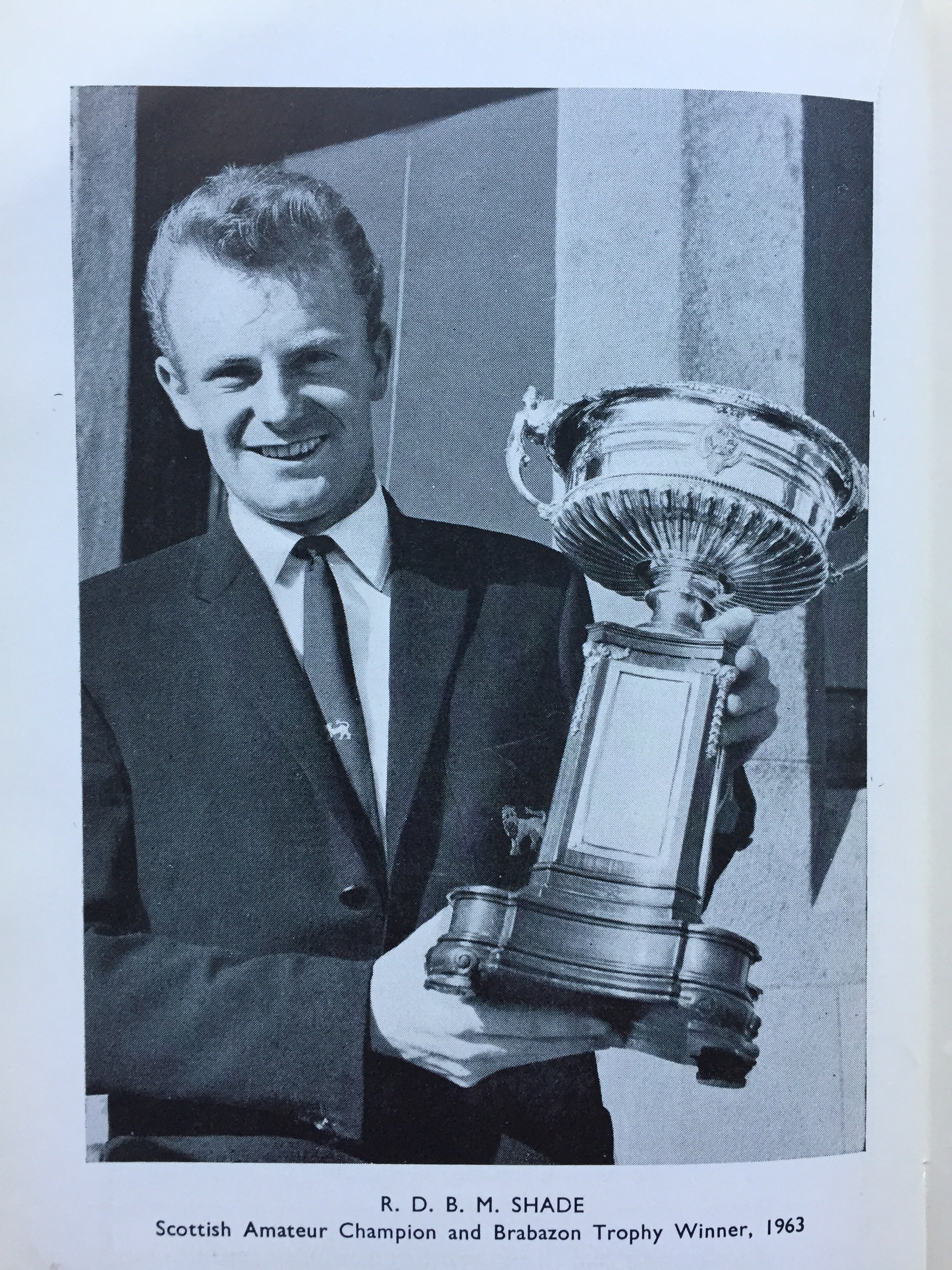
11. He was a member of the winning GB&I Eisenhower Trophy team in 1964. He played with Michael Bonallack, Michael Lunt and Ronnie Shade in Olgiata, near Rome. He also represented Great Britain and Ireland (GB&I) in 1970 in this competition.

12. He played in five consecutive Walker Cup‘s for GB&I, 1965, ’67, ’69, ’71 and ’73. However, as was the case with most golfers of this era, his playing record was disappointing – he played 17 games winning 2, losing 13 and halving 2.

13. He also represented Great Britain in the St. Andrews Trophy match against Europe in 1964, ’66, ’68 and ’70. GB won all four of these matches.

14. He was non-playing captain of England in 1976, ’77 and ’78, England winning the Home Internationals’ Raymond Trophy in his last two years.  He went on to become captain of the GB&I Walker Cup team in 1979 (Muirfield) and 1981 (Cypress Point). Both matches were lost, the former 8.5-15.5 and the latter 15.5-9.  In the middle year, 1980, he captained the St. Andrews Trophy Team which won at Royal St. George’s 19.5-10.5.

15. Rodney also played for Great Britain in 1967 (Canada) and 1971 (New Zealand) in the now defunct Commonwealth Tournament, competing against teams from Australia, Canada, New Zealand and South Africa.

16. He set many course records during his career including those at The Bradford (66), Leeds (64), Prestbury (66) and Troon 70.

17. He has honorary membership of many Yorkshire clubs in recognition of his service to the county and international playing achievements. These include The Bradford, East Bierley, Halifax, Ilkley, Keighley, Shipley, West Bowling and Woodsome Hall.

18. Finally, as one would expect he is also a member of The Royal & Ancient Golf Club of St. Andrews.

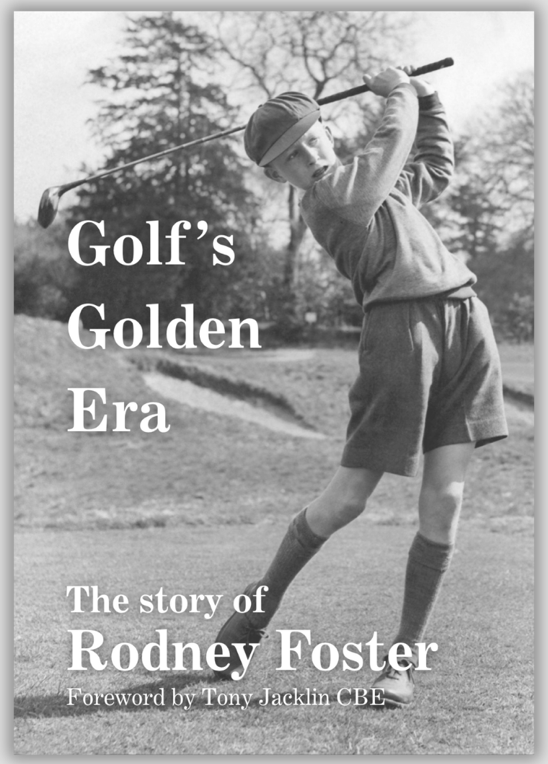
19. In December 2025 a biography, ‘Golf’s Golden Era – The Story of Rodney Foster’ by Robin Snook & Trevor Wilson was published. A copy can be acquired from the authors here.

ME.

Copyright © 2014-2025, Mark Eley. All rights reserved.
Ronnie Shade MBE

15th October 2016

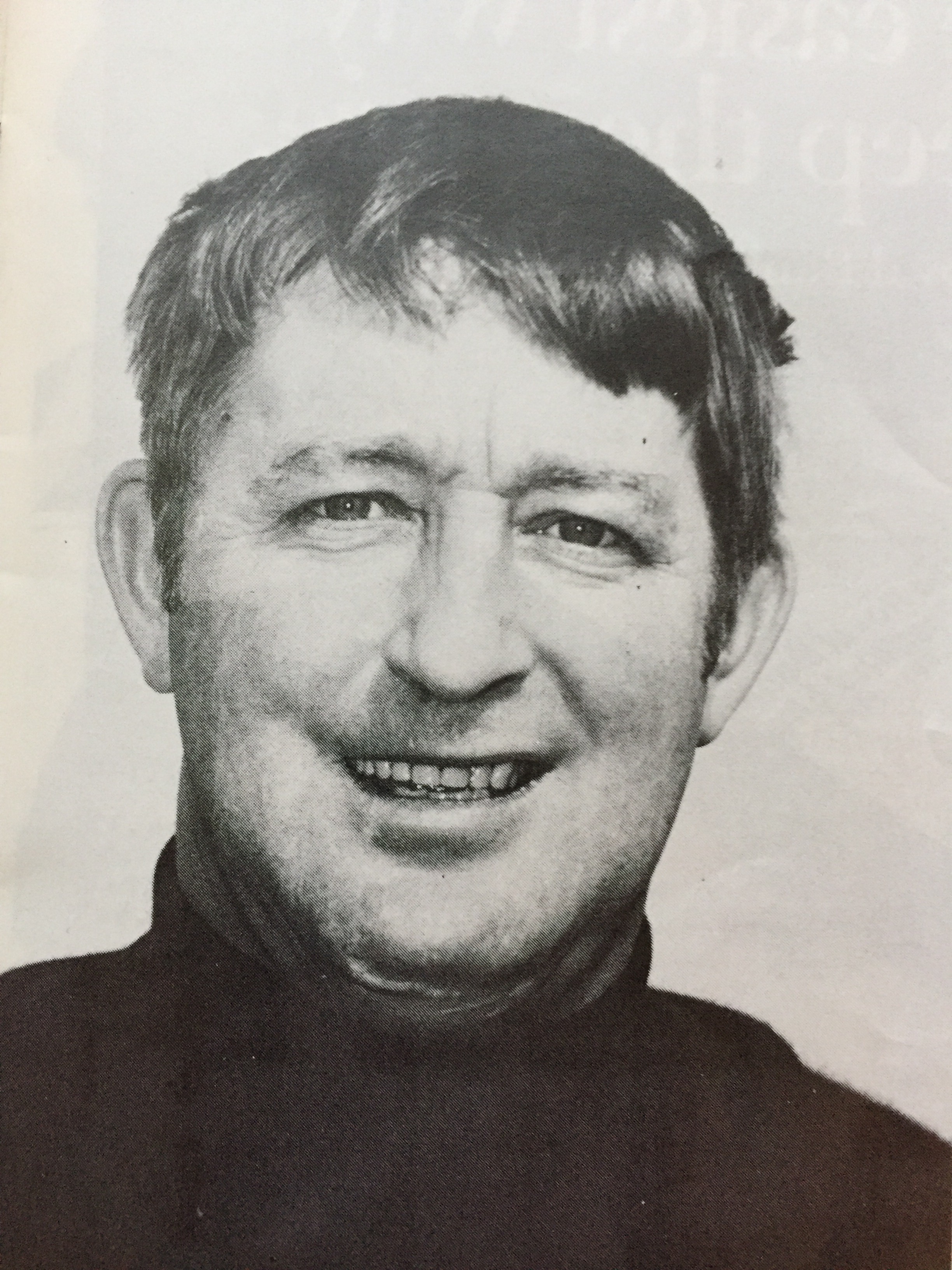
Ronnie Shade is one of Great Britain & Ireland’s best amateur golfers of all-time and probably Scotland’s very best. Indeed for a while in the mid-1960’s he was considered the best amateur in the world.

Ronald David Bell Mitchell Shade MBE was born on 15th October 1938 in Edinburgh.

He grew up playing golf at Duddingston Golf Club on the east side of the city where is father John was the club pro. He attended the nearby Portobello Secondary School.

Coached exclusively by his father he developed a somewhat mechanical swing but one that he could repeat and rely upon. He was known for keeping his head down well through impact.

“Before each shot, Ronnie goes through a series of seemingly odd contortions. These are his father’s idea. He believes that the muscles have to be ‘reminded’ of their role before each shot. Young Shade can be observed standing away from the ball posing in the top of the backswing position and flicking his hips. This is to ‘remind’ his hips to move first. His most unusual pose is the follow through which he performs and holds three three times before each stroke”  – World Sports Magazine, 1962. 

He quickly showed promise on the links winning the Edinburgh Boy’s Championship in 1954-55-56.

He represented Scotland in the Boys’ International Match in 1954-55-56, captaining the side in his final year.

He took his junior victories onto the national stage in 1954 firstly winning the British Youth’s Under 18 Open Championship by 3-shots at Dumfries and County GC. In 1956 he secured the Scottish Boys’ Amateur Championship beating AJ Hanley at North Berwick 7&6 in the final.

His best finish in the Boys’ Amateur Championship came in 1956 when he reached the semi-finals before losing 4&3 to CW Cole.

He was first selected for Scotland’s Men’s team in 1957, playing one match in The Amateur Internationals (now the Home internationals) against Ireland. He played in the Internationals in 1960-61-62-63-64-65-66-67-68 competing against all the home nations.

He is best known north of the border for winning five consecutive Scottish Amateur Championships between 1963-1967.

1963 – beat N Henderson 4&2 at Troon.
1964 – beat J McBeath 8&7 at Nairn.
1965 – beat GB Cosh 4&2 St. Andrews.
1966 – beat CJL Strachan 9&8 at Western Gailes.
1967 – beat AB Murphy 5&4 at Carnoustie.

When he lost in the fourth round of the 1968 Championship it brought to an end a staggering run of 43 successive match wins, 35 of them coming over 18 holes. His record could have been even better too as he also lost the 1962 final to SWT Murray 2&1 at Muirfield.

img_4165

Ronnie Shade (Photo: The Golfer’s Handbook 1964)

In 1968 Shade won the second Scottish Open Amateur Stroke Play Championship, held at Prestwick, with a 282 total score.

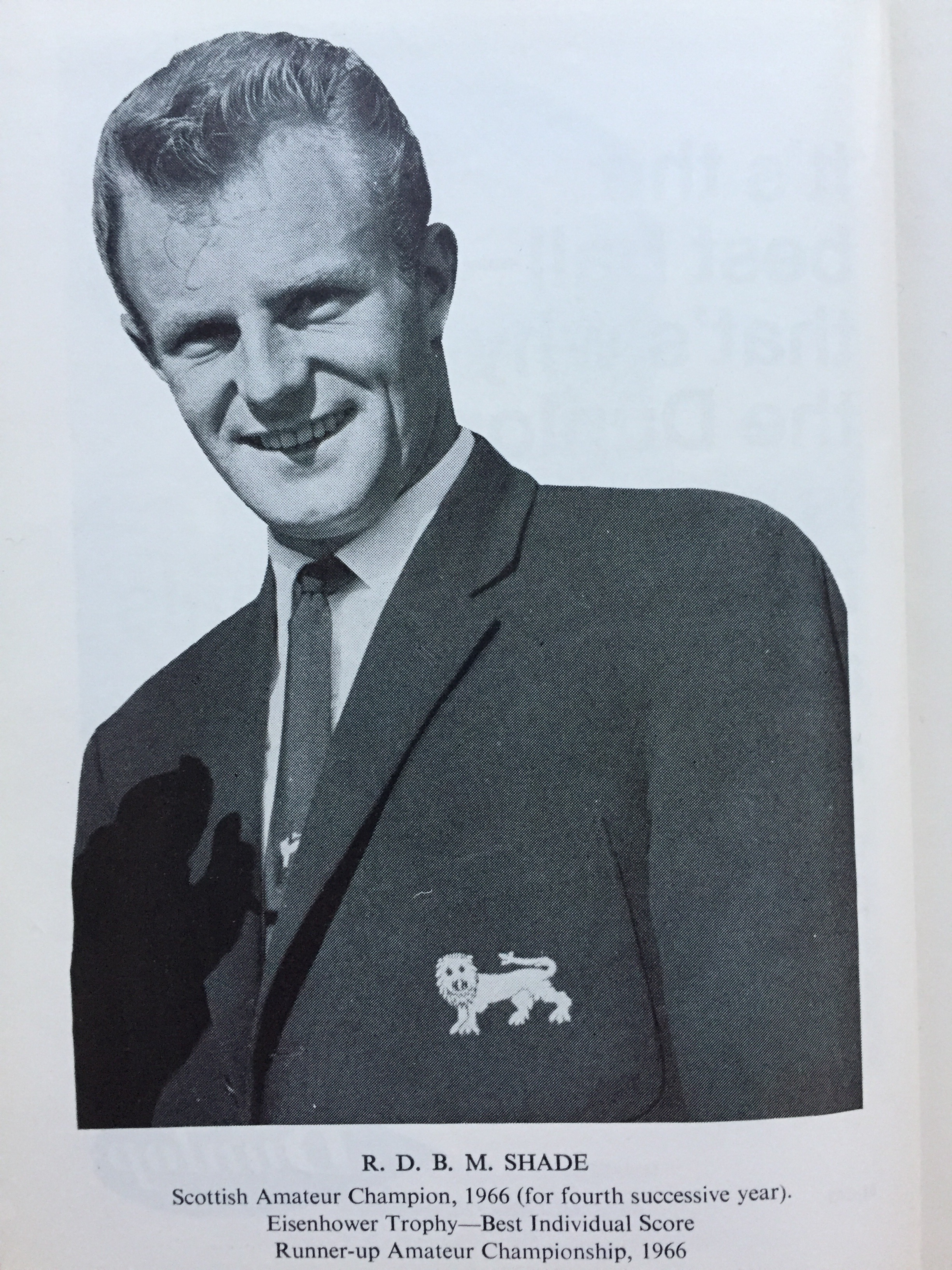
He won the the English Amateur Open Strokeplay Championship (for the Brabazon Trophy) three times, in 1961-63-67.

In 1966 he lost the final of The Amateur Championship to South African Bobby Cole. Shade played in 8 Amateur’s between 1961 and 1968 winning 26 of his 34 games Whilst his 76.5% win percentage is nothing to be ashamed of Shade must have been disappointed that he couldn’t have performed better in our most prestigious event.

1961  Turnberry               –  5th rd loss to J Walker 2&1
1962  Royal Liverpool     – 2nd rd loss to GJ Butler 20th hole
1963  St Andrews            – 5th rd loss to Dr. ER Updegraff 3&2
1964  Ganton                   – 2nd rd loss to PF Brady 1 hole
1965  Royal Porthcawl    – 4th rd loss to W Hyndman III 2&1
1966  Carnoustie            – Runner up losing to RE Cole 3&2
1967  Formby                  – 5th rd loss to RB Dickson 2&1
1968  Troon                     – 6th rd loss to RL Glading 1 hole.

He represented Great Britain and Ireland (GB&I) four times in the Walker Cup, playing in 1961-63-65-67. Ronnie Shade played  14 games winning 6, losing 6 and halving 2. In this era this represents a very creditable record.

1961  Seattle                      – USA 11 – 1 GB&I     P2  W0  L2  Ho
1963  Turnberry                 – GB&I 8 – 12 USA     P4  W2  L1  H1
1965  Baltimore                 – USA 11 – 11 GB&I   P4  W3  L1  H0
1967  Royal St. George’s  – GB&I 7 – 13 USA     P4  W1  L2  H1

Shade was selected for the 1962-64-66-68 GB&I teams for the Eisenhower Trophy. During the 1962 event he set a new course record at Kawana in Japan (66), in 1964 GB&I won the Trophy in Mexico (Shade played with Michael Bonallack, Rodney Foster and Michael Lunt) and in 1966 he was the leading individual player (283) with GB&I coming second (this time with Peter Oosterhuis and Gordon Cosh joining up with him and Bonallack).

In 1966 he won the Silver Medal for the low amateur at The Open Championship, finishing tied 16th. His only major championship appearances came in The Open which he played 14 times during his career.

The third Carling World Championship was held at Birkdale in 1966. Shade won the low amateur honours at this mixed pro and amateur event.


Ronnie Shade (Photo: The Golfer’s Handbook 1967)

In recognition of his outstanding 1966 he was awarded The Association of Golf Writers Trophy.

Ronnie was often referred to by his fellow players as “Right Down the Bloody Middle” – based on his initials – due to his consistent driving, which formed the bedrock of his play.

“No one I have ever seen, even to this day, hit the ball as straight as Ronnie did. He was an extraordinary player.” – Bernard Gallacher, The Scotsman, 2009. 

He was awarded an MBE in 1967 for services to golf whilst he was still an amateur and aged just 28.

Ronnie turned pro in late 1968 aged 30 and whilst he didn’t quite make it the move was not without some success. He won both the 1969 Carroll’s International and Ben Sayers Tournament in his rookie season. A smooth transition was not unexpected as Shade had a reputation for meticulous preparation in the amateur game which no doubt stood him in good stead. He finished 20th in the 1969 PGA Order of merit with prize money of £2,689. Fellow Lothians man Bernard Gallacher won the Order that year with £6,793. He got to 14th in the rankings in 1970 and finished in the top 60 every year until the mid-1970’s.

His only other pro wins came at the Scottish Professional Championship (1970) and Mufulira Open in Zambia (1975).

He represented Scotland at the World Cup three times, in 1970-71-72, and in the Double Diamond Internationals five times, in 1971-72-73-74-75.

Shade remained a strong match play exponent in the pro ranks, finishing runner-up at the British PGA Matchplay Championship in 1970 as well as reaching the semi-finals on two other occasions.

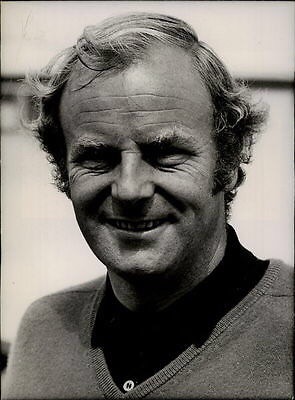
Ronnie Shade in 1973 (Photo: Fionnbar Callanan)

In 2005 in a Sunday Herald article by Golf Correspondent Nick Rodger Ronnie Shade was ranked 17th in a list of the Greatest Scottish Golfers.

After a long battle with cancer Ronnie Shade sadly died on 10th September 1986, just over 30 years ago, aged only 47. By this time he had been reinstated as an amateur golfer.

I have now written three profiles of Scottish golfers, Barclay Howard and Freddie Tait being the other two, and all of them have died well before their time.

His failure to lift The Amateur Championship leaves him just short of the greats of the GB&I amateur game in my eyes but his record remains one of the best and as such he deserves to be recognised and remembered.

ME.

Copyright © 2014-2025, Mark Eley. All rights reserved.
‘The Doctor’ – Dr. William Tweddell

21st March 2016

On Friday 20th June 1930 Bobby Jones shot rounds of 74 and 75 at Hoylake to win The Open Championship and secure the second leg of his famous Grand Slam. Despite being only 28 he must have been exhausted. 36-holes on the final day and the mental exertions of winning as the favourite would have taken their toll on anyone. Nevertheless the following day he left the Adelphi Hotel in Liverpool and drove himself 120 miles south to Blackwell Golf Club in Worcestershire.

Dr. William (‘Bill’) Tweddell was the reason why.

Tweddell was born on 21st March 1897 in the prosperous town of Whickham in County Durham, a few miles west of Newcastle under Tyne. He started playing golf when he was 7, his family having moved to Leyburn in North Yorkshire. Tweddell developed an upright back swing with arched wrists which was far from elegant but that enabled him to score. He was also said to be a slow player but one who had good concentration and a sound temperament, which meant that on his day he could be a match for anyone.

After school he joined the Army, serving with the Durham Light Infrantry in World War I. He became a Lieutenant and won the Military Cross and Bar at Passchendaele in 1917.

Once demobbed he went on to study Medicine at Aberdeen University. He played golf for the University in 1922, ’23 and ’24, often at Murcar Links and Royal Aberdeen. Dr. Tweddell later became the first President of the Scottish Universities Golfing Society, which was established in October 1906.

Having qualified he moved to a Manchester G.P. practice before quickly changing course and settling in The Black Country. He served the communities of Wordsley and Kingswinford (interestingly, at least for me, the place I was born and brought up) for the rest of his working life, living happily in the area. A Roman Catholic Tweddell married Dorothy Hillman at the Oratory Church in Birmingham on 2nd May 1930. They left the church through an arch of golf clubs held by guests.

The couple had three children William (like his father known as Bill), Mary-Ann and Michael. Bill also qualified as a Doctor and practiced in Wordsley and Kingswinford too. He was also Wolverhampton Wanderers F.C. Club Doctor between 1981 and 1994. Dr. Tweddell Jnr. died on 8th December 2015 aged 84. His daughter is the mother of Ben Robinson, the Worcestershire golfer currently studying at Louisiana Tech on a golf scholarship [Ben turned Pro in June 2016]. Michael’s son Matt Tweddell graduated from Hawaii Pacific University in 2014 and now plays golf professionally, mostly in Asia.

Dr. Tweddell joined Stourbridge Golf Club in late 1926 on his arrival in the area. Established in 1892 and located in Pedmore it was his most convenient option at the time. He continued to play well into his 70s, where his sons eventually joined him, and occasionally still posted scores below his age. He was Club Captain in 1928 and President between 1955-7.

Clearly Tweddell’s new working and golfing life in the West Midlands suited him as in 1927 he earned his greatest golfing achievement. He won The Amateur Championship at Hoylake, beating home player D. Eustace Landale 7&6 in the Final.

He played in 24 of the 29 Amateur Championships held between 1921 and 1955 (World War II). He played 77 matches in total, winning 54 and losing 23.  His win percentage of 70.13% is the 9th best for players who competed in at least 20 Amateurs. However his studies, his career and his family were important to him and he seems to have always viewed golf as just a sport to be enjoyed. His relaxed approach and friendly personality made him popular amongst his peers. He had a few good runs and over such an extended period met and competed against many of the great players from the first half of the 20th Century.

He had one other very real opportunity to win The Amateur. In 1935 he lost at Royal Lytham & St. Annes, the first time this course had hosted the Championship, to the defending champion and reigning US Amateur champion W. Lawson Little.

Herbert Warren Wind writing in ‘The Story of American Golf’ about the Final said about Tweddell: “He was a consistent low 70s shooter although, at first glance, he looked like a golfer who would have his work cut out to break 85. His arm action was stiff, and on his irons especially he aimed far to the right of his target and allowed for lots of draw. In 1935 he was playing hardly any tournament golf and might not have entered the Amateur had the week of the Championship not coincided with the vacation the doctor’s doctor had ordered him to take. Tweddell lost to Little but it is difficult not to think of him as the hero of their exciting match.”

Little, according to Warren Wind “was odds on favourite to take the final….by 7 and 6, 8 and 7 or some similarly secure margin” but ended up only winning the 36-hole Final by 1-hole.

WT and Lawson Little Amateur 1935

Tweddell with Little at the 1935 Amateur Championship (Photo: Historic Images)

Tweddell played in The Open Championship just once although it was a good one to view first hand – 1927 at St. Andrews with Bobby Jones the winner. He probably felt some obligation as Amateur champion as he appears to have made no effort to do so before or after. Jones won with a 285 total whilst The Doctor was well down the field on 306. He later admitted “I really am unable to play my game, or what I call my game, when I know that Bobby Jones is playing on the same course. Since I watched him at St. Andrews winning the British Open, I have had an inferiority complex.”

Tweddell was selected for England’s match against Scotland in 1928 (won), 1929 (halved) and 1930 (won). He also played in the Home Internationals in 1935, which only started in 1932 (England, Ireland and Scotland tied).

Dr. Tweddell’s second most noteworthy contribution to golf lies in The Walker Cup, although it can hardly be described as successful. He was playing captain of Great Britain & Ireland in both 1928 and 1936, albeit he chose not to play himself in the latter match. In 1928 at Chicago G.C. Tweddell paired himself with T. Phil Perkins in the Foursomes, another West Midlander and the reigning Amateur champion. They lost 7&6 in their 36-hole match with George Von Elm and Jesse Sweetser. In the Singles Tweddell lost again to Von Elm, this time 3&2. Perkins lost 13&12 to US Captain Bobby Jones – the 26 year old setting the event’s record defeat. At the end of play the 1928 match was lost 11-1.

The 1936 Walker Cup match was played at the relatively new and extremely difficult Pine Valley in New Jersey – an inexperienced GB&I team lost 9-0 to USA despite arriving early and practicing on site for 8 days beforehand. Three matches were halved but back then points were only allocated for victories. The record books therefore show the 1936 match as the only whitewash in the history of the competition.

Despite playing in a golfing era closely depicted by cigarette cards he featured only sparingly presumably reflecting his modest playing schedule and relative low profile.

In 1956 Dr. Tweddell captained a British Seniors team in a match against America and Canada played in Bermuda.

His contribution and standing in the game was rewarded when in 1961-62 Dr. Tweddell, by then 64, was elected Captain of The Royal and Ancient Golf Club of St Andrew’s.

So back to the match at Blackwell. The story goes that Tweddell invited his opposing Walker Cup captain Bobby Jones to play an exhibition match in the Midlands over dinner in 1928. When the date in 1930 had been agreed Tweddell made arrangements for the match to take place at Blackwell G.C., a local club he had been made an honorary member of following his Amateur victory 3 years earlier. Blackwell was (and still is) a much sterner test than Stourbridge, located 5 miles to the north so this decision was entirely understandable, albeit I can imagine it didn’t go down well at his home Club. Tweddell was no fool and paired himself with Jones. They took on two leading local golfers, Stanley Lunt from Moseley and Eric Fiddian, another Stourbridge amateur. Lunt went on to win the English Amateur in 1934 whilst Fiddian was the 1927 British Boys champion and went on to play in the Walker Cup’s of 1932 and ’34. Jones, perhaps not surprisingly arrived two hours late given the exertions of the day before and the lengthy drive – sadly for him the M6 and M5 were still to be built. A photo was taken (see below) before the match quickly got underway. It was a relaxed affair with Jones and Tweddell eventually running out 3&2 winners. Jones enjoyed the course and particularly the par 3 13th hole that it is said he later used as a blueprint for the famous 12th at Augusta.

Blackwell Match 1930

Tweddell, Jones, Lunt and Fiddian at Blackwell G.C. (Photo: Blackwell G.C.)

Dr. William Tweddell was an amateur golfer in the truest historical sense. He died on 5th November 1985 but there seems to have been little celebration of his life in the golfing world at the time. That’s a shame as his victory in the 1927 Amateur Championship and role in the formative years of The Walker Cup certainly place him above the rank and file. What I particularly like about him, and you can see for yourself, is that in all the old photos I can find he seems to have a broad smile on his face. It seems obvious looking at these as to why he was such a popular character.

At the end of the day any friend of Bobby Jones is a friend of mine.

ME.

Copyright © 2014-2025, Mark Eley. All rights reserved.
Lieutenant F. G. Tait

10th January 2016

Lieutenant F.G. (Frederick Guthrie) Tait was a leading golfer at the end of the 19th Century. A hugely charismatic man he starred alongside Johnny Ball, Harold Hilton, Harry Vardon and J.H. Taylor. At a time when amateurs and pros played together a lot their combined popularity helped to grow the game in Great Britain and Ireland.

So why haven’t most people heard of him ? Well sadly he only played competitive golf for 9 years before he was tragically killed aged 30 serving his country in the Second Boer War. Despite this his happy demeanour, good sportsmanship and attacking, winning play made him a national hero and left a golfing legacy that endures to this day.

img_3561

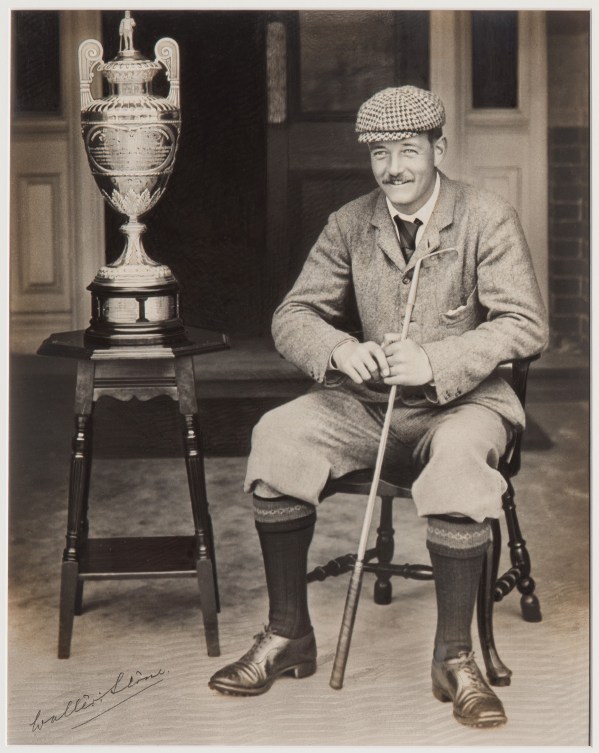
Freddie Tait with The Amateur Championship Trophy in 1898

So let’s take a look at the life of this important historical figure: –

1. Freddie Tait was born just under 150 years ago in Edinburgh, Scotland on 11th January 1870.

2. His father, Peter, was an Edinburgh University professor and fanatical golfer. As such the family spent most of their summer holidays in nearby St. Andrews. He started playing golf aged 5 and along with his three brothers learned to play the game on the Old Course. The family would often play up to five rounds a day starting at 6.00am. Professor Tait, known as ‘The Governor’ by Freddie, undertook many of the earliest experiments on the physics of golf using his son to produce the ball striking data he required.

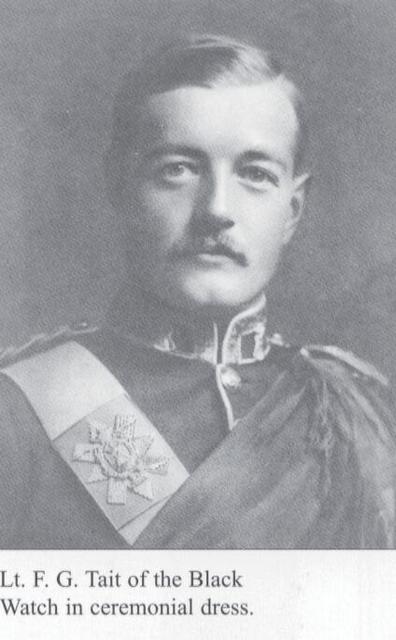
3. After completing his education at the Edinburgh Academy he joined the Royal Military College at Sandhurst – where it is said he introduced golf – and became an infantry soldier, eventually serving with the 2nd Battalion of The Black Watch (Royal Highlanders). He clearly had some flexibility with his employment and when he was not guarding Queen Victoria during her Balmoral stays he appears to have been able to play golf at will, be it friendlies, competitive matches or tournaments.

Freddie Tait Black Watch

4. He became a member of the Royal & Ancient G.C. of St. Andrews in early 1890 just after he had turned 20. Thereafter he repeatedly set new Old Course scoring records. A 77 in 1890, a 72 in 1894 and then in 1897 a remarkable 69.  From an early age he kept detailed records of all his matches, detailing his scores and play as well as the course conditions and his opponent’s play.

5. He was a 6 foot tall powerful man and one of the longest hitters of his era. He became famous nationwide when on 11th January 1893 he produced a record breaking drive of 341 yards on the 13th hole of the Old Course. His gutta-percha ball flew 250 yards and ran a further 91 yards on the frozen fairway.  This more than exceeded his Father’s “scientifically proven” maximum drive distance.

6. In total he won 28 tournaments between 1893 and 1899, many of them on the Old Course in Royal & Ancient Golf Club competitions. He also won three St. George’s Challenge Cups at Royal St. George’s. In his final 1899 season he won the Prestwick Silver Medal, the St. George’s, the three major Medals at the Royal & Ancient, the Calcutta Cup and was runner-up in the Amateur. In July 1899 he shot a new course record 63 at the old Archerfield Links. This was clearly a man at the top of his game come the turn of the century.

7. His greatest golfing achievements were his two Amateur Championship victories. Having reached the semi-finals in 1893, 1894 and 1895 his first victory came in 1896 when he beat Harold Hilton 8&7 in the final at Royal St. George’s. This was the first year the final was played over 36 holes and Tait went into the Championship as favourite having won the stroke play St. George’s Challenge Cup played immediately before it. Nevertheless his first win was hard fought; the draw seeing him have to beat John Laidlay, John Ball and Horace Hutchinson, all previous multiple Amateur champions, before facing Hilton.

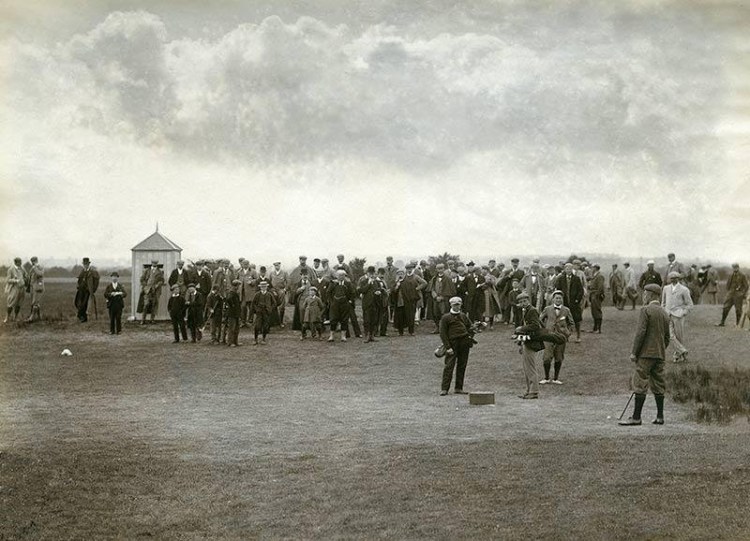
Freddie Tait & Harold Hilton

Freddie Tait tees off against Harold Hilton in The Amateur Championship of 1896

In 1898 Tait beat S. Mure Ferguson 7&5 at Hoylake.  In the fourth round Tait found himself up against local favourite Harold Hilton. The ‘match of the week’ turned into an anti-climax with Tait easily winning 6&5. In the next round he played another Hoylake member, Jack Graham, whose family he happened to be staying with. Tait was fortunate to win by 1 hole, Graham missing two late putts, one of which Hilton kindly described as “about the shortest I have ever seen missed in a Championship”. He was equally lucky in the semi-final where his mixed play saw him taken to the 20th hole.  Despite a comfortable win in the final he endeared himself to the locals with his humble victory speech: “Thank you for the way in which you have received my fluky win. I ought to have been beaten twice yesterday, but I got off. I played better today but I really don’t deserve the Championship”.

Tait’s record in the Amateur is the second best of those who have played 30 or more matches, beaten only by American Frank Stranahan. Between 1892 and 1899 he played in 8 Amateurs competing in 36 matches. He won 30 and lost 6 giving him a win percentage of 83.3% (Stranahan’s being 86%).

8. In what Bernard Darwin later described as “the greatest, most prostratingly exciting” match he ever saw Freddie Tait lost the final of the 1899 Amateur Championship, his last of course, to Johnny Ball. Played at Prestwick G.C. Tait again beat Hilton, this time by 1 hole in the quarter finals, on the way to the final. It was the final everyone wanted – Scotland versus England with the two most popular and respected figures in amateur golf going head to head. Tait led by 3 holes after the morning 18, albeit he had been 5 Up after 14.  Ball was level by the 6th in the afternoon and went 1 Up with just two holes to play.  On the 17th, the ‘Alps Hole’, Tait failed to carry the sandhills and ended up in the large cross bunker short of the green.  Due to heavy rain the bunker was full of water (see below). However, Tait managed to get the floating gutta-percha ball out of the water and half the hole; Ball having been just short of the green in two himself.  Tait then won the 18th to take the final to extra holes. Sadly for Tait Ball holed out for birdie on the 1st from seven feet whilst he missed from a similar distance.

9. He competed in eight Open Championships between 1891 and 1899. He missed the 1893 Open at Prestwick. He was the leading amateur six times with his best finish being third, which he achieved in both 1896 and 1897.

10. In 1898 he made a legendary bet that he could play from Royal St. George’s G.C. in Sandwich, Kent to the neighbouring Royal Cinque Ports G.C. 3.2 miles (5,652 yards) away in less than 40 teed strokes with the same ball. The two courses do not abut so some rough scrubland between the two also had to be overcome. It was agreed that when his ball struck the Cinque Ports clubhouse the cross-country shot count would end. With a gallery, some ball spotters and his dog ‘Nails’ helping him Tait achieved the feat in just 32 shots. Unfortunately his final shot went through a clubhouse window and as a result much of his winnings were paid over in compensation to the Club. Unusually he chose not to record the challenge in his diary but it was recorded for posterity in the R&A’s Golfer’s Handbook for many years.

11. Tait was well known for celebrating his golfing victories by playing his bagpipes loudly and marching up and down clubhouses and town centres across the country.  It was his friendliness and mischievous nature that the people of Scotland came to love.

12. His last competitive golf match took place at Royal Lytham & St. Anne’s G.C. on 2nd October 1899. It was a 36-hole re-match against Johnny Ball, a member of Lytham. With 5 holes to play Ball was 3-Up but Tait fought back and finally won on the 18th. Just three weeks later his life would be turned on it’s head and he would off to war.

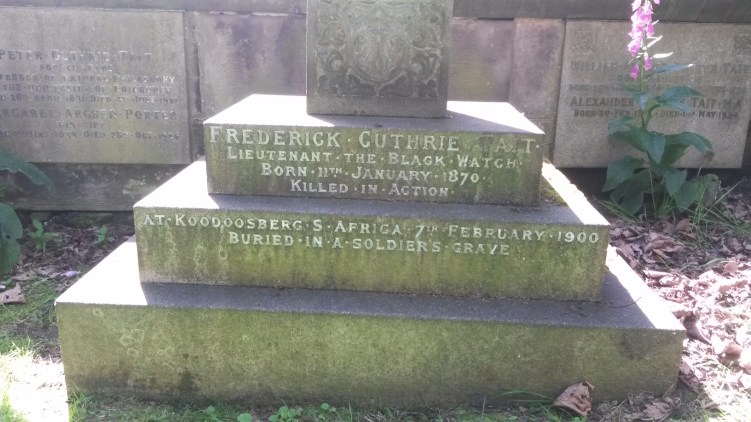
13. In October 1899 the Second Boer war broke out and on the 22nd, as a Lieutenant in the Black Watch, Tait travelled to Cape Town in South Africa to fight.  He was shot in the thigh of his left leg at the Battle of Magersfontein on 11th December. After recovering he returned to the front line in January to lead his platoon in the Battle of Koodoosburg Drift near Kimberley.  On 7th February 1900 he was shot dead leading a charge.

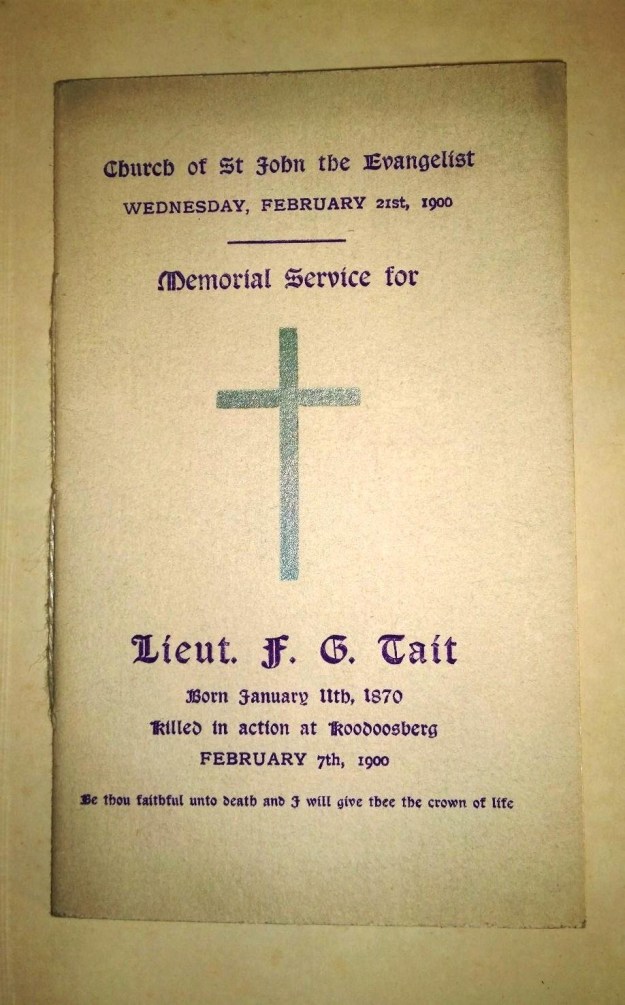
14. He and his fallen colleagues were ‘buried in a soldiers grave’ on the banks of the Riet River. In 1963 he was re-interred in the West End Cemetery in Kimberley by the War Graves Board. A plain marble cross simply records his name, and dates of birth and death. A memorial service was held for Tait at the Church of St. John The Evangelist on Princes Street, Edinburgh on 21st February 1900.  There is also a commemorative headstone in the church’s graveyard.

Freddie Tait Memorial Service

Freddie Tait Memorial Service Programme

Freddie Tait Edinburgh Headstone

Freddie Tait Commemorative Headstone in the Church of St. John’s Episcopal Church in Edinburgh

15. There was a national outpouring of grief when the news of Tait’s death was received back home. Another amateur golfer of the day John L. Low was asked to put together a remembrance book. ‘F.G. Tait – A Record; Being his Life, Letters and Golfing Diary’ was published in 1900. With the full cooperation of Tait’s family and everyone who knew him it was the first golf biography ever written and without question one of the most comprehensive. All of the profits from the sale of the book were donated to the Black Watch Widows’ and Orphans’ Fund.

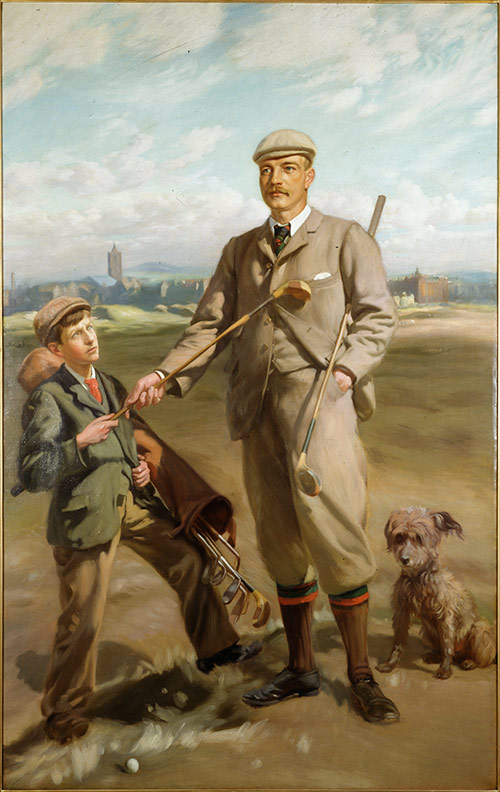
16. Given his status in the game and in particular at St. Andrews his fellow Royal & Ancient G.C. members commissioned John Henry Larimer, the famous Scottish artist, to paint his portrait in 1901. It still hangs in the R&A clubhouse to this day.  The 16th hole of the Jubilee Course at St. Andrews is also named ‘Freddie Tait’ after him.

Freddie Tait R&A Portrait

Freddie Tait with his terrier dog ‘Nails’ and a Boy Caddie (Photo: R&A)

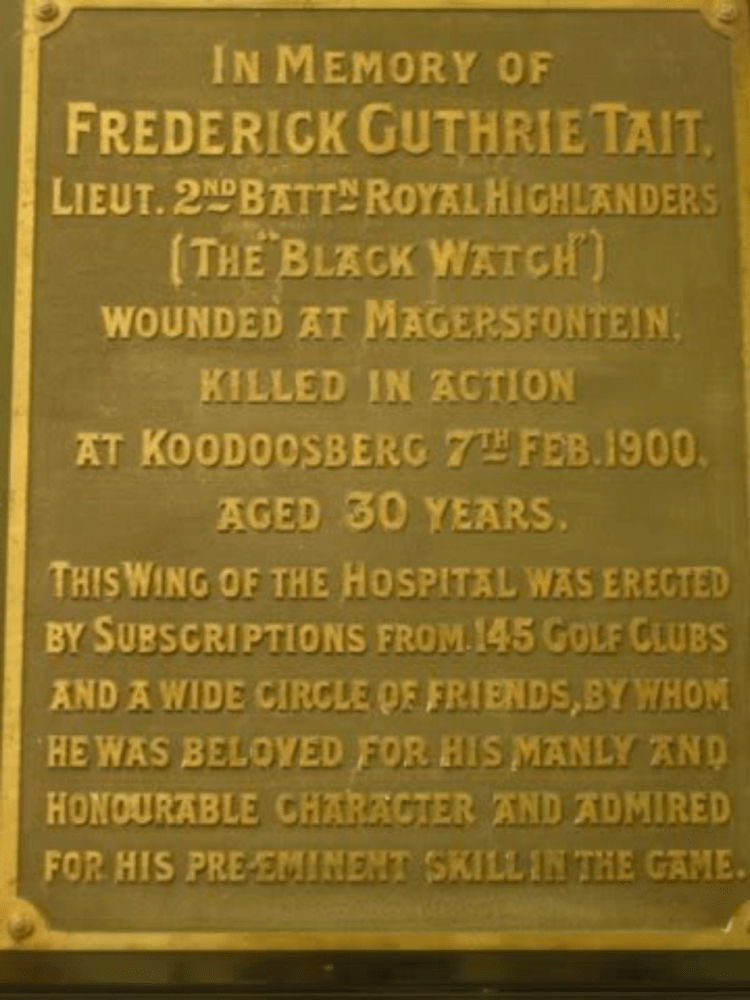
17. The St. Andrews Memorial Hospital in Abbey Walk, opened in 1902 and closed in 2009, was largely funded by monies raised in memory of Freddie Tait.

Freddie Tait Hospital Plaque

The St. Andrews Memorial Hospital Freddie Tait Wing Plaque

18. Tait was a founding member in 1894 of Luffness New G.C. in East Lothian. For many years his family allowed Luffness to display most of Freddie’s medals and other memorabilia in their clubhouse. The family tried to sell 36 of his medals in May 2009 but with an estimate of £120-180,000 they failed to sell at Convery Auctions. The National Library of Scotland acquired six Tait letters for £10,000 in the same auction. The medals were returned to their Luffness cabinet and remain there. The Club has an annual Freddie Tait foursomes stableford competition to start their season. The winners are allowed to wear some of the medals during a prize giving lunch afterwards.

19. In 1936 Lieutenant Tait’s putter was presented to the Kimberley Golf Club by J.H. Taylor who was touring with a group of UK professionals. Tait’s will had asked for his putter to be given to the club closest to the site of his death. Since 1937 the club has held an annual Freddie Tait Putter competition. In 1990, on the 90th anniversary of his death, The FG Tait Golf Museum was opened and then on the centenary in 2000 a Freddie Tait Golf Week was instigated.

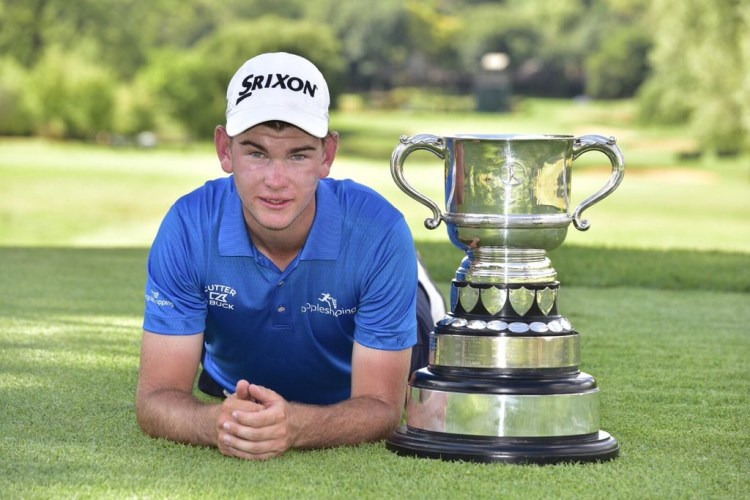
20. In 1928 The Freddie Tait Cup was donated to the South African Golf Association by a touring British Amateur team who found themselves with surplus funds. From 1929 it has been awarded to the leading amateur at the South African Open, subject to them making the cut. South African greats Bobby Locke, Denis Hutchison, Dale Hayes, Ernie Els and Trevor Immelmann have all won it in the past.

Freddie Tait Cameron Moralee 2016

Cameron Moralee with The Freddie Tait Cup in 2016 (Photo: Sunshine Tour)

Freddie Tait was a genuine national hero and a household name. Bernard Darwin, reflecting in 1933 said “I do not think I have ever seen any other golfer so adored by the crowd – no, not Harry Vardon or Bobby Jones in their primes.” He was clearly a superb golfer and a fans favourite. One can only wonder at what he may have achieved in the game if his life hadn’t been so cruelly ended by a shot through the heart when he was just 30 years old.

ME.

Copyright © 2014-2025, Mark Eley. All rights reserved.
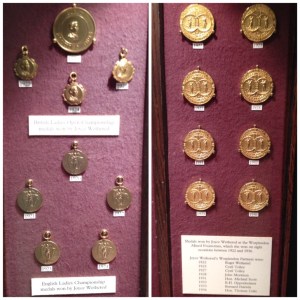
Roger Wethered

3rd January 2016

English amateur golfer Roger H. Wethered was born in Surrey on 3 January 1899. He was probably Britain’s best golfer in the 1920’s and was a leading figure in an important period in the development of the sport across the world.

He was the only son of Herbert Newton Wethered and Marion Emmeline Lund.  H. Newton Wethered, a low handicap golfer, wrote a number of famous golf books including ‘The Architectural Side of Golf’ (1929, with Tom Simpson) and ‘The Perfect Golfer’ (1933).

Roger was also the elder brother of Joyce Wethered (Lady Heathcoat-Amory following her marriage), who was born on 17th November 1901.  Joyce was the finest female golfer of the 1920s and 1930s and one of the greatest of all time. 

The family benefited from inherited wealth up until the Wall Street Crash in 1929 and clearly enjoyed a very comfortable lifestyle.  Both Roger and Joyce were home tutored and enjoyed what can only be described as a flexible education.

Roger quickly got the golf bug from his father.  He joined West Surrey Golf Club as a boy and the family played golf on holiday at Bude in Cornwall and Royal Dornoch in the Scottish Highlands.  He recorded all of his rounds and strove for improvement from an early age.  It is said that after a game Roger would often resort to the library to try and answer and understand a technical problem he had encountered.  In later years, typically for an old school amateur, it was said that he often preferred to theorise rather than practice his golf.

In early 1917 Roger followed his father to Oxford University where he enrolled at Christ Church College to read English.  World War I intervened in his studies and he served as a Second Lieutenant in France and Belgium.  He finally completed his studies in 1921, albeit only formally received his BA when he finally attended a degree ceremony in 1963.

In an era when the amateur game was at the forefront of golf and the sport was the preserve of the wealthy Roger unsurprisingly found himself mixing amongst the best young players at Oxford.  Wethered found himself spurred on by such competition, which included Cyril Tolley, and both of them soon became two of Britain’s leading players.  Wethered was a tall, powerful man whose strength was his mid-iron play and short game.

Roger Wethered, representing West Surrey Golf Club, entered his first Amateur Championship at Muirfield in 1920.  It was the first one since 1914 due to The Great War.  Save for 1935 he played in The Amateur every year up until 1936 (which he presumably couldn’t resist as it was played at St. Andrews) when he stopped competing.  Between 1921 and 1929 inclusive all of his entries were attributed to Worplesdon Golf Club, the club he and his sister were both associated for most of their golfing lives.  After 1930 he represented the Royal & Ancient Golf Club when playing in The Amateur.

In 1921 Roger Wethered, perhaps having recently become a member at 22 repesenting The Royal & Ancient Golf Club (R&A), played in his first Open Championship at St. Andrews.  Despite incurring a penalty shot for standing on his ball in the third round Wethered and Jock Hutchinson, a Scottish-born American, ended up tied on 296 after 72-holes.  Roger had committed to play in a cricket match the following day in London and therefore found himself compromised with regard to the 36-hole play-off.  It is said that R&A officials had to work hard to persuade him to compete in the play-off.  In the end Hutchinson won the play-off easily by 9-shots, his rounds of 74 and 76 (150) beating Wethered’s 77 and 82 (159).  Had Wethered won The Open in 1921 he would have been the last British amateur to do so. As it is Harold Hilton, who won the Championship in 1897, remains the last man to do so.

Perhaps highlighting the standing of The Open in the 1920’s Wethered only played in three more Championships during his career, finishing tied 32nd in 1922 (Royal St. George’s) and missing the cut in both 1924 (Hoylake) and 1928 (Royal St. George’s).

Roger Wethered’s greatest moment came in 1923 when he won the Amateur Championship at Deal, Kent.  Wethered beat Francis Ouimet, who had taken care of Cyril Tolley in the quarters, in the Semi-Final before beating Robert Harris in the Final 7&6.  Harris had no complaints: “I couldn’t have beaten him.  He was too powerful from the tee and too good on the putting green.”  With his driver behaving better than normal this was most likely the best he ever played.

He also reached the final of the Amateur in 1928 at Prestwick and in 1930 at St. Andrews.  In 1928 he lost 6&4 to T. Philip Perkins of Castle Bromwich GC.  In 1930 – with both having just captained their respective Walker Cup teams – he lost 7&6 to Bobby Jones who thus completed the first leg of his famous ‘Impregnable Quadrilateral’ (Grand Slam).   Roger also reached the semi-finals in 1924 at St. Andrews (where he lost to Edward Storey of Cambridge University by 2 holes) and 1927 at Hoylake (where he lost to the champion Dr. William Tweddell of Stourbridge GC by 4&3) and the quarter-finals in 1922.

British Pathé Highlights Of The 1930 Amateur Championship – Bobby Jones v. Roger Wethered

His overall Amateur record is amongst the best in the Championship’s history.  Ranked 9th Roger competed in 16 Amateurs playing 71 matches – he won 56 and lost 15, giving him a win percentage of 79%.  Looking only at golfers who have played at least this number of matches his record is only really surpassed by John Ball, Joe Carr and Sir Michael Bonallack, all amateur greats.

The Walker Cup was first played in 1922 and Wethered was a key figure in it’s formative years.  He played in 1922, 1923, 1926, 1930 and 1934.  At a time when the trip had to be self-financed and Roger would also have had work commitments (see below) I assume he excused himself from the 1924, 1928 and 1932 away matches.  He would have surely played if he had made himself available.  At a time when the USA dominated the match Wethered enjoyed an impressive record, playing 9 36-hole matches, winning 5, losing 3 and halving 1.  Two of his losses came against Bobby Jones in singles.  Looking at each match in turn: –

August 1922 – National Golf Links of America – USA 8 beat GB&I 4
Wethered played with Colin Aylmer in the Day 1 foursomes and they beat Charles Evans Jr and Robert A. Gardner by 5&4. In the Day 2 singles Wethered was paired with Bobby Jones and lost 3&2.

May 1923 – St. Andrews – GB&I 5 lost to USA 6
Wethered and Cyril Tolley lost to Francis Ouimet and Jesse Sweetser 6&5 in the Day 1 foursomes before he halved with Ouimet in the Day 2 singles.

June 1926 – St. Andrews – USA 9 beat GB&I 3
Wethered paired with Ernest Holderness to beat Ouimet and Jesse Guilford 5&4 in the Day 1 foursomes and then beat Ouimet again in the singles 5&4.

May 1930 – Royal St. George’s – GB&I 2 lost to USA 10
When Wethered, GB&I’s captain, was asked prior to the match why compatriot John Beck was not playing he supposedly replied “We thought of John but no one seemed to have his address.” suggesting a more relaxed selection environment than currently exists.  Wethered paired himself with Tolley again this time winning their foursome match against George Von Elm and George Voight by 2 holes.  In the singles Wethered was drawn against Bobby Jones, the USA captain.  Jones won the match by 9&8.

May 1934 – St. Andrews – GB&I 2 lost to USA 9
Wethered’s selection for his final Walker Cup match was controversial. Bernard Darwin writing on the matter in 1944 said “It seemed to me – and I was a selector – that so fine a golfer with so fine a record must be played since he loved St. Andrews, would have plenty of room and had a gift of rising to the occasion.  Others, not selectors, thought otherwise and I suppose they were right…”   Wethered only played in the Day 1 foursomes before standing himself down for the singles.  Paired with Tolley again Wethered drove awfully and they easily lost 8&6 to John Goodman and W. Lawson Little.

Following the 1930 Walker Cup match and before the Amateur Championship started at St. Andrews a four ball that has gone down in golfing lore took place at the Old Course.  Roger Wethered paired with another leading amateur T.A. Bourn took on Bobby Jones and his sister Joyce Wethered.  Playing off the same tees the greatest male and female golfers of the day famously won.  With the game won Joyce three putted the last two greens to finish one shot higher than her playing partner.

In his playing career Roger won many other important amateur events and represented his country throughout the 1920s.  Wins included the Royal St. George’s Cup (1924), the Golf Illustrated Gold Vase (1927) and the (Oxford and Cambridge Golfing Society’s) President’s Putter five times (1926T, 1927, 1928, 1935 and 1936).  He played for GB&I in the 1921 match against the United States at Hoylake, the precursor to the Walker Cup.  He was also capped by England in nine successive years in their annual match against Scotland (1922-30).  Roger also won the Worplesdon Mixed Foursomes in 1922 (with Joyce Wethered) and 1926 (with French champion Simone Thion de la Chaume).

In 1923 Roger briefly moved into politics taking up an unsalaried position as secretary to the Hon. F.S. Jackson who was the financial  secretary to the War Office.  Jackson was a former England cricket captain and a scratch golfer.

Roger married Elizabeth Cavendish-Bentinck at St. Margaret’s Church in Westminster on 29th April 1925.  Elizabeth’s mother’s family owned the City stockbroking firm of Grenfell and Co.  Roger joined the business, after unsuccessful spells with two other city firms, and worked at Grenfell for 25 years until his retirement in 1951.  Roger and Elizabeth later divorced and Roger re-married; to a Marjorie Stratford (nee Mitford Stubbs).

In 1925 Roger joined up with his sister Joyce to write ‘Golf From Two Sides’.  Both were in their mid-20’s and still living at home with their parents at the time so this demonstrates their confidence and standing.  The book was dedicated to their mother: “In recollection of numerous games and much affectionate encouragement.”

Roger continued to be involved in golf in his later years, playing well into his 70s and administering the game.  It was reported in the papers that he shot a 74 when 74 at Royal Wimbledon Golf Club.  He held many honorary club memberships.  He was elected captain of The Royal and Ancient Golf Club of St Andrews in 1939 but due to the commencement of World War II only took up office in 1946.  He was also President of Woking Golf Club from 1961 until his death in 1983.

He died on 12th March 1983 at his home Garnet House, Wimbledon.

Roger is often remembered in the shadow of his more famous sister. However, upon further inspection of his life he was clearly an important figure in the history of the game and someone who clearly deserves to be remembered in his own right.

ME.

Copyright © 2014-2025, Mark Eley. All rights reserved.
Joyce Wethered

17th November 2015

Joyce Wethered (who following her marriage became Lady Heathcoat-Amory) was unquestionably one of the most successful woman golfers of her day and is still widely considered one of the best the world has ever seen.  On the anniversary of her birth, 114 years ago today, I thought I would take a look at her story.

She was born in Brook, in south-west Surrey on 17 November 1901.

Wethered, whose father was a good player with a handicap of six and whose mother also played, took up the game as youngster during family holidays at Bude, Cornwall and in Dornoch, Scotland, where the family had a house overlooking the course.  She simply drifted into the game because that’s what her family did.

She started to take a real interest in golf aged 9 and shot an 89 when aged 10.  She never went to school so perhaps her home tutoring afforded her some practice flexibility.  She joined her local club, West Surrey, which had only opened in 1910, when she turned 12.  She made good progress and was 17 when she was first selected for the Surrey Ladies team, by this time playing at Worplesdon with a handicap of 5.

Despite only having one formal lesson she developed her game and competitive instinct by copying and playing with her older brother, the 1923 British Amateur Champion and Walker Cup player Roger Wethered, and observing Fred Robson, West Surrey’s Pro. At 5ft 10” she had a graceful, well balanced powerful swing and often hit the ball well over 200 yards, out-driving many of the leading male players of the time. Wethered also had a great mental strength, which she described as a “cocoon of concentration”.

Joyce Wethered – 1930 Swing Analysis

The greatest players of her era certainly admired her play and respected her abilities. Bobby Jones said: “I have not played golf with anyone, man or woman, amateur or professional, who made me feel so utterly outclassed. It was not so much the score she made as the way she made it. It was impossible to expect that Miss Wethered would ever miss a shot-and she never did.” Walter Hagen said: “As I watched her I thought there wasn’t a male golfing star in the world who wouldn’t envy the strong, firm strokes she played. She hit her shots crisply, like a man expert.” Henry Cotton said: “In my time, no golfer has stood out so far ahead of his or her contemporaries as Lady Heathcoat-Amory. I do not think a golf ball has ever been hit, except perhaps by Harry Vardon, with such a straight flight by any other person.”

She won the English Women’s Championship on the five occasions she entered it, 1920, ’21, ’22, ’23 and ’24, a run of 33 straight wins in the competition. At the 1920 Championship at Sheringham, in Norfolk, she primarily went to accompany her friend Molly Griffiths. Aged 18 she ended up beating the favourite and holder Cecil Leitch in the Final; it was Leitch’s first loss in a non-handicap match in seven years. Despite at one point being 6-down she finally won on the 17th. As she holed the winning 9 foot putt a train sped past the green. When asked about this later she famously replied: “What train?”.

At the time ladies golf was largely social and elite competitions were strictly amateur and few and far between.  Joyce only really played in the Surrey Ladies’ Championship beyond the two Majors noted above.  She won the inaugural Surrey event in 1921 and went onto win it a further four times, in 1922, ’24, ’29 and ’32.  A rare trip to France in 1921 saw her lose the final of their Ladies’ Open Championship 6 & 5 to Cecil Leitch.

Wethered also won the British Ladies’ Amateur Championship in 1922, ’24, ’25 and ’29. She lost the 1921 final to Cecil Leith 4 & 3 and fell at the semi-final stage in 1923. Her most satisfying victory came in 1929 when she came out of retirement to play at St. Andrews against America’s finest player Glenna Collett. Wethered had beaten Collett in the 1925 Championship 4 & 3 in an 18 hole match and it was almost inevitable that the two of them would reach the 1929 36 hole Final. Wethered fell behind early on – she was 5 down afer 11 holes – before rallying to win on the 35th hole, 3&1, in front of a crowd estimated at around 3,000.

British Pathé News Report Of The 1929 Ladies’ Championship Final

As noted above after winning the 1925 British Amateur she had retired aged 23. Faced with dismay from her growing army of supporters she said at the time: ”I have simply exercised a woman’s prerogative of doing something without the slightest regard for what anybody thinks and because I want to please myself.”

Wethered was persuaded to be playing captain of the Great British Curtis Cup team in the inaugural 1932 match against United States at Wentworth. The US Team were much better prepared, with the GB Team only arriving in Surrey the evening before the match, and won the contest easily 5.5-3.5. For the third and final time Wethered was again paired against Glenna Collett in the singles. Wethered maintained her 100% record winning 6&4 in their 18 hole match.

Joyce Wethered is always linked to the Worplesdon Mixed Foursomes competition, played annually since 1921 at the club that she and her brother were attached to for most of their lives. She won the competition eight times in all with seven different male partners.  Her successful partners included Bernard Darwin, Cyril Tolley (2) and her brother, Roger.  After the Second World War she often played with her husband in the competition.

Just a few months after her British Amateur win The Wall Street Crash occurred in late 1929 and her family lost much of their wealth, built up through their ownership of several coal mines. As a result Wethered had little choice but to pitch in.  She ended up forfeiting her amateur status in 1933 by joining the golf department at the London department store, Fortnum and Mason. Later the same year she agreed a contract with Spalding to market a range of steel shafted golf clubs in her name.

In 1935 she wished to visit friends in America and to help fund the 3 month trip she agreed to play in a number of exhibition matches across North America – these were sponsored by the John Wanamaker Department Store in Philadelphia who also contracted Wethered for marketing purposes. Joyce competed in 52 mixed four ball events with the likes of Bobby Jones, Francis Ouimet, Gene Sarazen, Glenna Collett and Babe Didriksen. Her itinerary included games at Winged Foot, Merion, East Lake, Medinah, Pasatiempo and Pebble Beach. It was reported that she broke 34 women’s course records during these matches. It is also said she cleared $20,000 during the trip, helped in no small part by Fortnum’s agreeing to pay her full salary whilst she was away.

She wrote a number of golfing articles and two famous books, ‘Golf From Two Sides’ (with Roger, 1922) and ‘Golfing Memories and Methods’ (1933).  The latter a mixed instructional and guarded autobiography.

In 1937 she married a baronet, Sir John Heathcoat-Amory and left her parents in Surrey to move to the ancestral home, Knightshayes Court in Tiverton, Devon. They had no children. After World War II she was reinstated as an amateur golfer and continued to play with her husband regularly, often at Tiverton, a club Sir John was instrumental in founding in 1932.  He owned the farm land and agreed to let 120 acres for the formation of a golf club.

Joyce joined Tiverton in 1937 and succeeded Sir John as Club President in 1973, a position she held until her death in 1997. Tom Hanson, the Assistant Pro at Tiverton, has kindly shared some photos of the commemorative items that adorn the clubhouse.

Tiverton Golf Club (© Tom Hanson)

The couple had a shared interest in gardening and took great delight in developing the land around Knightshayes. By way of acknowledgement as to the quality of their work the Royal Horticultural Society awarded the Victoria Medal of Honour to both Sir John and Lady Heathcoat-Amory. When Sir John died in 1972 Knightshayes was handed over to the National Trust. Joyce made numerous donations to the National Trust to support the renovation of the property in the 1970s.

There remains a small museum, ‘The Golf Room’, at Knightshayes remembering the famous Lady of the house. The displays contain some superb golfing memorabilia and medals from her career. Sadly there is no putting green or pitch ‘n’ putt in the extensive grounds !

JW Medals

Joyce Wethered’s Golfing Medals (© GolfBible)

In The Associated Press’s 50-year poll in 1950, Wethered ranked seventh among all golfers and first among female golfers. The men ahead of her were Bobby Jones, Ben Hogan, Walter Hagen, Byron Nelson, Sam Snead and Gene Sarazen.  More recently, in 1975, her status in the history of the game was recognised when she was inducted into the World Golf Hall of Fame.

In 2004 Basil Ashton Tinkler wrote a well received and long overdue biography entitled ‘Joyce Wethered: The Great Lady of Golf’.

Joyce Wethered enjoyed a long life dying on 18 November 1997, just a day after her 96th birthday.

ME.

Copyright © 2014-2025, Mark Eley. All rights reserved.
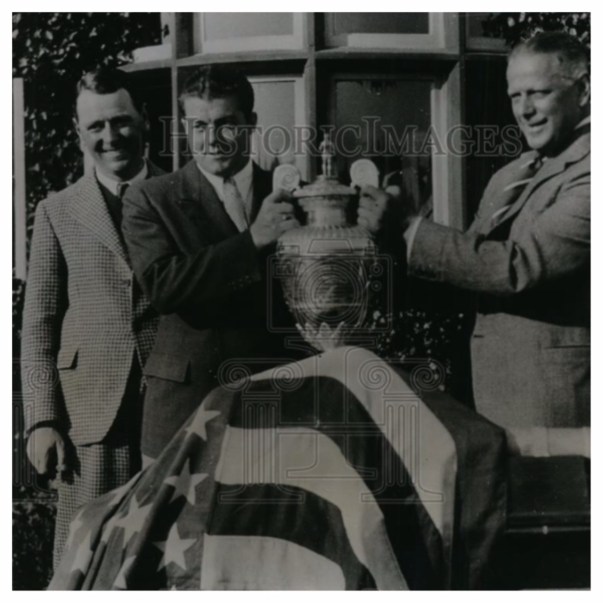
Peter McEvoy OBE

22nd March 2015 (Last Updated 7th April 2025)

Great Britain and Ireland (GB&I) has produced a number of distinguished amateur golfers in the post World War II period. Amongst a group that must include Sir Michael Bonallack, Joe Carr and Gary Wolstenholme comfortably sits Peter McEvoy OBE.

One of the most determined and competitive golfers to ever play the game Peter’s success was founded on long straight driving, well controlled approach shots (often played low) and impeccable putting. A technically sound golfer with an unflappable temperament will give most people a game – and McEvoy was certainly capable of that.

PM Walker Cup 2

Peter McEvoy holds The Walker Cup in 2001

Peter Aloysius McEvoy was born in London on 22nd March 1953. He died aged 72 on 6th April 2025 in Alloway, Ayrshire after battling cancer over recent years.

He was brought up in Renfrewshire, Scotland and swung a club for the first time here with his father, Daniel, a doctor, and a member of the local club, Gourock, near Greenock.

His family moved to the West Midlands when he was 10 and, aged 13, he joined Copt Heath G.C. near Solihull. He ultimately became an honorary member and despite moving from Tewkesbury to Ayrshire in 2018 was still seen regularly at the Club.

Peter quickly became proficient in the game and won the 1969 Warwickshire Boys Championship. He also won the British Universities Stroke Play in 1973 – he studied Law and qualified as a solicitor –  and was selected for England Youths in 1974.

Locally he also went on to win the Warwickshire Amateur Championship in 1974-76-77-80-84, the Warwickshire Matchplay Championship in 1973-75-81-83 and the Warwickshire Open Championship in 1973-74. Warwickshire were also County Champions in 1976 (held locally at Coventry GC) and 1977. Of course it was not in the Midlands that his legendary reputation was developed.

McEvoy gained national prominence when he won The Amateur Championship in both 1977 (Ganton) and 1978 (Royal Troon). Playing off a +2 handicap at the time he is the last player to successfully defend the title. Horace Hutchinson (1886-87), Harold Hilton (1900-01) Lawson Little (1934-35) and Sir Michael Bonallack (1968-69-70) are the only other players to achieve this feat. He reached the final again in 1987 at Prestwick – driven on by his non-selection for that year’s Walker Cup at Sunningdale when the team was announced in November 1986 and the matched played in late May – but lost to Welshman Paul Mayo.  In total he competed in 18 Amateur Championships playing 70 matches.  He won 54 and lost 16 of these giving him an impressive win rate of 77%.

He was a member of the Great Britain & Ireland (GB&I) Walker Cup team on five occasions – in 1977-79-81-85-89.  With business commitments impacting on the amount of golf he was able to play he missed out on the 1983 match.  McEvoy understood this decision but not his, and for that matter Garth McGimpsey’s, omission in 1987, just after they had both represented GB&I in the 4-man 1986 Eisenhower Trophy team. He would be the first to admit in later years that he was not unhappy to see the team lose 16.5 – 7.5. His first four Walker Cup matches were lost but the last one, at Peachtree, Atlanta, was won; the first time GB&I had won this historically one-sided contest on US soil. McEvoy contributed 2.5 points in that final game but his overall record was perhaps a little disappointing. He played 18 games in total, winning 5, losing 11 and halving 2. To date only Sir Michael Bonallack (25), Joe Carr (20) and Gary Wolstenholme (19) have played more Walker Cup games for GB&I.

He played in the St. Andrews Trophy for GB&I against the Continent of Europe in 1978-80-86-88. GB&I won on each occasion in what was then an event as one-sided as The Walker Cup.

Peter also played on five Eisenhower Trophy teams – in 1978-80-84-86-88. In 1988, aged 35, and a year after he hadn’t been selected for The Walker Cup he won the World Amateur Individual event and GB&I won the team event for the third time at Ullva, Sweden.

PM Eisenhower Trophy

The successful GB&I 1988 Eisenhower Trophy Team

His Amateur wins inevitably led to Major Championship invitations.  His strong play also enabled him to qualify for some Opens too.  After something of an apprenticeship in 1976 (Royal Birkdale) and 1977 (Turnberry, where he was paired with Jack Nicklaus and Gary Player) he achieved low amateur status at The Open Championship in both 1978 (St. Andrews, 39th) and 1979 (Royal Lytham St. Annes, T17th with Lee Trevino).  He also qualified for the 1984 Open at St. Andrews, making the cut for the third time but having to withdrawal due to ill health at the start of round 3.

McEvoy also played in three Masters. In 1978, paired with Tom Watson to start with, he became just the second GB&I amateur to make the cut at The Masters (after Joe Carr in 1967). He finished 53rd after rounds of 73, 75, 77 and 77, last of those that made the cut.  He perhaps surprisingly remains the last GB&I amateur to make the cut at The Masters. With the Augusta course becoming longer and tougher in recent years this GB&I record may well remain intact for a few more years to come. In his other two appearances he missed the cut; in 1979 paired with Jack Nicklaus he shot 79, 79 missing out by 13-shots and in 1980 paired with Sam Snead he scored 79, 76 missing out by 9-shots.

Despite not winning the English Amateur – he lost in the 1980 final to Peter Deeble – his name unsurprisingly adorns many of the other major amateur trophies. He won the: –

Duncan Putter – 1978 (winning by 13-strokes)-80-85-87
Scrutton Jug – 1978-80
Lytham Trophy – 1979
Selborne Salver 1979-80
Brabazon Trophy (English Open SP) – 1980 (tied with Ronan Rafferty),
Lagonda Trophy – 1980
West of England Open Amateur Strokeplay Championship – 1977-80-83-85
English County Champions’ Tournament – 1984 (tied with N Briggs)
Berkshire Trophy – 1985
Berkhamsted Trophy – 1986
Logan Trophy (English Open Mid-Amateur) – 1988
Hampshire Hog – 1989

Of course prior to the 1990s amateur golf was in a completely different place to where it is now. Golfers received no individual financial support from either their National Unions or the R&A.  Having to personally fund ones living and golfing expenses whilst maintaining a competitive game was clearly no mean achievement.

A Profile of Peter McEvoy (© Golfing World)

Peter McEvoy is England’s second most capped amateur golfer, competing in 153 matches between 1976 and 1992. Gary Wolstenholme achieved an astonishing 218 caps whilst Sir Michael Bonallack made 131 appearances for their shared country. He played in the Home Internationals of 1976-77-78-(79 not held)-80-81-83-84-85-86-87-88-89-91. England won in 1977-78-80-84-85-88-89. He went on to captain the team between 1994 and 1997, winning on each occasion. He holds the record for the highest win ratio (67.3%) of any British amateur golfer, playing 153 matches and winning 103 of them – he halved 16 and lost just 34 of the remaining ones. He amazingly lost just once in his first 30 singles matches.

He met his first wife Dorothy “Dee” Saunders at the 1978 Masters in Augusta and they married in the following December.  They divorced in 1993 having had two boys, Cameron and Richard. His waning powers, the fact many of his original peers had moved on and the inevitable stress of the break-up led to Peter stepping back from top-level amateur competition in 1992.  He met Helen Wilkinson, a recent divorcee herself with a daughter, Mary, shortly afterwards and they eventually re-married in 1995. They had a son Douglas.

Following his Amateur Championship victories his club, Copt Heath, invited Peter to suggest a way in which they could commemorate his achievements. He suggested a 72 hole competition – to be played over two days –  for Under 18 junior boy golfers, to be held annually at Copt Heath. Starting in 1981, The Peter McEvoy Trophy, has become the traditional curtain raiser to the boy’s golf season and is now viewed as one of the “must enter” junior major competitions. Past winners include Peter Baker (1983), Lee Westwood (1991), Brian Davis (1992), Steve Webster (1993) and Justin Rose (1998). The 44th Peter McEvoy Trophy will take place on 24th – 25th April 2025 with all of this year’s contestants having a scratch or better handicap.

PM McEvoy Trophy

Haydn McCullen, 2014 Champion, receives The Peter McEvoy Trophy

Peter subsequently enjoyed huge success as a Team Captain, leading GB&I to famous Walker Cup wins at Nairn (1999) and Sea Island, Georgia (2001). Both victories came by a score of 15-9 and were the first time GB&I had recorded consecutive wins in the event. He famously engaged Saatchi & Saatchi to produce a video ahead of the 1999 match to motivate his team and in 2001 handed out each player’s sweater in the team room, re-enforcing each member’s playing record in front of them all. He also captained GB&I to victory in the 1998 Eisenhower Trophy in Santiago, Chile. He is the only person to win the individual event as a player, the team event as a player, and the team event as a captain. He also captained again in 2000, and GB&I finished in second place. In 2002, when the home nations started to compete individually he captained the first England team.

In 2002, McEvoy was named Chairman of the R&A Selection Committee, responsible for the selection of the GB&I teams competing in various international events. Between 2008 and 2015 he was responsible for the GB&I Boys Team and manager of the Jacques Léglise Trophy team. He enjoyed this role, in many respects viewing junior golf as the only true amateur game that remained.

He was appointed Captain of the Europe Team for the 2020 Bonallack Trophy men’s match against Asia-Pacific.

Whilst a message few young players wanted to here he rightly continued to caution against juniors committing all of their energies to golf too soon, saying in an interview in Golf International magazine – for which he wrote a column for many years – in 2010: “the majority of the young golfers who (turn Pro) have no chance of making any money. They get to their mid-20s only to discover they are just not good enough at golf, they have no education and they get lost to the game. It’s a vicious circle: they become disenchanted with it all, so their golf suffers, and they suffer as individuals as well”. His view, based on years of experience, is that few really appreciate the huge gulf that exists between the elite amateur game and the professional ranks. He added more recently: “There’s not much room in the pro game for youngsters coming through. You’ve got to be exceptional”. The fact anyone can turn Pro rather than being selected or passing some qualification level appeared to frustrate him as did the historically draconian rules applying to amateur status which he felt only encouraged players to make the move too early.

Peter McEvoy was also been involved with golf course design and re-modelling for over 30 years, with his own company, Sporting Concepts (originally a management agency), and in collaboration with others (such as Craig Cooke, Ricky Willison and Bruce Weller). Amongst a number of projects, many in Ireland, he originally designed Fota Island, which has hosted the Irish Open, and notably built a short hickory course, Kingarrock G.C., near St. Andrews, where appropriate clubs and balls are provided to players. He was recently involved with the acclaimed renovation of Druids Glen.

He was honoured by the The Association of Golf Writers on two occasions. In 1978 he won The Golf Writers’ Trophy, “awarded each year to the individual, born or resident in Europe, or the European team, who have made the most outstanding contribution to golf in the preceding 12 months”. In 2001 the same award was given to the victorious 2001 Walker Cup team which he captained. More recently in 2009 he received the prestigious Association of Golf Writers’ Award for his outstanding services to the game.

The English Golf Union (now England Golf) named Peter McEvoy the winner of their 1999 Gerald Micklem Award.  This honour is given to those who have “made an outstanding contribution to further the interests of amateur golf in England”.

Peter McEvoy was also named an Officer of the Order of the British Empire (OBE) in the 2003 Queen’s New Year’s Honours List, for “services to golf”.

In 2006 Peter McEvoy published his excellent and somewhat self deprecating autobiography ‘For Love or Money’ (HarperSport). The book was written with the assistance of Sunday Telegraph journalist Mark Reason and is well worth a read.  It was rumoured that the R&A questioned his amateur status following its publication but in the end nothing appeared to come of this.

PM For Love Or Money

‘For Love Or Money’ – Peter McEvoy

In February 2008, McEvoy helped devise and launch PowerPlay Golf alongside David Piggins, a shortened version of golf in a bid to create golf’s version of Twenty20 cricket. The format was simple: nine holes with two flags on each green, one hard (Black) and one easy (White) with a modified stableford scoring system. Each player had to take on three Black hole locations in their first 8-holes with an extra one available on the final hole. Despite appearing to tick all of the boxes in terms of fun and speed of play – matters which have taken on greater importance in recent years as golf participation in the UK has fallen – the format failed to take off and is now rarely heard of or seen.

In February 2024 McEvoy was included amongst a group of 12 golfers inducted into the new England Golf Hall of Fame.

Peter McEvoy clearly loved the game of golf and the amateur game in GB&I was fortunate to have him as a leading figure for many years. Golf was at the centre of his life for over 50 years and his contribution as an elite player, captain (perhaps the best golf captain, pro or amateur, ever), administrator, coach, course designer and journalist / writer is almost without parallel.

ME.

Copyright © 2014-2025, Mark Eley. All rights reserved.

Joe Carr

18th February 2015

On the anniversary of his birth I thought I should record the career of Ireland’s best ever amateur golfer, Joe Carr.

Here are 20 facts you should know about the great man: –

1) Joseph Benedict Carr was born on 18th February 1922 in Inchicore, near Dublin.

2) He was the fifth of seven children born to George and Margaret Waters.  When he was just 10 days old he was adopted by his maternal Aunt Kathleen and her husband James Carr.  The Carr’s had recently been appointed steward and stewardess of Portmarnock GC so Joe was brought up with practice facilities literally on his doorstep.

3) It was not possible for him to join Portmarnock given his parent’s positions so he joined nearby Sutton Golf Club.  Sutton was his golfing home for his entire career and he spent much of his life living in Suncroft House, overlooking the course’s 2nd green.  He was an aggressive, big hitter and quickly developed into a fearless competitor.  The Joe Carr Room at Sutton Golf Club today houses much of his memorabilia.

img_5730

Joe Carr Portrait at Sutton GC (Photo: John Hanna)

4) He won three British Amateur Championships in 1953, ’58 and ’60.  He was also runner-up to Michael Bonallack in 1968.  He competed in 26 Amateurs in total playing 119 matches.  He won 96 and lost 23 of these giving him a superb 81% win rate.  He was determined to win at St. Andrews in 1958 – “With all the practice shots I hit by way of preparation for St Andrews, I almost wore through the blades of my eight and nine irons,” he recalled.  He later estimated that he had hit 47,000 shots in preparation for that championship.

5) He was prolific in Irish amateur golf despite strong competition at the time, winning six Irish Amateur Close Championships (1954, ’57, ’63, ’64, ’65 and ’67), four Irish Amateur Open Championships (1946, ’50, ’54 and ’56), 12 West of Ireland Championships (1946, ’47, ’48, ’51, ’53, ’54, ’56, ’58, ’60, ’61, ’62 and ’66), 12 East of Ireland Championships (1941, ’43, ’45, ’46, ’48, ’56, ’57, ’58, ’60, ’61, ’64, and ’69) and three South of Ireland Championships (1948, ’66 and ’69).

6) He also won the Gleneagles Saxone (1955), Golf Illustrated Golf Vase (1951), Berkshire Trophy (1959), Formby Hare (1962) and Antlers Royal Mid Surrey (1970) in Great Britain.

7) He played in a record (for both sides) 10 Walker Cup teams (1947, ’49, ’51, ’53, ’55, ’57, ’59, ’61, ’63 and ’67).  He was a non-playing captain in 1965 and the playing captain in 1967.  He played 20 matches but surprisingly has a relatively poor record; W5 L14 H1, perhaps worn down by the heavy responsibility he personally carried throughout this era.  GB&I lost every match in which he competed but halved the 1965 contest in Baltimore.

8) The Eisenhower Trophy started in 1958 and Joe played in the first two at St. Andrews (’58) and Merion (’60).  He was non-playing captain of the GB&I team in 1964 (Rome) and ’66 (Mexico City).

9) He also played for GB&I in the first St Andrews Trophy match against Europe in 1956, ’64 (playing captain) and 1968. He was non-playing captain of the team in 1966.  All of these matches were won by GB&I.

10) He played international golf for Ireland for an astonishing 22 years, from 1947 to 1969 inclusive, earning 157 caps. He played 138 games, accumulated 166 points and had a 56.5% win percentage (W 78, H 10 and L 50). The European Team Championships started in 1959 and Joe represented Ireland in this competition in 1965, ’67 and ’69, the team winning the first two of these.  As captain in later years he brought an organisation to the international team that had previously not been seen and that perhaps only he could deliver.

11) He was the leading amateur at the Open Championship, winning the Silver Medal, in both 1956 (73 77 79 77 / T36) and 1958 (70 74 77 77 / 37th). Surprisingly he only played in four Opens, often because the dates clashed with Irish amateur events he wished to enter. His first Open was at Royal Portrush in 1951 (75 76 73 76 / T24) and the last at St. Andrews in 1960 (72 73 67 73 / 8th), his best finish, albeit one beaten by Guy Wolstenholme (6th).

12) He was also the leading amateur at the Irish Open in 1946, ’48, ’50 and ’53.

13) Joe played in many professional events during his career.  His best finish coming in the 1959 Dunlop Masters, played at Pormarnock, where he was second to Christy O’Connor Snr.

14) Joe was the first Irishman to play in the US Masters Tournament, competing in 1967, ’68 and ’69.  In 1967 he was paired with the defending champion Jack Nicklaus.  Carr made the cut but Jack missed it.  In 1968 he played with Arnold Palmer; again he made the cut, finishing 52nd, whilst Arnie missed it.  In 1969 he played with Sam Snead but this time both players failed to make the final two rounds.

15) Joe was made Captain of The Royal & Ancient Golf Club of St. Andrews in 1991-92, the first Irishman to be afforded this honour.

16) He won numerous awards during his lifetime, including the Association of Golf Writers’ Award (1953), the Bobby Jones Award (1961), for distinguished sportsmanship in golf, and the Walter Hagen Award (1967) for his contribution to Anglo-American goodwill.

17) He was inducted into the World Golf Hall of Fame posthumously in 2007.  Jack Nicklaus gave the induction speech for his old friend.  He was again the first Irishman to have this golfing honour bestowed upon them.

18) He ran a successful clothing business for many years.  Joe was also a keen gambler and certainly enjoyed a wager on the course and elsewhere.  This approach to life was also reflected in his approach to the game, where he often took on brave recovery shots.  In 2002 Irish golf writer Dermot Gilleece wrote a biography on Joe Carr, ‘Breaking 80: The Life and Times of Joe Carr’.

Joe Carr ProfileJoe Carr

19) His first wife Dorothy (‘Dor’), died in 1976.  They had six children, Jody, Roddy, Sibeal, John, Gerry and Marty.  He married for a second time to Mary.

20) Joe died on 3rd June 2004 near Portmarnock, aged 82.  His golfing achievements and gentlemanly charm made him one of the most famous and popular Irishmen of the 21st Century.

ME.

Copyright © 2014-2025, Mark Eley. All rights reserved.