Claire Dowling

18th February 2015 (and updated since)

Claire Dowling (née Hourihane) was born on 18th February 1958 near Dublin in Ireland. She shares her birthday with the great Irish amateur Joe Carr, who was born in 1922.

Her father, Bill, was a keen golfer and member of Woodbrook GC in Bray, County Wexford, on the coast just south of Dublin. Claire joined Woodbrook and represented the Club throughout her career.

By no means long she developed a game based on a rhythmical swing that consistently delivered sound ball striking and accuracy. “When I was playing reasonably well, I would regularly hit 16 or 17 greens in regulation. And I really loved my 4-wood. I had great confidence in hitting it 170-175 yards off the fairway.” she recently told Irish golf writer, Dermot Gilleece.  In her book ‘The Women Golfer’ Belle Robertson described Claire as ‘a wonderfully tidy little golfer who should never be underestimated’.

Her biggest individual win came in the 1986 British Ladies’ Open Stroke Play Championship at Blairgowrie, where famous Scottish golfer, Jessie Valentine, aged 71, provided lodgings and caddied for her. She also won the 1987 Spanish Ladies’ Amateur Championship.

She twice lost in the semi-finals of the British Ladies’ Open Amateur Championships.

Claire won the Irish Women’s Close Amateur Championship five times – in 1983, ’84, ’85, ’87 and ’91.

She was only the second Irish golfer to win in the USA, following Christy O’Connor Snr at the 1977 World Seniors, when she won the 1983 Women’s South Atlantic Amateur tournament (‘The Sally’).

In terms of the other leading English Women’s amateur events Claire also won the Hampshire Rose (1986), the Critchley Salver (1990) and the Bridget Jackson Bowl (1998).

Unsurprisingly she earned a great deal of international recognition: –

Claire was selected for the GB&I Curtis Cup side 4-times: –
1984 Muifield – GB&I 8.5 – USA 9.5
1986 Prairie Dunes, KS – USA 5 – GB&I 13
1988 Royal St. George’s – GB&I 11 – USA 7
1992 Hoylake – GB&I 10 – USA 8

The 1986 victory was particularly memorable because it represented the first time a British or European golf team, male or female, had won in the United States.

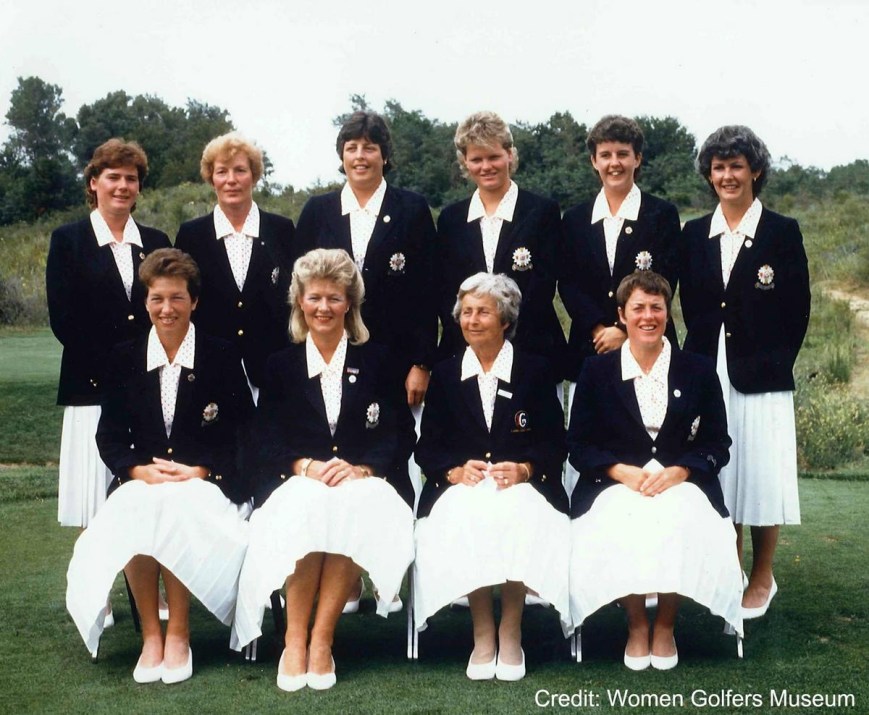
Claire Dowling Curtis Cup 1986 Team

The 1986 GB&I Curtis Cup Team (Photo: Women Golfers Museum)

Disappointingly Claire was omitted from all four series of games by Captain Diane Bailey in 1988.

In total she played in 8 Curtis Cup games finishing with a creditable individual record of W3 H2 L3. From Ireland only Mary McKenna (P30 W10 H4 L16), Leona Maguire (P14 W6 H2 L6) and Philomena Garvey  (P11 W2 H1 L8) have played more Curtis Cup games.

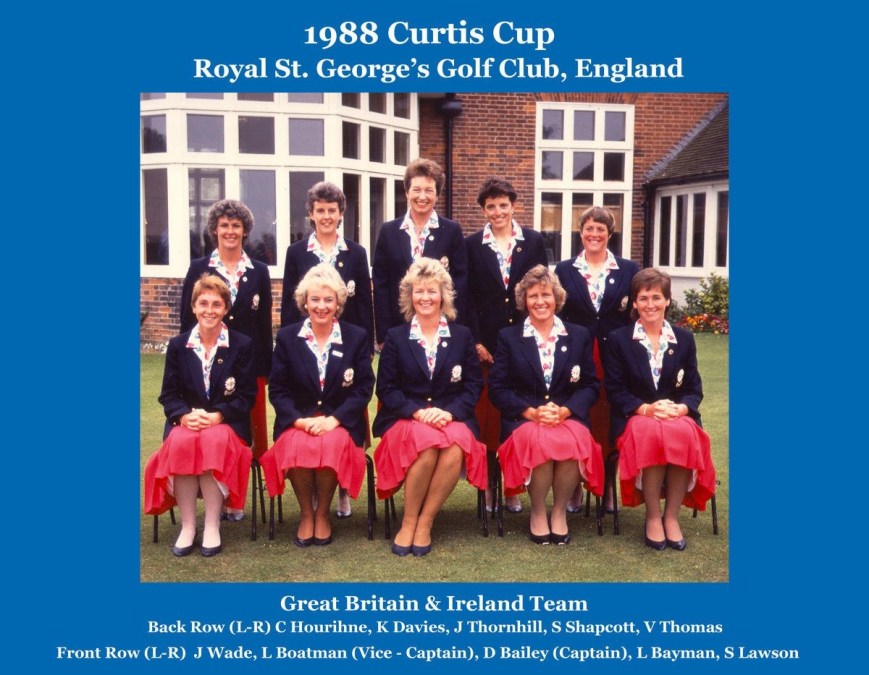
Claire Dowling Curtis Cup 1988 Team

The 1988 GB&I Curtis Cup Team (Photo: Ladies Golf Union)

She also played for GB&I in the Women’s World Amateur Team Championships for the Espirito Santo Trophy (1986 and ’90) and the Vagliano Trophy match against Europe (1981-83-85-87-89-91).

Claire also represented Ireland in the Women’s European Team Championships (1981, ’83, ’85, ’87, ’89 and ’91) and in the Women’s Home International Matches (1979, ’80, ’81, ’82, ’83, ’84, ’85, ’86, ’87, ’88, ’89, ’91 and ’92). 1983 remains the last time Ireland won the Women’s European Team Championship.

Partnering Phil Wickham Claire won the Irish Bi-Centennial Foursomes in 1981-82-84 and ’85.

Claire captained Ireland in the Women’s European Team Championships in Finland in 1997 and at the Women’s Home International Matches in 1996 and 1997.

She was due to captain the GB&I team at the World Amateur Golf Team Championship in Chile in November 1998. However, the Ladies Golf Union withdrew the travelling party due to safety concerns following the arrest in London a few weeks earlier of the former Chilean dictator General Augusto Pinochet. The Eisenhower Trophy event was played the following week in Chile with the Men’s GB&I team travelling and ultimately winning the competition.

Claire subsequently captained GB&I against Europe in the Vagliano Trophy in July 1999. Europe won 13 – 11.

Last but far from least Claire was non-playing captain of the 2000 Curtis Cup team. GB&I lost the match at Ganton GC 10 – 8.

In June 2006 Claire retired from competitive golf – which at the time was County Golf with Warwickshire.

However, she was persuaded to come out of retirement by her friend Tracy Atkin in 2012 to play in the Brenda King Foursomes, an England Golf run national competition for senior ladies.  Tracy and Claire won the competition (Frilford Heath) and successfully defended it in both 2013 (Gog Magog) and 2014 (Minchinhampton). They decided to go out at the top and didn’t defend at Coxmoor in 2015.

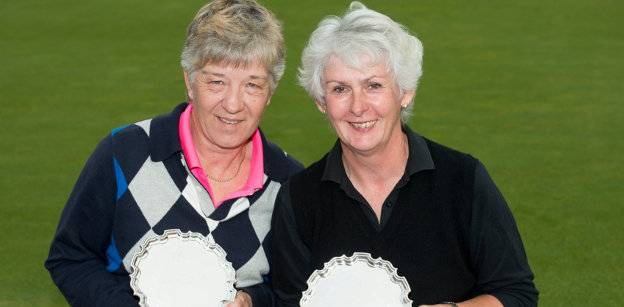
Claire Dowling Brenda King 2014

Tracy Atkin and Claire Dowling (Photo: England Golf / Leaderboard Photography)

Claire moved to England in the late 1980s obtaining an administrative job at the famous Wentworth Club in Surrey. While there she met and married her husband Peter. They subsequently moved to Solihull in the West Midlands in 1996 and Claire joined Copt Heath. Interestingly her appointment as 2000 Curtis Cup captain coincided with Peter McEvoy’s captaincy of the Walker Cup Team in 1999 and 2001, thus making Copt Heath, probably the first and last club to provide the GB&I captain to both female and male amateur teams simultaneously.

Claire was afforded honorary membership of Copt Heath in 2014. She was already an honorary member of Cork GC and Woodbrook GC and in 2022 also added Portmarnock GC to her roster, becoming one of the first women members of this prestigious Dublin club.

Following Peter’s retirement the couple moved to Budleigh Salterton in 2014 and Claire now plays at the local club, East Devon.  In one of her first competitions at her new club she won the Ladies’ Club Championship by 8-shots.  She still plays off a low single figure handicap.

In 2012 Claire was appointed Chair of the Handicap and Course Rating Committee for England Golf. She also sat on England Golf’s Club Services Committee.  The former role means she also sat on the The Council of National Golf Unions (CONGU) Board and Technical Committee up until 2016, with representatives from The R&A and the other Home Unions.

In February 2015 Claire became one of the first women members of The Royal & Ancient Golf Club of St. Andrews (The R&A). Within this first wave of 14 ladies there were just five women from Great Britain and Ireland (GB&I). These were HRH The Princess Royal, Dame Laura Davies, Lady Angela Bonallack, Belle Robertson MBE and Claire Dowling. For more information on the R&A’s Women Members click here: Women Members – The R&A and Augusta National GC.

This was not her first involvement with the R&A though. As a representative of the Ladies Golf Union she became the first women to sit on the R&A’s Amateur Status Committee between 1997-2001.

Claire qualified as a Level 3 Tournament Referee in 2011 and in September 2015 was invited to join the R&A’s Rules of Golf Committee. In September 2017 she was made Deputy Chair(wo)man of this Committee, also becoming a member of the Joint Rules Committee (with the USGA). As a result she played an important role in developing the new January 2019 rules.

In recent years Claire has refereed at many events including The Open Championship, The Ricoh Women’s British Open, The Amateur Championship, The Walker Cup, and The Arnold Palmer Cup.

On 21st January 2016 she received the ‘Distinguished Services To Golf’ Award from the Irish Golf Writers’ Association (IGWA).  Claire had previously been awarded the IWGA’s ‘Women’s Amateur Player Of The Year’ award in 1981, 1983, 1984, 1986 and 1987.

On 28th January 2017 Claire was elected an Honorary Life Member of the Irish Ladies’ Golf Union Limited at their Annual General Meeting.

In September 2019 Claire was invited to join the General Committee of The R&A.

ME.

Copyright © 2015-2025 Mark Eley. All rights reserved.

Barclay Howard

27th January 2015

D. Barclay Howard, the Scottish amateur golfer, was born in Glasgow on 27th January 1953.  Whilst by no means an amateur great his roller coaster life on and off the course made him something of a legendary figure in Scottish and, to a degree, British golf.

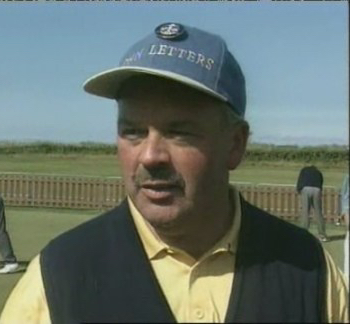
Barclay Howard Open 1997

Barclay Howard at the 1997 Open Championship at Royal Troon

He was raised in Johnstone, a town 12 miles west of Glasgow in Renfrewshire.  He went to school with Sky Sports golf presenter David Livingstone.  Both played golf at their local club, Cochrane Castle Golf Club to which Barclay was associated all his life.  He joined his father, David, there starting as a Junior in 1960.  Indeed the family home was just a pitching wedge away from the course.  He was made an honorary life member of Cochrane Castle in 1980.

Howard tragically died from pneumonia on 19th May 2008, aged just 55.  His health had not been good for many years due to chain smoking, his well publicised alcoholism and the legacy of contracting leukaemia when he was 44.  The latter illness afflicted him just six weeks after probably his finest golfing moment, winning the Silver Medal at the 1997 Open.  He started to feel unwell at that year’s Walker Cup and later in 1997 underwent both a stem-cell operation and a course of chemotherapy to aid his recovery.  His weight dropped from 14st to 9st 6lb.  It took around 3 years for him to fully recover and return to the golf course; it was another two before he had the strength to enjoy his golf again.  He first contracted pneumonia in 2006 and already weakened by the cancer never really recovered from it.

His first competitive golf tournament for this ‘natural’ came as a 13-year-old when he played in the 1966 Scottish Boys Championship at North Berwick.  In his younger days he also lost the final of the 1969 West of Scotland Boys Championship 3 & 2 to Sam Torrance.  Torrance later recalled the two things that first struck him about Howard: “his unmistakeable golfing talent and his engaging personality.  He was good fun to be around”.  His game continued to develop and was sufficiently good for him to be selected for the Great Britain & Ireland (GB&I) Youths Team that played Europe in 1971.

Howard joined Clydesdale Bank straight from school in 1971.  While there he met and married Sandra in 1972.  He was just 19 and the marriage, triggered by the impending birth of a daughter, Linda (b. 1972), almost certainly came too soon for both of them.  The family struggled to make ends meet and Barclay ended up moving to Rolls Royce in 1973, where he worked at their Hillington factory.  He also started to drive an ice cream van in the weekday evenings to bring in more money.  A second daughter, Lorraine (b. 1976) followed which only added to the personal and financial pressures.  The couple inevitably split up in 1978 and sadly Barclay lost touch with all three of them.  With these work and family responsibilities any thought of turning Pro at an early age seems to have simply past him by.

Following his divorce, and now with a little more time on his hands, Howard started to drink more and it became clear to his friends that he was becoming an alcoholic.  With the benefit of hindsight Barclay later timed his drinking demise to 1980.  Despite this he remarried another local girl, Alison, in 1981.  With Barclay’s addiction now reaching something of a peak she showed huge patience in staying with him until 1985.  As he said himself: “I was a truly awful husband.  From the age of 18 to 38 my life was a mess.  I was a lost cause for a while”.

In 1979 he was called up for Scotland’s Mens team for the first time, playing against England.  Despite his drinking he still managed to perform on the course and continued to be selected for his country and GB&I in the early 1980s.  However, his alcoholism and all too frequent drunken and abusive behaviour – frequently whilst on team duty –  led to him being excluded from international competition in 1984.  At the time he tended to pack lager and vodka in his bag before his balls and tees, needing a regular drink during a round to steady his on-course nerves.

img_8700

Barclay Howard (Photo: SNS)

Having lost most of his friends he was eventually persuaded in the summer of 1991 to join Alcoholics Anonymous (AA).  A decision almost certainly triggered by him receiving a 12 month ban from Cochrane Castle in June of that year and a handicap suspension (thus preventing him from playing in any competitions).  He had not helped himself by turning up to his disciplinary meeting with the Club’s Committee drunk.  He thankfully worked things out and eventually overcame the ‘disease’.  He hardly drunk at all in the following years and completely stopped in 1997.

A reformed character he started up a new relationship with Letitia, the daughter, of one of his AA sponsors, Davie Muir.  This also gave him more conviction in the new path he was treading and he soon married Tish in April 1992, who was already pregnant with their daughter Laura-Jane (b. August 1992).  It weighed heavily on the reformed Barclay that Laura-Jane turned five and started school while he was in the States playing in the 1997 Walker Cup and US Amateur.

He amazingly managed to keep his job at Rolls Royce throughout his personal turmoils – mainly by restricting his big drinking sessions to the weekend.  During the winter of 1991/92, the final months of his enforced exile, he used the company gym to get himself fit, losing two and half stone in the process.  Cochrane Castle got wind of his progress and eventually allowed him to return in April 1992, two months early.  He shot a gross 68 in the April Medal and was off and running.  He re-dedicated himself to the game and when he was made redundant in 1993, along with hundreds over other workers at his plant, he chose to commit himself fully to golf.  Tish was happy as long as he didn’t start drinking again.  Things went well and Barclay was re-selected for Scotland in 1993 and then for the GB&I St. Andrews Trophy team in 1994.  During his subsequent years as a full time amateur he did some work in customer relations for club-maker John Letters.

Over his career he won over 100 amateur competitions, many of which came after he had beaten the dreaded drink.  Whilst he fell short of winning any of the amateur majors he did record a number of notable victories: –

  • 1975, 1984 & 1995 Cameron Corbett Vase
  • 1993 West of Scotland Open
  • 1994 Leven Gold Medal
  • 1994 & 1996 St. Andrews Links Trophy
  • 1997 Scottish Open Amateur Stroke Play (at Monifieth and Panmure)

His status in the game in the 1990s and new found sobriety meant he was regularly picked for national team competitions again between 1993 and 1997.  He played on the GB&I team in the Eisenhower Trophy in 1996 and in the St. Andrews Trophy twice, 1994 and 1996.  Indeed in 1996 he was named Scottish Amateur Golfer Of The Year by the Scottish Golf Union.

However, it was his Walker cup appearances that obviously meant the most to him, particularly as they came when he was 42 and 44, an exceptional age for the GB&I Team in the modern era. Howard played in the Walker Cup twice, winning in 1995 at Royal Porthcawl (P3 W0 H2 L1) and losing in 1997 at Quaker Ridge, New York (P3 W0 H0 L3).  As can be seen in the photo below the 1995 GB&I team contained Padraig Harrington, David Howell and Stephen Gallacher and famously overcame a strong US team containing Tiger Woods.

The Great Britain And Ireland Team Wins The Walker Cup

Barclay Howard (front left) with the successful 1995 Walker Cup Team.

Without question Barclay’s most famous golfing achievement came at the 1997 Open at Royal Troon when he secured the low amateur Silver Medal.  In the end he finished 60th on 293, tied with the great Jack Nicklaus.  This was the first time a Scot had achieved the honour since Charlie Green in 1962.  In round one Howard birdied four of his first six holes to take a share of the lead.  He had a four foot birdie putt on the ‘Postage Stamp’ 8th to take the lead on his own but mistakenly looked at a leaderboard as he walked onto the green.  Despite falling back into the pack he carried this early momentum throughout the Championship to secure the famous prize.

His performance in The Open, and let’s remember he was 44, caught the public’s imagination and won him plaudits from around the world.  Indeed he was invited to play in a number of professional tournaments on the back of his impressive Open showing.  It even saw the Republic of Tadjikistan in Central Asia produce a commemorative stamp featuring him !

Barclay Howard Stamp

Barclay Howard’s Tadjikistan Commemorative 1997 Open Stamp

Howard made the news again shortly afterwards.  After playing in the Walker Cup match he stayed in the States to play in the US Amateur at Cog Hill.  Well rested he qualified for the match play stage after rounds of 70 and 71 – the only member of the Walker Cup team to do so.  However, he was later disqualified for signing a wrong scorecard – due to a matter that he brought to the attention of the USGA.  He had inadvertently been given a different make of ball by his caddie to play the 18th hole of his second round thus contravening the ‘one ball’ rule that existed in the US at the time.  Having bogeyed his last hole he put the ball in his pocket and whilst finishing his lunch came across it and realized the error that had been made.  Having not added the two penalty shots to his score for 18, with the benefit of hindsight he knew he should have, he quickly disqualified himself from the Championship.  To his eternal credit Howard said of his decision at the time: “I would know.  Say I was walking up to win this on the weekend, how could I live with myself. Yes, I’ve had my share of problems, but after 44 years, you’re going to start cheating? No! I could never do that”.  He was hailed a hero by the US golfing press in the days that followed.

Having returned to Scotland Barclay set about preparing for his supposed swan song – the 1997 Home Internationals – having announced his retirement from international play whilst at the Walker Cup the previous month.  Unfortunately he never got to play.  Illness beset him and he was soon diagnosed with the cancer he would fight for the rest of his life.

Looking back on his career and serious illness Barclay said: “The biggest regret I have is not turning professional.  Once I had got myself sorted out with the drinking I started to work much harder on my game.  I felt that even in 1997 I hadn’t reached my full potential.  I was 44 then and I was thinking about the Seniors Tour a few years down the line but then that was all taken away from me.”

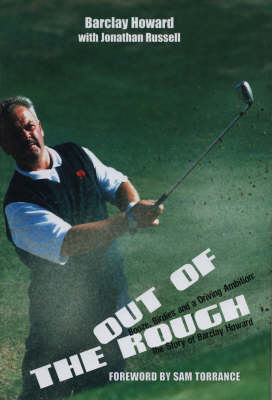
In his 2001 autobiography, ‘Out Of The Rough: Booze, Birdies and a Driving Ambition’, written with the help of Jonathan Russell, he candidly discusses his career and battle with alcohol. It was typical of his generosity that he donated the royalties from the book to the leukaemia unit at Glasgow Royal Infirmary.

Barclay Howard Open 1997

Barclay Howard’s ‘Out Of The Rough’ Autobiography

In 2006, despite being frail, Howard was appointed Captain of the Scottish Youths team by the Scottish Golf Union, a role he relished.  Far from an act of compassion he earned the role having captained Renfrewshire to the Scottish Area Team Championship in 2005.

Upon his death Sir Michael Bonallack said “Barclay played golf the way he lived life.  He was a great fighter, someone who wouldn’t give up. He will be sorely missed”.

With the 2016 Open Championship again staged at Royal Troon the opportunity arose for a number of tributes to be paid to Barclay. Jimmy Roberts did a great job for NBC Channel.

Jimmy Roberts looks into the life of Barclay Howard for NBC and the Golf Channel. 

In a life and golfing career of real extremes Barclay Howard is a golfer and man we should all remember and can no doubt learn from when we face our own adversities.  What a comeback story.  Yes he made some poor decisions and missed some opportunities but who hasn’t.  His tenacity served him well on the course and in dealing with his numerous health issues, whilst his honesty and generosity were a credit to himself and the game he loved.

ME.

Copyright © 2014-2025, Mark Eley. All rights reserved.

Sir Michael Bonallack

31st December 2014 (Last Updated 7th May 2025)

There are few people who have made a more significant contribution to the game of golf than Sir Michael Francis Bonallack, Kt, OBE. He was an outstanding amateur golfer who became a highly respected administrator.

He was born in Chigwell, Essex, England on 31st December 1934 and died on 26th September 2023 in St. Andrews.

Michael first picked up a golf club when he was 10 whilst on holiday in North Devon, playing on the beach with his brother. Taking to it well the boys were enrolled by their parents at the local Chigwell G.C. shortly afterwards. Michael quickly started to win junior competitions and saw his handicap tumble.

Michael’s younger sister Sally (Barber) was also a very accomplished player. She was the English Ladies Champion in 1968 and played for both England (1960-72) and Great Britain & Ireland (GB&I) in the Curtis Cup (1962). She turned professional in 1979 before having her amateur status re-instated in 1982.

After just a few years at Chigwell Michael joined Thorpe Hall G.C. and it is this club, near Southend-on-Sea in Essex, that he represented throughout his amateur career. Thorpe Hall is a tight tree-lined course with small greens and this contributed to Bonallack becoming a straight-hitter with an exceptional short game.

Educated at Haileybury, Michael achieved a scratch handicap at 16 and quickly made a name for himself; regionally, winning the Essex Boys title in 1950 and 1951, and then nationally, winning the British Boys Championship in 1952, beating Alec Shepperson on the 37th hole of the final at Formby GC.

He went on to win the Amateur Championship five times; the last three being in successive years: –
1961 v. Jimmy Walker 6&4 at Turnberry
1965 v. Clive Clark 2&1 at Porthcawl
1968 v. Joe Carr 7&6 at Troon
1969 v. Bill Hyndman (USA) 3&2 at Hoylake
1970 v. Bill Hyndman (USA) 8&7 at Newcastle, County Down
img_7224

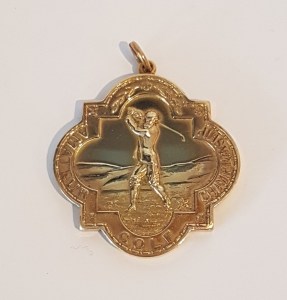
Michael Bonallack’s 1968 Amateur Gold Medal (Photo: British Golf Museum)

His favourite Amateur win was the 1965 one at Porthcawl against Clive Clark. “I was six down after 12 holes of the 36 hole final but got it back to three down by lunch when, just to pass the time, I started sticking sixpences into the fruit machine. On about the fifth pull I won the jackpot. I made sure Clive knew about it. ‘Must be my lucky day’ I told him”. Famous Scottish caddie Willie Aitchison, who helped Roberto De Vicenzo and Lee Trevino to their Open wins, also caddied Bonallack to all of his Amateur wins.

Nationally he also won the English Amateur Championship five times (1962, ’63, ’65, ’67 and ’68) and the English Open Amateur Stroke Play Championship (Brabazon Trophy) four times (1964, ’68, ’69 (tied with Rodney Foster) and ’71).

Other notable victories came in the Lytham Trophy (1965T and ’72), Berkshire Trophy (1957, ’61, ’65, ’68, ’70, ’71T), St. George’s Grand Challenge Cup (1965, ’68, and ’81), H.R.H. Prince of Wales Challenge Cup (1967), Hampshire Hog (1957 and 1979) and the no longer contested Golf Illustrated Gold Vase (1961T, ’67T, ’68, ’69T, ’71 and ’75). Second Lieutenant MF Bonallack (Royal Army Service Corps.) also won the Army Championship in 1955 at Muirfield. He captained the Army Team between 1962-67. Finally, he also won the Sunningdale Foursomes in 1959 playing with Doug Sewell and The Antlers at Royal Mid-Surrey in 1964, playing with Dr. David Marsh – Sewell and Marsh both being first class amateurs themselves.

Since 1959 the Philip Scrutton Jug has been awarded to the player with the lowest aggregate scores in the each year’s Brabazon and Berkshire Trophies.  Given his record in both competitions Sir Michael won the jug in 1961, ’64, ’66, ’68, ’69, ’70 and ’71.

Unsurprisingly he dominated men’s golf in Essex winning the Essex Amateur Championship a record 11 times, in 1954, ’57, ’59, ’60, ’61, ’63, ’64, ’68, ’69, ’70 and ’72.  Sir Michael also won the 1969 Essex Open Championship in 1969 and East Anglian Open Championship in 1973.

He represented GB&I in nine Walker Cup teams, two as playing Captain (in 1957, ’59, ’61, ’63, ’65, ’67, ’69,  ’71 and ’73). He played 25 individual games, more than any other GB&I player in the history of the match and is only beaten by Jay Sigel’s 33 on the USA side. His record reads won 8, lost 14 and halved 3. The highlight for Bonallack was contributing to the victorious side in 1971 where GB&I won the cup for the first time in 33 years. “I was playing captain that year when we won over the Old Course at St. Andrews, and it does not get, cannot get, any better than that,” he later recalled.

Bonallack, representing GB&I at the time, also played in seven World Amateur Team Golf Championships, for the Eisenhower Trophy, the last three as playing Captain (1960, ’62, ’64, ’66, ’68, ’70 and ’72). In 1968 he tied for the Individual title with Vinny Giles from the USA. He also represented GB&I in biennial matches against The Rest of Europe between 1958-72.

Sir Michael represented England in the Home International Matches on 17 occasions (1957-72, ’74). He captained the team between 1962-1967. His record was played 131; won 79, halved 15 and lost 37.  He also played in the British Commonwealth Team in 1959, 1963, 1967 and 1971, captaining the team in 1971 and 1975 (non-playing).

He played in 13 Open Championships. His best finish coming in his first when he tied 11th at Muirfield. He didn’t win the Silver Medal that year but secured it in 1968 (Carnoustie – T21) and again in 1971 (Royal Birkdale – T22). He considered these results his main golfing disappointment, reflecting in later years: “I wish I had done better in The Open”.

Bonallack had little overseas success. He played in the U.S. Amateur six times between 1957 and 1973, his best finish T11 coming at Scioto CC in 1968. He also played in the US Masters three times, 1966, ’69 and ’70, missing the cut on each occasion. However, he did have the pleasure of sitting next to his hero Bobby Jones at the traditional Amateurs’ Dinner in 1966 and then playing alongside the legendary Ben Hogan, whom he described as “the finest ball-striker I ever saw”.

Bonallack was not long off the tee and had an unconventional putting stance but he certainly got the job done. Peter Alliss described him as “a remarkable player. He had a wonderful short game, which was of his own making. Big wide stance, nose sniffing the ball, short jabby swing, but all the putts went in the hole. He had the most wonderful temperament. He appeared calm and yet he had that steely something that all great champions have.”

Good friend Donald Steel, writing for Country Life in July 1983, upon Bonallack’s competitive retirement, described him as a “fierce competitor” before adding “I have never seen anyone hole more critical putts than he did or impose the same magical touch on a whole variety of wedge and bunker play.”

Bonallack’s playing pre-eminance came just before the establishment of the European Tour and the growth in tournament purses. The transition from amateur to professional was more cumbersome in those days – the PGA prevented amateurs from taking prize money for two years – and with a lack of conviction that he was really good enough little time appears to have been spent worrying about doing so. It simply made more sense for him to work in sales for the family business which was involved with refrigerated trucks and container bodies. This earned him a salary whilst affording him the flexibility to practice (normally in his lunch breaks) and play on the weekends as he wished.
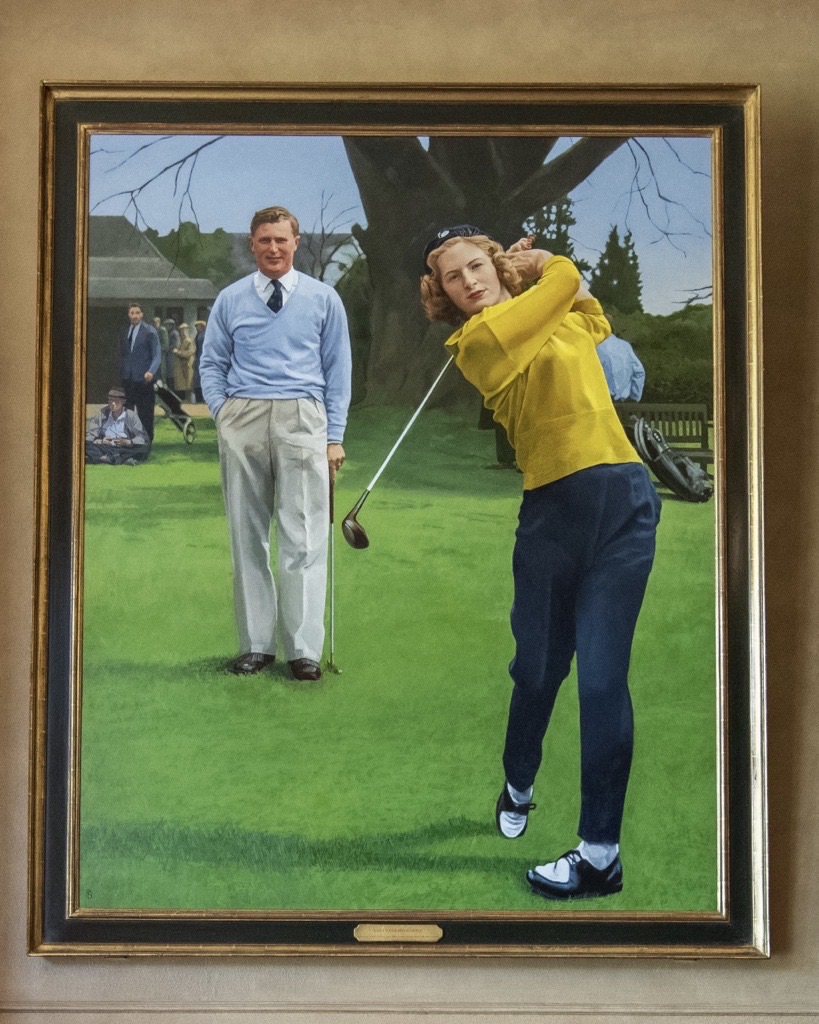
Sir Michael Bonallack and Lady Bonallack R&A Portrait (Photo: The R&A)

He married Angela Ward in 1958.  A celebrity couple of the day the announcement of their earlier engagement made the front page news of almost every daily newspaper. Angela was the British Girls Champion in 1955 and English Ladies Champion in 1958 and 1963. Lady Bonallack was also runner-up in the British Ladies Amateur in 1962 and 1974.  She played in six Curtis Cup teams (1956, ’58, ’60, ’62, ’64 and ’66). Playing together Angela and Michael won the Worplesdon Mixed Foursomes in 1958. In February 2015 Lady Bonallack became one of the first women ordinary members of The Royal & Ancient GC of St. Andrews.

A new portrait (see above), painted by Paul Branson, of the couple was unveiled in the Big Room of the R&A Clubhouse on 2nd May 2025. It replaced the individual portrait of Sir Michael shown further down this article.

The couple have four children, Glenna, Jane, Sara and Robert and many grand children. Unsurprisingly golf still runs through the family’s veins with Glenna, Jane and Robert all very good players. Jane (Baker – known as “JB” to her friends) went her own way preferring horses and riding. Angela and Glenna won the well known Royal Mid-Surrey Mothers and Daughters Competition in 1979 and 2000. In 2013 Glenna won it with her own daughter, Harriet.

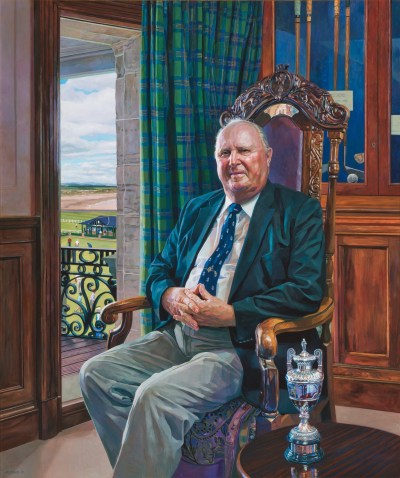
Michael Bonallack joined The Royal and Ancient Golf Club of St. Andrews in 1960. Over these years he was Chairman of the Amateur Status Committee (1975-79) and of the Selection Committee (1975-79) and a Member of the Rules of Golf Committee (1979-83), the General Committee (1975-1978 and 1999-2000) and the Heritage Committee (2006-10).  At the Club’s Autumn Meeting in September 2013 he become the 16th Honorary Member of The Royal and Ancient. He had previously been made a Life Member in 1999. The portrait below was for many years displayed in the Big Room of The Royal and Ancient Clubhouse. Sir Michael said at the time: “I am extremely proud. I feel privileged to have been so closely involved with the Club for so much of my life and both it and the town of St Andrews are incredibly dear to me. It has been an honour to serve the Club.”
img_7223

Sir Michael Bonallack’s R&A Portrait (Photo: British Golf Museum)

Sir Michael was appointed Secretary of the Royal & Ancient Golf Club of St. Andrews in 1983, succeeding Keith Mackenzie. In the early 1980s Bonallack was running the Leisure Division of construction and property developer company Miller Buckley based in Rugby, albeit the family still lived in Essex. Among his roles was Chairman of Cotton Pennick & Lawrie, the Golf Course Architect company (1978-83), that had been acquired by Miller Buckley. Upon his appointment he left Miller Buckley to take on the Secretary’s role and moved with Angela up to Fife.

As Secretary of the R&A, Bonallack helped to guide the game into the 21st Century. “He has bridged the gap between the history and heritage and tradition of The Open Championship and golf in general as it moved into the commercial age globally and internationally and he’s done it with great taste and tact and really stands almost alone as someone who has handled that crossing.” said the late Mark McCormack, chairman of International Management Group. Bonallack himself said: “It’s one continual satisfaction to see the way in which golf is developing. Obviously, the expansion of The Open, and the fact that we can generate this money to put back into the development of the game is very satisfying”.
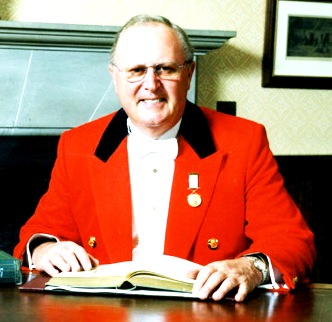
MB 2

Sir Michael Bonallack – 1999/2000 Captain Of The Royal & Ancient 

He retired as Secretary in 1999 after 16 years and was succeeded by Peter Dawson. He was immediately nominated for the Captaincy of the Club for the millennium 1999-2000 year. There were two themes that he sought to bring to the role during his term of office: “…maintaining behavioural standards and ensuring that amateur golf is not destroyed by over-commercialism and ridiculously large prizes”.

The Bonallack Trophy, a biennial amateur competition played between teams from Europe and Asia-Pacific, was first played in 1998. The teams consist of 12 amateur golfers with no more than two players coming from the same country. The competition named in honour of Sir Michael continues to grow in importance and helps to raise the profile of the game, particularly in the Far East, Indian and Australasia areas.

Other golfing competitions and trophies have been named after Sir Michael too.  In 2007 the Essex Golf Union established The Sir Michael Bonallack Trophy, a 36-hole scratch men’s stroke play competition, in honour of their Life Vice-President.  Finally, 2014 has seen the commencement of The Concession Cup, a match between teams of mid, senior and super-senior amateurs from the USA and GB&I, and the commissioning of the Bonallack Campbell (William) Trophy for the winners.

He enjoyed many other golf club memberships, notably Pine Valley and Elie, as well as many honorary memberships offered in recognition of his service to the game, including Augusta National G.C.

Sir Michael held many important positions in the golfing world and over the years has received numerous honours and awards.  Some of these are detailed below: –

Honours
Officer of the Order of the British Empire (OBE) (1971)
Knight Bachelor awarded by Queen Elizabeth II (1998). Sir Michael became the third ‘golfing knight’ after Sir Henry Cotton and Sir Bob Charles. Sir Nick Faldo subsequently joined the select group in 2009. The other three all being Open champions.

Awards
Association of (British) Golf Writers – Golf Writers’ Trophy Award (1968)
United States Golf Association – Bobby Jones Award (1972)
American Society of Golf Course Architects – Donald Ross Award (1991)
England Golf – Gerald Micklem Award for Outstanding Contribution to Amateur Golf in England (1991)
Northern Ohio Golf Charities – Ambassador of Golf (1995)
Golf Association of Philadelphia – Arnold Palmer Lifetime Service Award (1997)
Spanish Golf Federation Golf – Medal of Honour (1999)
Association of (British) Golf Writers – Award For Outstanding Services To Golf (1999)
World Golf Hall of Fame entry – Lifetime Achievement in Golf (2000)
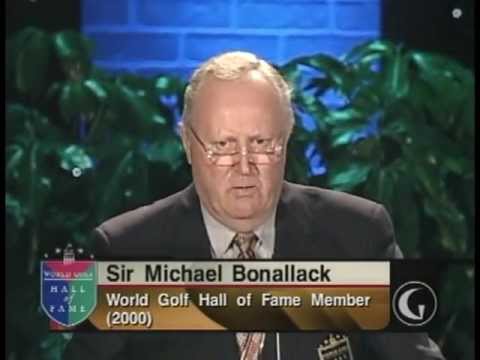
MB 3

Sir Michael Bonallack Introduces Allan Robertson To The World Golf Hall Of Fame in 2001

Czech Republic – Golf Shield of Honour (2000)
Metropolitan Golf Association – Lifetime Service Award (2000)
GOLF EUROPE legend award (2004)
BIGGA Lifetime Achievement Award (2005)
Honoree at The Memorial Tournament (2006)
England Golf Hall of Fame Inductee (Feb. 2024)

Other Golf Positions
President, Golf Club Managers’ Association (1974-1984)
Chairman, PGA of Great Britain and Ireland (1976-1982)
Chairman, Golf Foundation (1977-1982)
President, English Golf Union (1982)
President, British and International Golf Greenkeepers Association (BIGGA) (1999-2016)
President, The Society of One Armed Golfers (1995-2023)
Chairman, Golf Foundation (2000-2003)
Non-Executive Director of the PGA European Tour (2000-2015)
The Professional Golfers Association of Europe (2002-2004)
President, PGAs of Europe (2003-2004)
Chairman of the Official World Golf Rankings Governing Body (2004-2016)
Vice President, Association of (British) Golf Writers (N/k)
Patron, Artisan Golfer’s Assocation (2007-2023)
President of the National Association of Public and Proprietary Golf Courses (NAPGC) (2008-2023).
Patron, British and International Golf Greenkeepers Association (BIGGA) (2016-2023)

In August 2018 The R&A published ‘Par Excellence’, a biography of Sir Michael written by Donald Steel. On 21st February 2019 the USGA announced that the book was to be the recipient of their Herbert Warren Wind Book Award for 2018, in recognition of its outstanding contribution to golf literature.
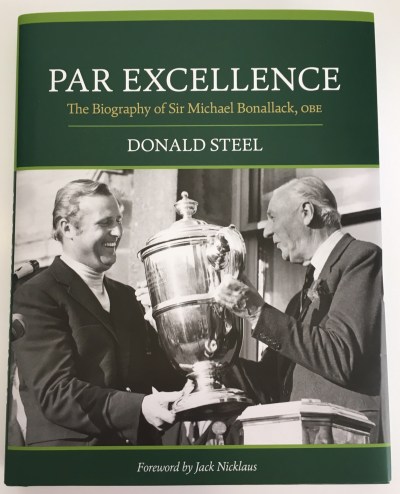
img_9871-1

‘Par Excellence’ Book (Photo: GolfBible)

Lady Bonallack died on Friday 1st July 2022 at the age of 85. She had been in poor health for a few years and finally succumbed to the COVID-19 virus.

Clearly in poor health Sir Michael was a very welcome guest at the opening ceremony of the 49th Walker Cup match played at St. Andrews at the start of September 2023.

Sir Michael’s was a life well lived and he leaves a legacy to the game that can only be matched by a handful of others.

ME.

Copyright © 2014-2025, Mark Eley. All rights reserved.
John Ball Jr

24th December 2014

On the anniversary of his birthday I thought I would research the career of arguably Britain’s greatest ever amateur golfer.  Indeed many commentators place him only behind the legendary Bobby Jones on the world’s greatest list.

John (‘Johnny’) Ball was born in Hoylake on the Wirral, England on 24th December 1861.

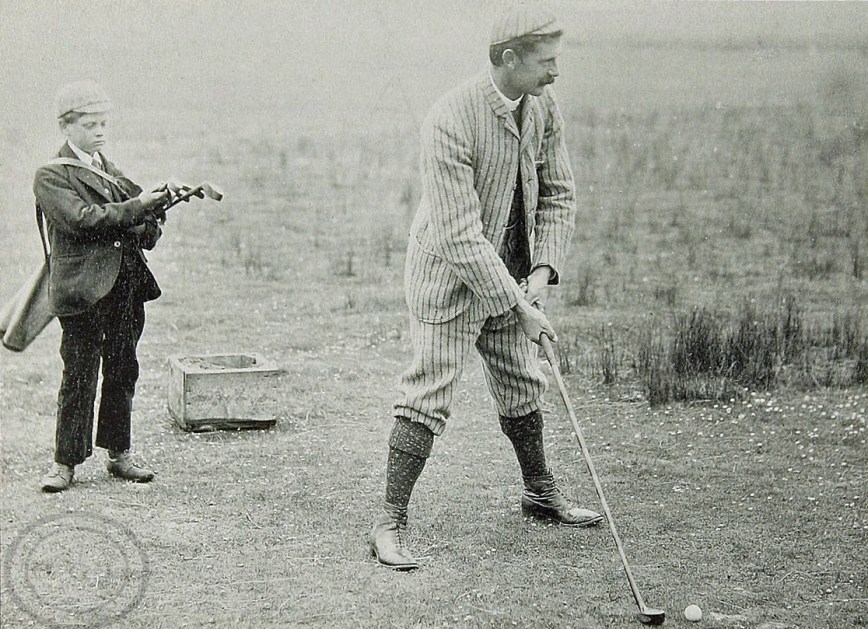
John Ball 1

John Ball

John Ball’s father, John Senior, owned the Royal Hotel at Hoylake.  The hotel became the club house for the Liverpool GC (the Royal was conferred in 1871) when it was first established in 1869.  Living adjacent to the famous links (and old race course) John soon took up the game and quickly became proficient.

He grew to know Royal Liverpool like the back of his hand. He proved it in 1907 when he took a bet that he could go round the course in a dense fog in under 90 shots, without losing a ball and taking no longer than two and a quarter hours. Playing with a single painted black ball he scored 81 well within the allotted time.

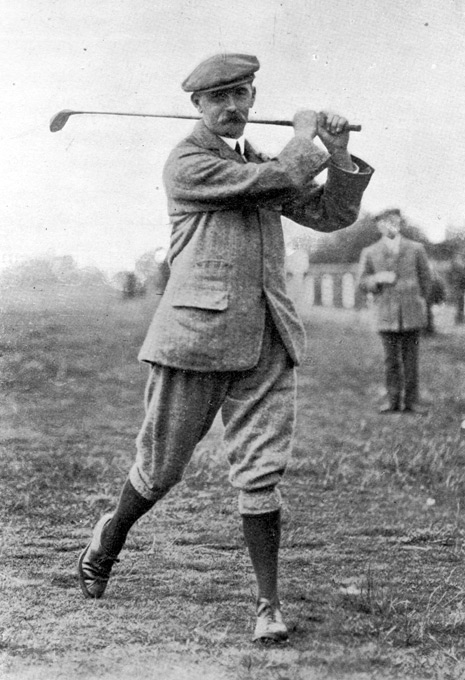
He had a natural talent and the most envied swing of the time, despite what Bernard Darwin described as a “curious right-handed grip”.  Darwin, the famous Times Golf Correspondent, who saw all of the old greats play in person, thought very highly of Ball, saying “The beauty of any particular player’s style must, like his exact placing in the golfing firmament, be a matter of individual feeling, and I can only say that I have derived greater aesthetic and emotional pleasure from watching Mr. Ball than from any other spectacle in any game”.

A5CABAE1-6761-4130-8C55-CBF8E3F97928

John Ball Competing In The 1912 Amateur Championship (Photo: Royal North Devon G.C.)

In 1878, aged 16, he came to national prominence when he finished fifth in the Open Championship held at Prestwick GC.  The Open, largely aimed at professional golfers, had been inaugurated by Prestwick GC in 1860.

In 1885 his home club, Royal Liverpool, held an informal Open Amateur ‘Grand Tournament’, which was played during their Spring Meeting.  This match play competition attracted 44 leading players “from recognised clubs” of the time, including Ball (23) who had gained entry through some Committee shenanigans (having received a £1 payment for his Open place in 1878 and whose amateur stays was therefore questionable at the time).  In the middle of the competition the stroke play Club Gold Medal was contested.  Ball won this with a course record 77.  The following morning he played Horace Hutchinson in a titanic semi-final match in the resumed Grand Tournament, losing on the 18th 2 Down.  Later that day Allan Macfie beat a spent Horace Hutchinson 7&6 in the final.  The event proved to be the success the Club had hoped for and as planned a proposal was put to the Royal & Ancient Golf Club (R&A) for a formal Amateur Championship to be established thereafter.  The suggestion was accepted and the first Amateur Championship was staged at St. Andrews in 1886, albeit the 1885 Hoylake Tournament was subsequently recognised in 1922.

John Ball went on to win 8 Amateur Championships in total – 1888, ’90, ’92, ’94, ’99, 1907, ’10, and ’12.  His wins came at Prestwick (2), Hoylake (3), Sandwich (1), St. Andrews (1) and Westward Ho ! (1).  His final Amateur victory in 1912 came when he was 50 years old.  The gap of 24 years between his first and last victories is clearly a record that will never be broken.  He was also runner-up twice, in 1887 and 1895.  Playing his last Amateur in 1921 at Hoylake, aged 60, he reached the last 16 from a starting field of 223.  His Amateur win record of W99-L22 (81.8%) is unparalleled.

When one considers Ball was playing in The Open in 1878 (8 years before the first Amateur) and that he also missed the 1900, ’01 and ’02 Championships due to military commitments (see below) one can only hazard a guess at how many Amateurs he may have won if events had unfolded in a more favourable manner.

img_5514

John Ball’s Medals at Royal Liverpool GC (Photo: GolfBible) 

Ball also won the Open Championship in September 1890 at Prestwick GC – only the second time he had played since his 1878 debut.  He was the first Englishman and the first amateur to win the Championship.  He was also the first to hold both the Amateur and Open Championships – a feat matched by Bobby Jones in 1930 on his way to the Grand Slam.  Fellow Royal Liverpool member Harold Hilton is the third and only other amateur to win The Open.  He was runner-up in the 1892 Open at Muirfield, when he let a lead slip to his friend Hilton.

The importance afforded to the Amateur over The Open in these early years is clear when one considers that Ball played in every Amateur between 1885 and 1921, save for his three war years, but was sporadic in his Open entries.

Unsurprisingly given his match play record he was a stubborn and determined competitor who would fight to the very end.  Darwin once noted that Ball had “a strong vein of hostility and if he wanted a player’s blood, he would fight his way through a tournament with the sole object of getting him”.

In 1908 he created a record by winning every one of the Royal Liverpool G.C.’s scratch medals.

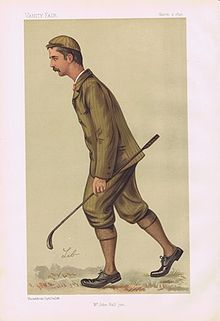
John Ball 2

John Ball’s ‘Vanity Fair’ picture

After his 6th Amateur win in 1907 at St. Andrews he was made an honorary member of the R&A.

He served for the Cheshire Yeomanry in the Second Boer War (October 1899 – May 1902) in South Africa.  During this period he played next to no golf and missed three Amateur Championships.  Indeed one of his fiercest competitors, Scotland’s Freddie Tait, was killed in the same conflict.  His later competitive years would also have been impacted by World War I (1915-19) when he served in the Home Forces and most competitions were cancelled.

Ball was a quiet, retiring, introverted character who said very little to anyone.  It is next to impossible to find any written words or quotes from the great man.  He was very modest preferring to let his golf do the talking for him.  This approach created a certain mythology around him which remains to this day.  The quality of his game meant that he was the first player to consistently go for nearly every flag, whereas his peers simply played for the green.  This led to many memorable, heroic shots in his matches which spectators would talk about for days afterwards.  It also helped nullify his main weakness which was his putting.

He was a traditionalist who fought against the introduction of the lofted iron.  He described the niblick (a modern 8-iron), which he refused to carry, as “just another bloody spade” and felt it de-skilled the game he loved.  He believed players should simply adjust the lie of their existing mid-iron clubs with their grip when height was required on an approach shot.

He retired a ‘legend in his own lifetime’ to his farm in Holywell, Flintshire in nearby North Wales where he eventually died on 2nd December 1940, just shy of his 79th birthday.

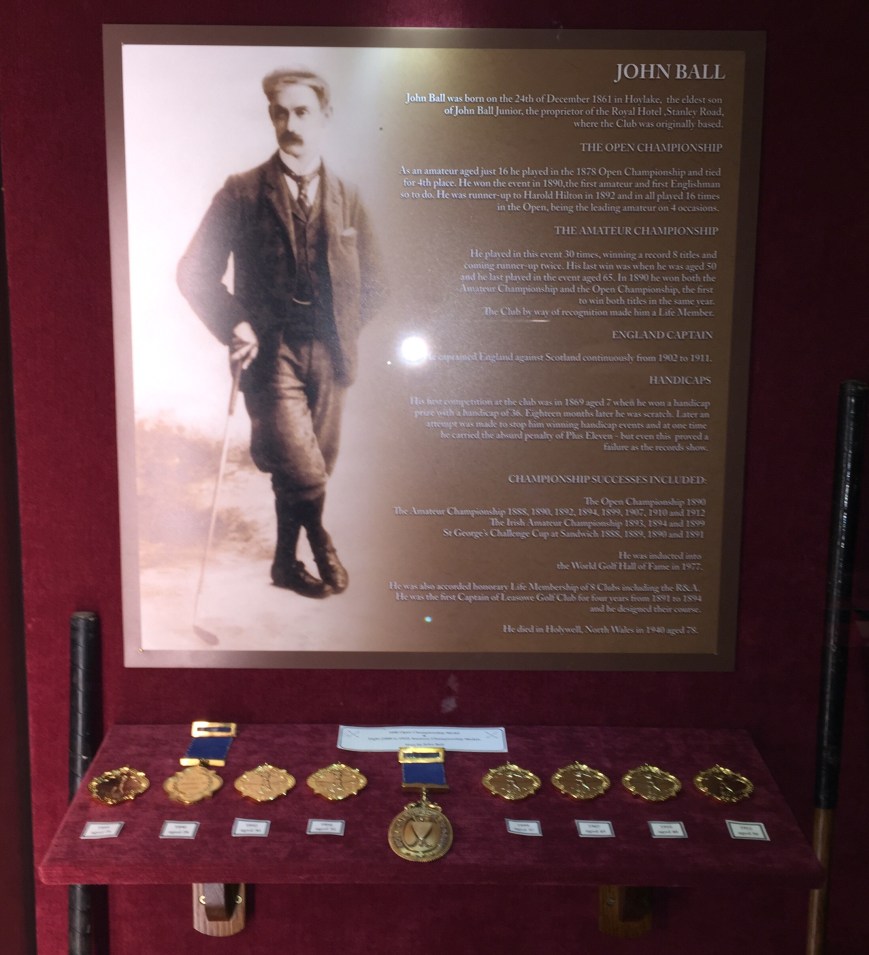
John Ball 3

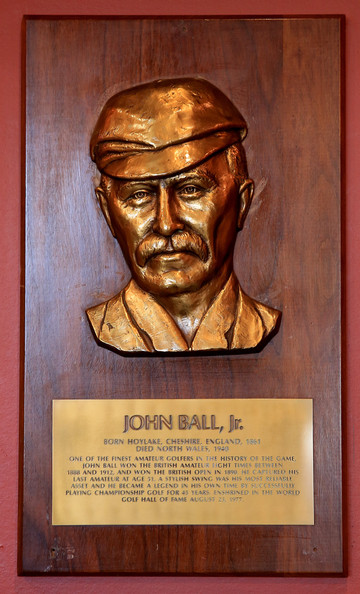
John Ball’s World Gall Hall of Fame Plaque

He was inducted into the World Golf Hall of Fame in 1977.

John Ball is a true great of the game who undoubtedly helped spread the popularity of the sport in Great Britain and Ireland in the early 20th Century.  He is clearly someone whose legacy should not be allowed to fade away and who should be remembered by us all.

ME.

Copyright © 2014-2025, Mark Eley. All rights reserved.