John Ball Jr

24th December 2014

On the anniversary of his birthday I thought I would research the career of arguably Britain’s greatest ever amateur golfer.  Indeed many commentators place him only behind the legendary Bobby Jones on the world’s greatest list.

John (‘Johnny’) Ball was born in Hoylake on the Wirral, England on 24th December 1861.

John Ball 1

John Ball

John Ball’s father, John Senior, owned the Royal Hotel at Hoylake.  The hotel became the club house for the Liverpool GC (the Royal was conferred in 1871) when it was first established in 1869.  Living adjacent to the famous links (and old race course) John soon took up the game and quickly became proficient.

He grew to know Royal Liverpool like the back of his hand. He proved it in 1907 when he took a bet that he could go round the course in a dense fog in under 90 shots, without losing a ball and taking no longer than two and a quarter hours. Playing with a single painted black ball he scored 81 well within the allotted time.

He had a natural talent and the most envied swing of the time, despite what Bernard Darwin described as a “curious right-handed grip”.  Darwin, the famous Times Golf Correspondent, who saw all of the old greats play in person, thought very highly of Ball, saying “The beauty of any particular player’s style must, like his exact placing in the golfing firmament, be a matter of individual feeling, and I can only say that I have derived greater aesthetic and emotional pleasure from watching Mr. Ball than from any other spectacle in any game”.

A5CABAE1-6761-4130-8C55-CBF8E3F97928

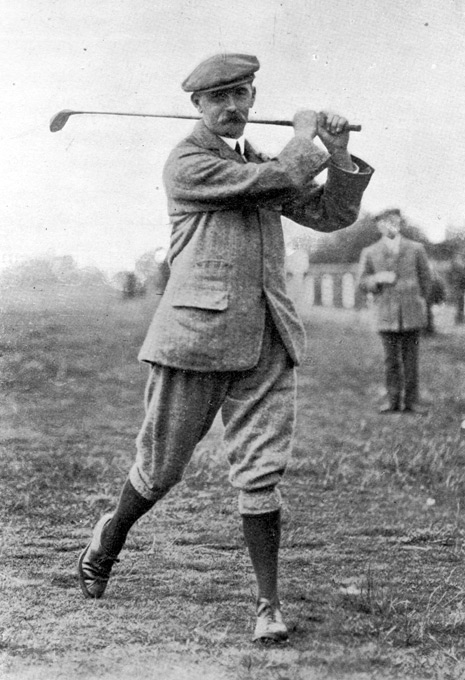
John Ball Competing In The 1912 Amateur Championship (Photo: Royal North Devon G.C.)

In 1878, aged 16, he came to national prominence when he finished fifth in the Open Championship held at Prestwick GC.  The Open, largely aimed at professional golfers, had been inaugurated by Prestwick GC in 1860.

In 1885 his home club, Royal Liverpool, held an informal Open Amateur ‘Grand Tournament’, which was played during their Spring Meeting.  This match play competition attracted 44 leading players “from recognised clubs” of the time, including Ball (23) who had gained entry through some Committee shenanigans (having received a £1 payment for his Open place in 1878 and whose amateur stays was therefore questionable at the time).  In the middle of the competition the stroke play Club Gold Medal was contested.  Ball won this with a course record 77.  The following morning he played Horace Hutchinson in a titanic semi-final match in the resumed Grand Tournament, losing on the 18th 2 Down.  Later that day Allan Macfie beat a spent Horace Hutchinson 7&6 in the final.  The event proved to be the success the Club had hoped for and as planned a proposal was put to the Royal & Ancient Golf Club (R&A) for a formal Amateur Championship to be established thereafter.  The suggestion was accepted and the first Amateur Championship was staged at St. Andrews in 1886, albeit the 1885 Hoylake Tournament was subsequently recognised in 1922.

John Ball went on to win 8 Amateur Championships in total – 1888, ’90, ’92, ’94, ’99, 1907, ’10, and ’12.  His wins came at Prestwick (2), Hoylake (3), Sandwich (1), St. Andrews (1) and Westward Ho ! (1).  His final Amateur victory in 1912 came when he was 50 years old.  The gap of 24 years between his first and last victories is clearly a record that will never be broken.  He was also runner-up twice, in 1887 and 1895.  Playing his last Amateur in 1921 at Hoylake, aged 60, he reached the last 16 from a starting field of 223.  His Amateur win record of W99-L22 (81.8%) is unparalleled.

When one considers Ball was playing in The Open in 1878 (8 years before the first Amateur) and that he also missed the 1900, ’01 and ’02 Championships due to military commitments (see below) one can only hazard a guess at how many Amateurs he may have won if events had unfolded in a more favourable manner.

img_5514

John Ball’s Medals at Royal Liverpool GC (Photo: GolfBible) 

Ball also won the Open Championship in September 1890 at Prestwick GC – only the second time he had played since his 1878 debut.  He was the first Englishman and the first amateur to win the Championship.  He was also the first to hold both the Amateur and Open Championships – a feat matched by Bobby Jones in 1930 on his way to the Grand Slam.  Fellow Royal Liverpool member Harold Hilton is the third and only other amateur to win The Open.  He was runner-up in the 1892 Open at Muirfield, when he let a lead slip to his friend Hilton.

The importance afforded to the Amateur over The Open in these early years is clear when one considers that Ball played in every Amateur between 1885 and 1921, save for his three war years, but was sporadic in his Open entries.

Unsurprisingly given his match play record he was a stubborn and determined competitor who would fight to the very end.  Darwin once noted that Ball had “a strong vein of hostility and if he wanted a player’s blood, he would fight his way through a tournament with the sole object of getting him”.

In 1908 he created a record by winning every one of the Royal Liverpool G.C.’s scratch medals.

John Ball 2

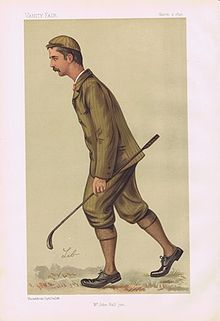
John Ball’s ‘Vanity Fair’ picture

After his 6th Amateur win in 1907 at St. Andrews he was made an honorary member of the R&A.

He served for the Cheshire Yeomanry in the Second Boer War (October 1899 – May 1902) in South Africa.  During this period he played next to no golf and missed three Amateur Championships.  Indeed one of his fiercest competitors, Scotland’s Freddie Tait, was killed in the same conflict.  His later competitive years would also have been impacted by World War I (1915-19) when he served in the Home Forces and most competitions were cancelled.

Ball was a quiet, retiring, introverted character who said very little to anyone.  It is next to impossible to find any written words or quotes from the great man.  He was very modest preferring to let his golf do the talking for him.  This approach created a certain mythology around him which remains to this day.  The quality of his game meant that he was the first player to consistently go for nearly every flag, whereas his peers simply played for the green.  This led to many memorable, heroic shots in his matches which spectators would talk about for days afterwards.  It also helped nullify his main weakness which was his putting.

He was a traditionalist who fought against the introduction of the lofted iron.  He described the niblick (a modern 8-iron), which he refused to carry, as “just another bloody spade” and felt it de-skilled the game he loved.  He believed players should simply adjust the lie of their existing mid-iron clubs with their grip when height was required on an approach shot.

He retired a ‘legend in his own lifetime’ to his farm in Holywell, Flintshire in nearby North Wales where he eventually died on 2nd December 1940, just shy of his 79th birthday.

John Ball 3

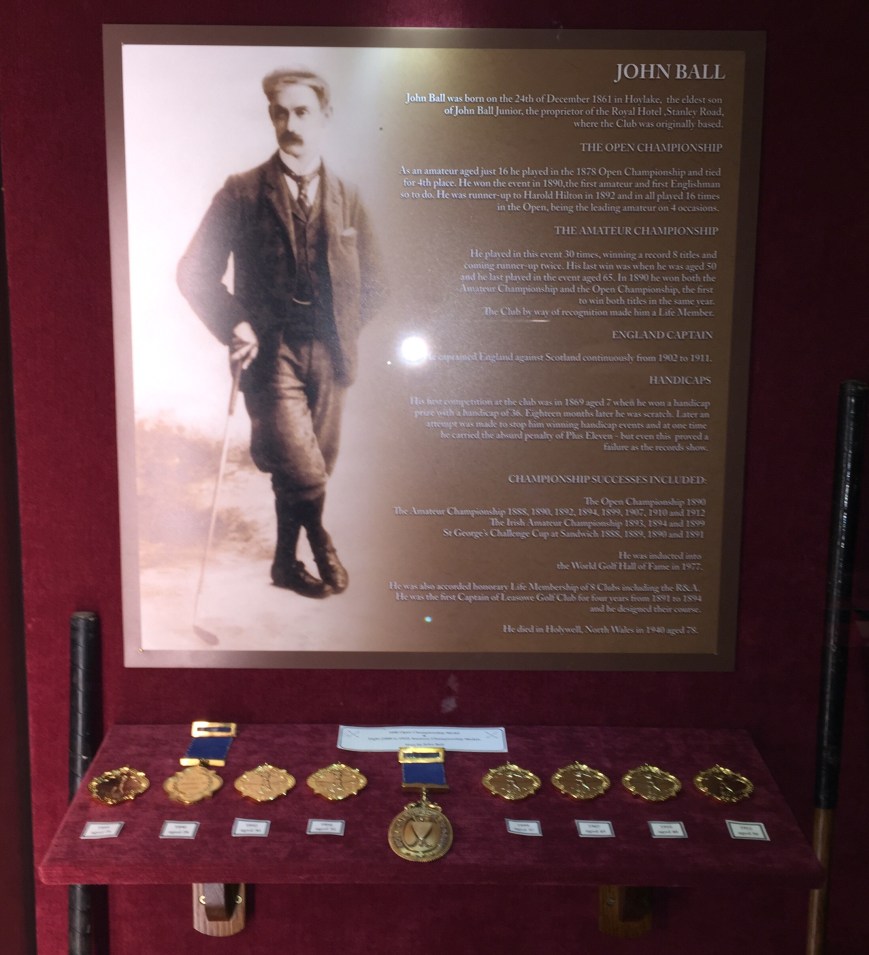
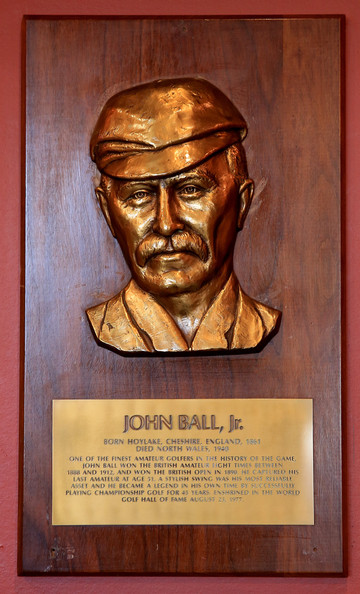
John Ball’s World Gall Hall of Fame Plaque

He was inducted into the World Golf Hall of Fame in 1977 and the England Golf Hall of Fame in March 2026.

John Ball is a true great of the game who undoubtedly helped spread the popularity of the sport in Great Britain and Ireland in the early 20th Century.  He is clearly someone whose legacy should not be allowed to fade away and who should be remembered by us all.

ME.

Copyright © 2014-2025, Mark Eley. All rights reserved.

European Tour Q-School Finances 2014

20th November 2014

The 2014 European Tour Qualifying School (Q-School) came to a close this afternoon with 27 players earning a European Tour card for the 2015 season.  All of the 76 professionals who made the cut shared a prize fund of €152,278 with the winner, Finland’s Mikko Korhonen, taking home €16,000.  I am sure the money is not that important to the qualifiers.  It was always about the ‘golden tickets’ and the opportunity that now lies before them.

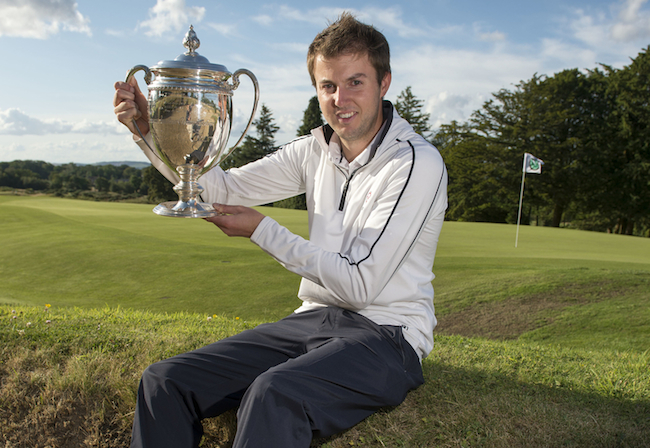
Mikko Korhonen

2014 Q-School Winner – Mikko Korhonen (Photo: Getty Images / European Tour)

Whilst the wannabes will now be reflecting on their season the Tour’s superstars have today also teed off in the Dubai Ports World Tour Championship, the European Tour’s season finale.  The Top 60 players on The Road To Dubai (R2D) 2014 Order of Merit will be fighting it out for the US$8m prize fund and on Sunday the Final 15 will also carve up a US$5m R2D Bonus Pool.

The difference in prize money at the two ends of the European professional golf spectrum couldn’t be more clearly highlighted than during this week. This got me thinking about the Q-School’s finances and how it must feel to be one of the 899 ‘unsuccessful’ players.

I was surprised to discover a few weeks ago that the 2014 Q-School entry fee was “€1,725 (or the sterling equivalent of £1,400)”.  This seemed expensive to me, particularly when I considered who the majority of the participants were likely to be.  Even more so when I added on the accompanying travel, accommodation and possibly caddie costs associated with competing.

I estimate it costs a Q-School competitor anything between £500 and £5,000 in ancillary costs. The amount obviously depends on where they enter the process and how far they go.

European Tour QS

First Stage entries closed on 27th August, with later cut-offs put in place for those exempt from the First (27th October) and Second Stages (6th November).  All of the players have had to pay the full fee irrespective of their entry point into the qualification process.

So let’s have a look at how each stage has gone from the financial perspective of the European Tour:-

First Stage Q-School
Eight 72-hole First Stage events were held across Europe between 9th September and 3rd October on eight different courses.  102 places were available at each First Stage course, meaning a maximum of 816 players could have entered the process right at the beginning.

In the end 737 scratch or better players teed off.  Therefore the European Tour received First Stage entrance fees of €1,271,325.  Prize money of €5,000 was paid to the Top 5 professionals at each First Stage event.  In addition to this €40,000 the European Tour will have also incurred staff costs as well as host course fees in staging these qualifiers.  €25,000 per venue doesn’t appear unreasonable to me after allowing for the marketing benefits / hospitality income that could be realised by the venues.  Allowing for other upfront administrative costs and some contingencies (say, €60,000) I estimate the Tour will have spent c.€300,000 completing the First Stage.  It should therefore have generated a surplus to take to Second Stage of around €975,000.

Second Stage Q-School
Four 72-hole Second Stage events were held between the 7th and 10th November.  The fields were made up of 191 First Stage qualifiers and a 102 exempt players who had earned the right to enter the process at the Second Stage.

102 new players means additional entry fees of €175,950.  The Second Stage prize fund remained at €5,000 per site.  Deducting costs for staff and courses of, say €125,000, means it is not unreasonable to think that a further c.€30,000 may have been added to the rolling surplus.

Final Stage Q-School
A field of 156 started the 108-hole Final Stage event at PGA Catalunya which ended today.

87 golfers were exempt to this Stage, meaning an additional entry fee income of €150,075.  The total entry fees received this year have therefore been €1,438,990 by my calculation.

The PGA Catalunya Resort courses are taken out of play for a week which is not going to come cheap albeit the prestige of hosting the dramatic Final Stage must count for something.  Let’s assume a deal has been done for €50,000.  If I deduct staff costs of €25,000 and the above-mentioned prize money of €152,278 that leaves a standalone Final Stage deficit of -€77,203.

Adding up the figures from each Stage suggests that the European Tour will leave Spain with a surplus of c.€930,000.

I believe making such a profit out of the Q-School is unfair.  I appreciate that the European Tour has many other costs to meet during the year and perhaps it is unfair to look at this specific event in isolation.  I also know that many tournaments are increasingly requiring subsidies to keep them going.  However, the Tour also has a TV broadcasting contract with Sky and does it not share in the proceeds of the Ryder Cup too.  Without seeing their accounts it is of course hard to comment with real clarity.

Nevertheless it does seem inequitable to me that many golfers are asked to incur quite sizeable costs for a ticket to the Q-School lottery for a European Tour card.  By definition many of them will be just starting out or have found it difficult to make a living as a Touring Pro to date.  Surely the costs could be reduced in someway, even pro rated depending on status or better still the prize money across the three stages increased.

In many ways the current arrangements appear to be a case of ‘robbing the poor, to pay the rich’, particularly when you look at the riches available in Dubai this week. The implication has to be that the Q-School surplus is needed to help keep the main European Tour (and probably the Challenge Tour) going throughout the year.  I know this is naive, given the dog-eat-dog world of professional sport, but shouldn’t the Main Tour players be helping to achieve this as they are the ones who really benefit from it.  Higher tournament entry fees (do they pay these ?) or slightly lower prize funds every week could help in this regard.   I was pleased to read this week that Rory McIlroy, via his Foundation, was putting something back into the game and supporting the 2015 Irish Open at Royal County Down.  More of this is needed from our multi-millionaire golfers.

Rory McIlroy DPWTC

Rory McIlroy tees off at the DP World Tour Championship (Photo: Getty Images / European Tour) 

Am I missing something ?  If so what ?

Good luck to the 27 golfers who have secured their Category 15 2015 European Tour playing rights today (and those who have gained other Categories and / or rights on the Challenge Tour) but do spare a thought for the other 899 who haven’t and have once again lost a lot of money pursuing their dreams over the last few weeks and months.

ME.

Copyright © 2014, Mark Eley. All rights reserved.
ET Final Stage Q-School 2014: Day 4 Cut

18th November 2014

European Tour QS

The 72-hole cut has today been made at the Final Stage European Tour Qualifying School (Q-School) event at the PGA Catalunya Resort in Spain.

The 926 players who entered Q-School had already been whittled down to 156 by the start of Final Stage qualifying.  We are now down to the final 78, all of whom scored -1 or better over the first four days.

The final 36-holes will now take place on the 7,333 yard, Par 72 Stadium Course, starting tomorrow.

To recap once play is complete on Thursday:-
– the top 25 players (and ties) are eligible for Cat. 15 European Tour and Cat. 5 Challenge Tour membership.
– those that made the cut are eligible for Cat. 20 European Tour and Cat. 9 Challenge Tour membership.
– Players who failed to make the cut will be eligible for Category 15 membership of the Challenge Tour.

So let’s have a look at how the 51 GB&I players have got on so far.  I have listed each player below.  The colour, as you see from the Notes, signifies where they entered the Q-School process.

Notes
Final Stage Qualifying Entrants (25)
Second Stage Qualifying Entrants (14)
First Stage Qualifying Entrants (12)
* Geoff turned Pro. ahead of competing at Second Stage Q-School.
~ Zander and Renato turned Pro. ahead of playing in the Final Stage.

Made Cut

  •  1st  Matt Ford (ENG)  74, 64, 65, 68  -13
  •  8th  Richard McEvoy (ENG)  73, 65, 64, 72  -10
  • T  9  Chris Lloyd (ENG)  72, 66, 66, 71  -9
  • T12  John Parry (ENG)  68, 68, 71, 69  -8
  • T12  Tom Murray (ENG)  76, 64, 63, 73  -8
  • T12  Paul Maddy (ENG)  67, 72, 68, 69  -8
  • T12  Stuart Manley (WAL)  66, 72, 67, 71  -8
  • T20  Andrew Marshall (ENG)  69, 71, 69, 68  -7
  • T20  Chris Paisley (ENG)  70, 69, 68, 70  -7
  • T26  Max Orrin (ENG)  69, 73, 66, 70  -6
  • T26  Kenneth Ferrie (ENG)  66, 75, 65, 72  -6
  • T26  Kevin Phelan (IRE)  69, 72, 65, 72  -6
  • T37  Matthew Fitzpatrick (ENG)  70, 66, 67, 76  -5
  • T37  David Dixon (ENG)  68, 72, 65, 74  -5
  • T37  Peter Lawrie (IRE)  71, 67, 67, 74  -5
  • T43  Simon Thornton (IRE)  68, 69,67, 76  -4
  • T43  Sam Walker (ENG)  66, 71, 68, 75  -4
  • T49  Phillip Archer (ENG)  68, 74, 72, 67  -3
  • T49  Peter Whiteford (SCO)  77, 66, 65, 73  -3
  • T49  Ben Evans (ENG)  73, 68, 66, 74  -3
  • T54  Scott Fallon (ENG)  72, 65, 71, 74  -2 
  • T54  Garrick Porteous (ENG)  80, 64, 69, 69  -2
  • T54  Duncan Stewart (SCO)  67, 76, 71, 68  -2
  • T54  Gary Lockerbie (ENG)  76, 67, 70, 69  -2
  • T54  Gareth Maybin (NI)  74, 71, 72, 65  -2 
  • T67  Dave Coupland (ENG)  76, 70, 69, 68  -1 
  • T67  Scott Henry (SCO)  70, 72, 68, 73  -1
  • T67  Simon Griffiths (ENG)  76, 68, 67, 72  -1
  • T 2 Renato Paratore (ITA)~ 67, 70, 66, 69  -12
  • T12 Emilio Cuartero Blanco (AM) (SPA) 74, 65, 66, 71  -8

Comments
– 28 out of the 51 GB&I players (55%) who started the Final Q-School event on Saturday have made the cut.
– Based on point of entry those who made the cut came from – Final Stage 15, Second Stage 9 and First Stage 4. 
– However, just 9 of the 28 are inside the important Top 25.
– After a slow start Matt Ford (ENG) has recorded three superb rounds.  Today he recorded his second eagle and had a bogey free round on the Stadium Course.
Tom Murray (ENG) is well placed on -8 and T12 to complete the full Q-School journey as a First Stage entrant.
Garrick Porteous (ENG) has again showed great mental strength.  To make the cut on -2 after a Rd. 1 80 (+8) is impressive.  He was also +4 after 5 holes today before recovering to shoot 69 (-1)
Gareth Maybin (NI) 65, Phillip Archer (ENG) 67, Dave Coupland (ENG) 68, Duncan Stewart (SCO) 68 Gary Lockerbie (ENG) 69 also all played their way into the Cut today.

Other News
– 17 year old Renato Paratore’s (ITA) decision to turn Pro ahead of the Final Q-School is looking inspired.
– Emilio Cuartero Blanco (SPA) is the last Amateur still competing.
– John Hahn’s (USA) 58 (-12) Rd. 4 on the Tour Course saw him rise 92 places and make the cut in T12 (-8)

John Hahn 58 Scorecard

Missed Cut

  • T79   William Harrold (ENG)  Par
  • T90   Callum Shinkwin (ENG)  +2
  • T90   Ross Kellett (SCO)  +2
  • T90   Nathan Kimsey (ENG)  +2
  • T101 Simon Wakefield (ENG)  +3
  • T101 Wallace Booth (SCO)  +3
  • T101 Garry Houston (WAL)  +3
  • T101 Lloyd Kennedy (ENG)  +3
  • T101 Toby Tree (ENG)  +3
  • T111 Ben Parker (ENG)  +4
  • T111 Michael McGeady (IRE)  +4
  • T116 Lee Slattery (ENG)  +5 
  • T126 Robert Coles (ENG)  +7
  • T126 Billy Hemstock (ENG)  +7
  • T131 Matthew Southgate (ENG)  +8
  • T131 Paul Howard (AM) (ENG)  +8
  • T131 Nick Dougherty (ENG)  +8
  • T136 Neil Chaudhuri (ENG)  +9
  • 144th Rhys Davies (WAL)  +12
  • 145th Ross McGowen (ENG)  +14
  • RETD Stephen Dodd (WAL) 
  •  W/D  Phillip Price (WAL)  
  •  W/D Jamie Elson (ENG)
  • T111 Geoff Drakeford (AUS)*  +4
  • T121 Zander Lombard (SA)~  +6

The European Tour’s Final Q-School Leaderboard can be viewed by clicking here – Live Scores.

ME.

Copyright © 2014, Mark Eley. All rights reserved.
How did the 2013 Q-School Graduates Get On ?

18th November 2014

European Tour QS

This time last year 27 players obtained a Category 15 Card via the Final Q-School event at PGA Catalunya.

So how did last year’s European Tour graduates get on in 2014 ?

Following last weekend’s Turkish Airlines Open The Race To Dubai (R2D) Rankings now confirm the following results: –
2 – Finished R2D Top 60, qualifying for the DP World Tour Championship.
6 – Finished R2D 66th – 111th, securing a Cat. 10 2015 ETCard.
1 – Finished R2D > 111th but won a 2014 ET winner (Cat. 5 membership).
9 – Finished R2D > 111th, currently playing at Final Q-School.
6 – Finished R2D > 145th, failed to progress from Second Stage Q-School.
3 – Finished R2D > 145th, status / plans currently unclear.

Therefore: –
30% of the players retained their European Tour cards for the 2015 season.
4% won a tournament and therefore have some 2015 playing rights.
33% can still salvage the year by coming through Final Q-School this week.
33% are already seeking alternative playing options for next year.

The two ‘stars’ were Fabrizio Zanotti (33rd) and Wade Ormsby (49th), the latter playing his way into the Tour Championship last week in Turkey.

If proof were required of the high standards required here it is.  The message seems to be Q-School may be hard to get through but staying on the European Tour thereafter is even harder.  Let no one tell you that the life of a professional golfer is anything other than a tough one.

The specific player results were as follows: –

1. Carlos DEL MORAL (Spa) -26
R2D €217,778 (113th) – 29 events / AT FINAL Q-SCHOOL

2. Fabrizio ZANOTTI (Par) -21
R2D €1,004,024 (33rd) – 27 events / TOP 60 CARD RETAINED

3. Marco CRESPI (Ita) -15
R2D €241,717 (105th) – 26 events / TOP 111 CARD RETAINED

4. Gary STAL (Fra) -14
R2D €294,998 (89th) – 25 events / TOP 111 CARD RETAINED

5. Mikael LUNDBERG (Swe) -13
R2D €269,690 (96th) – 24 events / TOP 111 CARD RETAINED

6. Adrien SADDIER (Fra) -13
R2D €176,547 (127th) – 27 events / AT FINAL Q-SCHOOL

7. John HAHN (USA) -13
R2D €197,124 (120th) – 22 events / AT FINAL Q-SCHOOL

8. Connor ARENDELL (USA) -12
R2D €19,073 (219th) – 13 events / WEB.COM Q-SCHOOL

9. Wade ORMSBY (Aus) -12
R2D €741,089 (49th) – 27 events / TOP 60  CARD RETAINED

10. Stuart MANLEY (Wal) -12
R2D €182,305 (125th) – 29 events / AT FINAL Q-SCHOOL

11. James MORRISON (Eng) -12
R2D €302,098 (88th) – 28 events / TOP 111 CARD RETAINED

12. James HEATH (Eng) -11
R2D €111,257 (151st) – 23 events / SECOND STAGE Q-SCHOOL (T21)

13.  Simon WAKEFIELD (Eng) -11
R2D €135,575 (142nd) – 26 events / AT FINAL Q-SCHOOL

14. Jens DANTORP (Swe) -11
R2D €85,408 (154th) – 23 events / SECOND STAGE Q-SCHOOL (T56)

15. Brinson PAOLINI (USA) -11
R2D €50,103 (177th) – 23 events / SECOND STAGE Q-SCHOOL (T41)

16. Patrik SJÖLAND (Swe) -11 / UNKNOWN
R2D €61,957 (168th) – 17 events

17. Kevin PHELAN (Ire) -10
R2D €174,382 (129th) – 26 events / AT FINAL Q-SCHOOL

18. Andreas HARTØ (Den) -10
R2D €73,299 (163rd) – 26 events / SECOND STAGE Q-SCHOOL (T58)

19. Daniel BROOKS (Eng) -10
R2D €138,641 (140th) – 24 events / WON 2014 MADEIRA OPEN (CAT. 5)

20. Thomas PIETERS (Bel) -10
R2D €332,371 (83rd) – 27 events / TOP 111 CARD RETAINED

21. Lucas BJERREGAARD (Den) -10
R2D €291,549 (90th) – 26 events / TOP 111 CARD RETAINED

22. Jason KNUTZON (USA) -9
R2D €119,040 (149th) – 21 events / AT FINAL Q-SCHOOL

23. Mikko KORHONEN (Fin) -9
R2D €174,775 (128th) – 21 events / AT FINAL Q-SCHOOL

24. Estanislao GOYA (Arg) -9
R2D €136,954 (141st) – 21 events / AT FINAL Q-SCHOOL

25. Jack DOHERTY (Sco) -9
R2D €51,630 (175th) – 22 events / SECOND STAGE Q-SCHOOL (T27)

26. Adam GEE (Eng) -9
R2D €117,527 (150th) – 23 events / SECOND STAGE Q-SCHOOL (T21)

27. Alistair FORSYTH (Sco) -9
R2D €83,020 (157th) – 24 events / UNKNOWN

ME.

Copyright © 2014, Mark Eley. All rights reserved.
ET Final Stage Q-School 2014: Preview

14 November 2014

European Tour QS

The Final Stage European Tour Qualifying School (Q-School) event starts tomorrow at the PGA Catalunya Resort near Girona in North East Spain. The Final has been held here since 2008.

By way of briefing I thought I would lay out some background information for you: –

1) The entry fee for the 2014 European Tour Q-School was €1,725 (c.£1,400).  All players who compete must pay this sum irrespective of their Qualifying entry point.

2) 737 players entered at the First Stage competing in eight 72-hole events across Europe between 9th September and 3rd October on eight different courses.  Each competition had a prize fund of €5,000.

3) Four Second Stage 72-hole events were held between the 7th and 10th November.  The field of 293 consisted of 191 First Stage qualifiers and a 102 exempt players who had earned the right to enter the process at this next level.  110 players from Great Britain & Ireland (GB&I) competed in these qualifiers.  Again the prize fund for each competition was €5,000.

4) A field of 156 golfers will compete in the 108-hole (6 rounds) Final Stage competition which starts tomorrow.  Two courses are used; the Stadium (7,333 yards / Par 72) and the Tour (6,610 yards / Par 70).  Prior to the 72-hole cut two rounds are played on each.  The final two rounds are played by the leading 70 players on the Stadium Course.

5) All players competing at the Final Stage will be ranked according to their score.  The leading 25 players (and ties) are eligible for Category 15 membership of the European Tour (and Category 5 membership of the Challenge Tour) for the 2015 season.  The remainder of those making the cut will be eligible for Category 20 membership of the European Tour (and Category 9 membership of the Challenge Tour).  Players who miss the cut will be eligible for Category 15 membership of the Challenge Tour.   Information on the European Tour membership categories can be found here.  The prize fund is yet to be confirmed but last year it was €150,000.

6) 28 different countries are represented in the Final Stage.  The standard is high – 29 players have previously won a European Tour event and between them they account for a total of 49 Tour victories.  Two players, Phillip Price and Ignacio Garrido have represented Europe in the Ryder Cup.

7) Out of the 156 players 87 were exempt into the Final Stage, 30 players were exempt into the Second Stage and 39 players started at the First Stage.  In total 926 players will have therefore entered the 2015 Q-School.  As this is the seventh successive year that the final has been held at PGA Catalunya the two courses will be familiar to many of the players.

8) England are the best represented country with 36 competitors. Sweden have 18 players, France 14, Spain 12, Australia 7, South Africa 6 and Germany 5.  Scotland 5, Wales 5, Ireland 4 and Northern Ireland 1 make up the home nations.

9) The GB&I competitors are listed below with their entry points.  I am particularly interested in the First Stage qualifiers as it is clearly some achievement to successfully negotiate all 252 Q-School holes and to secure a Card.  Good luck to all of our players but particularly this group.

Final Stage Qualifying Entrants – 25 Players

  • Phillip Archer (ENG)
  • Robert Coles (ENG)
  • Dave Coupland (ENG)
  • Rhys Davies (WAL)
  • David Dixon (ENG)
  • Stephen Dodd (WAL)
  • Nick Dougherty (ENG)
  • Ben Evans (ENG)
  • Kenneth Ferrie (ENG)
  • William Harrold (ENG)
  • Scott Henry (SCO)
  • Peter Lawrie (IRE)
  • Gareth Maybin (NI)
  • Stuart Manley (WAL)
  • Andrew Marshall (ENG)
  • Ross McGowen (ENG)
  • Max Orrin (ENG)
  • John Parry (ENG)
  • Kevin Phelan (IRE)
  • Phillip Price (WAL)
  • Callum Shinkwin (ENG)
  • Lee Slattery (ENG)
  • Simon Thornton (IRE)
  • Simon Wakefield (ENG)
  • Peter Whiteford (SCO)

Second Stage Qualifying Entrants – 14 players

  • Wallace Booth (SCO)
  • Jamie Elson (ENG)
  • Matthew Fitzpatrick (ENG)
  • Matt Ford (ENG)
  • Billy Hemstock (ENG)
  • Lloyd Kennedy (ENG)
  • Nathan Kimsey (ENG)
  • Gary Lockerbie (ENG)
  • Chris Lloyd (ENG)
  • Paul Maddy (ENG)
  • Richard McEvoy (ENG)
  • Chris Paisley (ENG)
  • Duncan Stewart (SCO)
  • Sam Walker (ENG)

First Stage Qualifying Entrants – 12 players

  • Neil Chaudhuri (ENG) – Frilford Heath – Blue
  • Scott Fallon (ENG) – The Roxburghe
  • Simon Griffiths (ENG) – Golf d’Hardelot
  • Garry Houston (WAL) – Golf d’Hardelot (17th Q-School app.)
  • Paul Howard (AM) (ENG) – Frilford Heath – Red
  • Ross Kellett (SCO) – Frilford Heath Blue
  • Michael McGeady (IRE) – Golf d’Hardelot
  • Tom Murray (ENG) – The Roxburghe
  • Ben Parker (ENG) – Fleesensee
  • Garrick Porteous (ENG) – The Roxburghe
  • Matthew Southgate (ENG) – Frilford Heath – Blue
  • Toby Tree (ENG) – Golf d’Hardelot

10) I am also keeping an eye on the overseas ‘Amateurs’ who are still in play, some of whom have turned Pro during the Q-School process: –

Other Overseas Notables

  • Emilio Cuartero Blanco (AM) (SPA) – 1st Stage (Bogogno)
  • Geoff Drakeford* (AUS) – 1st Stage (Frilford Heath – Red)
  • Zander Lombard~ (SA) -1st Stage (Ribagolfe)
  • Renato Paratore~ (ITA) – 2nd Stage (WAGR ranking exemption)

* Geoff turned Pro. ahead of competing at Second Stage Q-School.
~ Zander and Renato are turning Pro. ahead of playing in the Final Stage.

To follow the European Tour’s Final Stage Q-School Live Scoring link click here.

ME.

Copyright © 2014, Mark Eley. All rights reserved.
ET Second Stage Q-School 2014: Day 4

10th November 2014

European Tour QS

The Second Stage European Tour Qualifying School (Q-School) events have been completed today.  293 players competed over 72-holes across four different courses.  In the end there were 69 qualifying spots available across these venues – 17 each at El Saler, Lumine and Panoramica and 18 at Las Colinas.

110 players from Great Britain & Ireland (GB&I) started the Second Stage competitions.  26 of these have progressed to the Final Stage.  Matthew Cort sadly missed out in the Las Colinas play-off.  I have collated the 72-hole Second Stage results of the GB&I Amateurs, some of the GB&I Pro’s and various Overseas Notables below so you can quickly see who has qualified. Players in bold have qualified.

If you want to look at the detailed results for each venue simply click on the underlined Course Names and a link will take you to the European Tour’s live scoring page for that site.

The Final Stage Q-School will start at the PGA Catalunya Resort this coming Saturday, the 15th November.  The top 25 and tied finishers after six rounds will secure Category 15 European Tour cards for 2015.

Campo de Golf El Saler
6,449 yards, Par 72 – 29 GB&I players / 17 Qualifying Spots

  •  1st  Garry Houston (WAL)  70, 71, 71, 65 (-11)
  •  3rd  Simon Griffiths (ENG)  72, 69, 69, 69 (-9)
  • T  5  Matthew Fitzpatrick (ENG)  72, 72, 67, 71 (-6)
  • T  5  Ben Parker (ENG)  71, 72, 68, 71 (-6)
  • T  5  Wallace Booth (SCO)  73, 68, 69, 72 (-6)
  • T  8  Billy Hemstock (ENG)  73, 72, 68, 71 (-4)
  • T12  Neil Chaudhuri (ENG)  72, 71, 72, 70 (-3)
  • T12  Michael McGeady (IRE)  73, 70, 72, 70 (-3)
  • T15  Chris Lloyd (ENG)  72, 69, 72, 73 (-2)
  • T18  Aaron Rai (ENG)  77, 74, 67, 69 (-1)
  • T18  Ryan Evans (ENG)  76, 70, 67, 74 (-1)
  • T21  Dominic Foos (GER)  74, 73, 72, 69 (Par)
  • T30  Elliott Saltman (SCO)  77, 70, 76, 68 (+3)
  • T50  Joshua White (ENG)  75, 73, 74, 75 (+9)

Las Colinas Golf & Country Club
6,974 yards, Par 71 – 25 GB&I players / 17 Qualifying Spots

  •  1st  Chris Paisley (ENG)  66, 66, 69, 66 (-17)
  • T  2  Sam Walker (ENG)  68, 63, 66, 73 (-14)
  • T  4  Jamie Elson (ENG)  65, 68, 68, 71 (-12)
  • T  6  Scott Fallon (ENG)  67, 69, 69, 69 (-10)
  • T  6  Richard McEvoy (ENG)  67, 65, 71, 71 (-10)
  • T  9  Lloyd Kennedy (ENG)  69, 70, 68, 68 (-9)
  • T  9  Emilio Cuartero Blanco (AM) (SPA)  69, 70, 66, 70 (-9)
  • T16  Geoff Drakeford* (AUS)  69, 67, 69, 72 (-7) AFTER PLAY OFF
  • T16  Matthew Cort (ENG)  70, 70, 69, 68 (-7)
  • T20  Raymond Russell (SCO)  68, 70, 71, 69 (-6)
  • T27  Jordan Smith (ENG)  73, 67, 69, 70 (-5)
  • T41  Alexander Culverwell (AM) (SCO)  66, 73, 74, 70 (-1)
  • T46  Chris Robb (SCO)  69, 72, 69, 74  (Par)
  • T51  Zane Scotland (ENG)  68, 69, 73, 75 (+1)

Lumine Golf & Beach Club (Lakes)
6,909 yards, Par71 – 27 GB&I players / 17 Qualifying Spots

  • T  4  Paul Maddy (ENG)  75, 65, 65, 65 (-14)
  • T10  Matt Ford (ENG)  76, 66, 70, 62 (-10)
  • T10  Paul Howard (AM) (ENG)  70, 67, 68, 69 (-10)
  • T14  Garrick Porteous (ENG)  67, 77, 64, 67 (-9)
  • T14  Nathan Kimsey (ENG)  72, 67, 69, 67 (-9)   
  • T16  Daniel Givens (ENG)  68, 70, 72, 66 (-8)
  • T21  James Heath (ENG)  72, 65, 71, 69 (-7)
  • T21  Neil Kearney (IRE)  70, 69, 66, 72 (-7)
  • T25  Neil Fenwick (SCO)  72, 67, 69, 70 (-6)
  • T32  Steven Tiley (ENG)  70, 69, 69, 71 (-5)
  • T34  Stiggy Hodgson (ENG)  73, 71, 70, 66 (-4)
  • T37  Luke Johnson (AM) (ENG)  75, 68, 70, 68 (-3)
  • T41  Ashley Chesters (AM) (ENG)  72, 66, 72, 72 (-2)
  • T64  Neil Raymond (ENG)  72, 70, 73, 76 (+7)

Panoramica Golf & Sport Resort
7,030 yards, Par 72 – 29 GB&I players / 17 Qualifying Spots

  •  1st  Matthew Southgate (ENG)  66, 69, 64, 67 (-22)
  • 2nd  Toby Tree (ENG)  66, 67, 65, 69 (-21)
  • T  8  Ross Kellett (SCO)  71, 68, 68, 65 (-16)
  • T  8  Renato Paratore (AM) (ITA)  70, 65, 71 (-16)
  • T  8  Duncan Stewart (SCO)  75, 63, 67, 67 (-16)
  • T13  Tom Murray (ENG)  65, 73, 66, 70 (-14)
  • T15  Zander Lombard (AM) (SA)  68, 70, 70, 67 (-13) AFTER PLAY-OFF
  • T15  Gary Lockerbie (ENG)  72, 67, 68, 68 (-13) AFTER PLAY-OFF
  • T24  Martin Sell (ENG)  68, 66, 69, 74 (-11)
  • T51  Scott Borrowman (AM) (SCO)  68, 71, 75, 69 (-5)
  • T56  Mark Young* (ENG)  72, 71, 70, 71 (-4)
  • 68th  Luke Joy (ENG)  75, 69, 72, 73 (+1)

* Turned Professional ahead of Q-School.

ME.

Copyright © 2014, Mark Eley. All rights reserved.
ET Second Stage Q-School 2014: Day 3

9th November 2014

European Tour QS

The Second Stage European Tour Qualifying School events started on Friday in Spain. 293 players are competing over 72-holes across four venues.  All are looking to progress to the Final Stage which will take place at the PGA Catalunya Resort between 15th and 20th November. Ultimately the top 25 and tied finishers will secure Category 15 European Tour cards via the Q-School series.

I have collated the 54-holes scores of the GB&I Amateurs, some of the GB&I Pro’s and various Overseas Notables below.

This week there are 68 qualifying spots available across the four venues – 17 at El Saler, Las Colinas, Lumine and Panoramica (an extra one was added to Panoramica overnight).

If you want to look at the detailed results for each venue simply click on the underlined Course Names and a link will take you to the European Tour’s live scoring page for that site.

Campo de Golf El Saler
6,449 yards, Par 72 – 29 GB&I players / 17 Qualifying Spots

  • T  1  Wallace Booth (SCO)  73, 68, 69 (-6)
  • T  1  Simon Griffiths (ENG)  72, 69, 69 (-6)
  • T  4  Matthew Fitzpatrick (ENG)  72, 72, 67 (-5)
  • T  4  Ben Parker (ENG)  71, 72, 68 (-5)
  • T  6  Garry Houston (WAL)  70, 71, 71 (-4)
  • T  8  Chris Lloyd (ENG) 72, 69, 72 (-3)
  • T  8  Ryan Evans (ENG)  76, 70, 67 (-3)
  • T  8  Billy Hemstock (ENG)  73, 72, 68 (-3)
  • T16  Neil Chaudhuri (ENG)  72, 71, 72 (-1)
  • T16  Michael McGeady (IRE)  73, 70, 72 (-1)
  • T26  Dominic Foos (GER)  74, 73, 72 (+3)
  • T42  Joshua White (ENG)  75, 73, 74 (+6)
  • T48  Elliott Saltman (SCO)  77, 70, 76 (+7)

Las Colinas Golf & Country Club
6,974 yards, Par 71 – 25 GB&I players / 17 Qualifying Spots

  • T  1  Sam Walker (ENG)  68, 63, 66 (-16)
  • T  2  Jamie Elson (ENG)  65, 68, 68 (-12)
  • T  2  Chris Paisley (ENG)  66, 66, 69 (-12)
  • T  6  Richard McEvoy (ENG)  67, 65, 71 (-10)
  • T  8  Alex Wrigley (ENG)  69, 69, 66 (-9)
  • T10  Scott Fallon (ENG)  67, 69, 69 (-8)
  • T10  Emilio Cuartero Blanco (AM) (SPA)  69, 70, 66 (-8)
  • T10  Geoffrey Drakeford* (AUS)  69, 67, 69 (-8)
  • T25  Jordan Smith (ENG)  73, 67, 69 (-4)
  • T25  Raymond Russell (SCO)  68, 70, 71 (-4)
  • T38  Chris Robb (SCO)  69, 72, 69 (-3)
  • T38  Zane Scotland (ENG)  68, 69, 73 (-3)
  • T54  Alexander Culverwell (AM) (SCO)  66, 73, 74 (Par)

Lumine Golf & Beach Club (Lakes)
6,909 yards, Par71 – 27 GB&I players / 17 Qualifying Spots

  • T  6  Paul Howard (AM) (ENG)  70, 67, 68 (-8)
  • T  6  Neil Kearney (IRE)  70, 69, 66 (-8)
  • T  6  Paul Maddy (ENG)  75, 65, 65 (-8)
  • T14  James Heath (ENG)  72, 65, 71 (-5)
  • T14  Garrick Porteous (ENG)  67, 77, 64 (-5)
  • T14  Neil Fenwick (SCO)  72, 67, 69 (-5)
  • T14  Steven Tiley (ENG)  70, 69, 69 (-5)
  • T14  Nathan Kimsey (ENG)  72, 67, 69 (-5)
  • T26  Ashley Chesters (AM) (ENG)  72, 66, 72 (-3)
  • T46  Luke Johnson (AM) (ENG)  75, 68, 70 (Par)
  • T52  Stiggy Hodgson (ENG)  73, 71, 70 (+1)
  • T57  Neil Raymond (ENG)  72, 70, 73  (+2)

Panoramica Golf & Sport Resort
7,030 yards, Par 72 – 29 GB&I players / 17 Qualifying Spots

  •  1st  Toby Tree (ENG)  66, 67, 65  (-18)
  • 2nd  Matthew Southgate (ENG)  66, 69, 64  (-17)
  • T  7  Martin Sell (ENG)  68, 66, 69  (-13)
  • T  9  Tom Murray (ENG)  65, 73, 66  (-12)
  • T13  Duncan Stewart (SCO)  75, 63, 67 (-11)
  • T15  Renato Paratore (AM) (ITA)  70, 65, 71 (-10)
  • T28  Zander Lombard (AM) (SA)  68, 70, 70 (-8)
  • T54  Mark Young* (ENG)  72, 71, 70  (-3)
  • T59  Scott Borrowman (AM) (SCO)  68, 71, 75 (-2)
  • T66  Luke Joy (ENG)  75, 69, 72  (Par)

* Turned Professional ahead of Q-School.

ME.

Copyright © 2014, Mark Eley. All rights reserved.

ET Second Stage Q-School 2014: Day 2

8th November 2014

European Tour QS

Second Stage European Tour Qualifying School events started yesterday in Spain.  293 players are competing across four venues, all looking to progress to the Final Stage which will take place at the PGA Catalunya Resort between 15th and 20th November.  Ultimately the top 25 and tied finishers will secure Category 15 European Tour cards via the Q-School series.

I have collated the scores of the GB&I Amateurs, some of the GB&I Pro’s and various Overseas Notables below.

There are 67 qualifying spots across the four venues – 17 at El Saler, Las Colinas, Lumine and 16 at Panoramica.

If you want to look at the detailed results for each venue simply click on the underlined Course Names and a link will take you to the European Tour’s live scoring page for that site.

Campo de Golf El Saler (6,449 yards, Par 72) – 29 GB&I players.

17 Qualifying Spots

  • T  1  James Ablett (ENG)  72, 69 (-3)
  • T  1  Simon Griffiths (ENG)  72, 69 (-3)
  • T  1  Garry Houston (WAL)  70, 71 (-3)
  • T11  Matthew Fitzpatrick (ENG)  72, 72 (Par)
  • T25  Ryan Evans (ENG)  76, 70 (+2)
  • T30  Elliott Saltman (SCO)  77, 70 (+3)
  • T30  Dominic Foos (GER)  74, 73 (+3)
  • T42  Joshua White (ENG)  75, 73 (+4)

Las Colinas Golf & Country Club (6,974 yards, Par 71) – 25 GB&I players.

17 Qualifying Spots

  • T  1  Sam Walker (ENG)  68, 63 (-11)
  • T  4  Jamie Elson (ENG)  65. 68 (-9)
  • T13  Geoffrey Drakeford* (AUS)  69, 67 (-6)
  • T17  Zane Scotland (ENG)  68, 69 (-5)
  • T21  Raymond Russell (SCO)  68, 70 (-4)
  • T27  Alexander Culverwell (AM) (SCO)  66, 73 (-3)
  • T34  Jordan Smith (ENG)  73, 67 (-2)
  • T42  Chris Robb (SCO)  69, 72 (-1)

Lumine Golf & Beach Club (Lakes) (6,909 yards, Par71) – 27 GB&I players.

17 Qualifying Spots

  • T  6  James Heath (ENG)  72, 65 (-5)
  • T  6  Paul Howard (AM) (ENG)  70, 67 (-5)
  • T11  Ashley Chesters (AM) (ENG)  72, 66 (-4)
  • T17  Neil Kearney (IRE)  70, 69 (-3)
  • T17  Nathan Kimsey (ENG)  72, 67 (-3)
  • T36  Neil Raymond (ENG)  72, 70 (Par)
  • T44  Luke Johnson (AM) (ENG)  75, 68 (+1)
  • T55  Garrick Porteous (ENG)  67, 77 (+2)
  • T55  Stiggy Hodgson (ENG)  73, 71 (+2)

Panoramica Golf & Sport Resort (7,030 yards, Par 72) – 29 GB&I players.

16 Qualifying Spots

  • T  2  Toby Tree (ENG)  66, 67 (-11)
  • T  6  Martin Sell (ENG)  68, 66 (-10)
  • T10  Renato Paratore (AM) (ITA)  70, 65 (-9)
  • T10  Matthew Southgate (ENG)  66, 69 (-10)
  • T19  Lauri Ruuska (AM) (FIN)  70, 67 (-7)
  • T26  Tom Murray (ENG)  65, 73 (-6)
  • T26  Zander Lombard (AM) (SA)  68, 70 (-6)
  • T38  Scott Borrowman (AM) (SCO)  68, 71 (-5)
  • T56  Mark Young* (ENG)  72, 71 (-1)
  • T63  Luke Joy (ENG)  75, 69 (Par)

* Turned Professional yesterday.

ME.

Copyright © 2014, Mark Eley. All rights reserved.
ET Second Stage Q-School 2014: Day 1

7th November 2014

European Tour QS

The Second Stage European Tour Qualifying School events started today in Spain.  The 191 players who negotiated the First Stage have now been joined by 102 new players who through their past endeavours were exempt from September’s eight pre-qualifying competitions.

The six-round Final Stage will take place at the PGA Catalunya Resort between 15th – 20th November.  The number of qualifying spots available to the Final Stage will be confirmed tomorrow afternoon once the Challenge Tour Grand Final in Dubai has been concluded and that Tour’s rankings are finalised.

I thought it may be useful to collate the scores of the GB&I Amateurs, some GB&I Selected Pro’s and various Other Notables from the four courses in one place: –

Campo de Golf El Saler – 29 GB&I players in total.

  • T  9  Matthew Fitzpatrick (ENG)  72 (Par)
  • T27  Dominic Foos (GER)  74 (+2)
  • T36  Joshua White (ENG)  75 (+3)
  • T43  Ryan Evans (ENG)  76 (+4)
  • T53  Elliott Saltman (SCO)  77 (+5)

Las Colinas Golf & Country Club – 25 GB&I players in total.

  • T  2  Jamie Elson (ENG)  65 (-6)
  • T  5  Alexander Culverwell (AM) (SCO)  66 (-5)
  • T16  Zane Scotland (ENG)  68 (-3)
  • T16  Raymond Russell (SCO)  68 (-3)
  • T22  Chris Robb (SCO)  69 (-2)
  • T22  Geoffrey Drakeford* (AUS)  69 (-2)
  • T54  Jordan Smith (ENG)  73 (+2)

Lumine Golf & Beach Club (Lakes Course) – 27 GB&I players in total.

  • T  3  Garrick Porteous (ENG)  67 (-4)
  • T15  Paul Howard (AM) (ENG)  70 (-1)
  • T36  Ashley Chesters (AM) (ENG)  72 (+1)
  • T36  Nathan Kimsey (ENG)  72 (+1)
  • T36  Neil Raymond (ENG)  72 (+1)
  • T50  David Higgins (IRE)  73 (+2)
  • T50  Stiggy Hodgson (ENG)  73 (+2)
  • T62  Luke Johnson (AM) (ENG)  75 (+4)

Panoramica Golf & Sport Resort – 29 GB&I players in total.

  • T  2  Tom Murray (ENG)  65 (-7)
  • T  4  Toby Tree (ENG)  66 (-6)
  • T18  Zander Lombard (AM) (SA)  68 (-4)
  • T18  Scott Borrowman (AM) (SCO)  68 (-4)
  • T35  Renato Paratore (AM) (ITA)  70 (-2)
  • T52  Mark Young* (ENG)  72 (Par)
  • T68  Luke Joy (ENG)  75 (+3)

* Turned Professional today.  

If you click on the underlined Venue Names it will take you to the European Tour’s live scoring page for that site where you can see all of the day’s scores.

ME.

Copyright © 2014, Mark Eley. All rights reserved.

An Introduction To US College Golf

18th October 2014

Like most UK golfers I was aware of College golf in the United States (US).  I had heard TV commentators reference the stellar college records of Phil Mickelson and Tiger Woods at various times.  I also knew that from our side of the pond Graeme MacDowell and Luke Donald had studied and played golf in the US and done very well.  As that was broadly the extent of my knowledge I thought I should try and find out a bit more.

Here are the 8 key points I discovered: –

1) There are about 1,300 colleges and universities across the US.  Not surprisingly each one is different in terms of student numbers, sports facilities, budgets and scholarship packages.  In Year 1 a student is a ‘Freshman’, Year 2 a ‘Sophomore’, Year 3 a ‘Junior’ and finally in Year 4 a ‘Senior’.

2) Non-profit Athletic Associations organise competitive men’s and women’s sport for the US colleges.  It is big business too.  The better men’s football and basketball teams play in front of huge crowds, matches are televised and these sports generate millions of dollars of revenue for their institutions.  All other sports, of which golf is one, whilst prestigious to differing degrees, are unprofitable to run for their colleges.  The primary Association is the National Collegiate Athletic Association (NCAA).  This body focuses on the larger colleges.  It has history too – the first men’s golf event being staged in 1897.  The National Association of Intercollegiate Athletics (NAIA) performs a similar role for smaller colleges.  It has held a men’s golf championship since 1952.  The National Junior College Athletic Association (NJCAA) completes the group, arranging sporting events for community and junior colleges.  It held its first men’s golf championship in 1959.

3) Each Athletic Association is split into Conferences based on geographic regions.  Colleges are then split into different Divisions – normally I, II and III.  Generally, the larger schools compete in Division I and smaller schools in II and III.  The NCAA, as it deals with the larger colleges with the most resources, is at the pinnacle of US college golf.  In turn the Division I colleges attract the best golfers as they offer the best coaches and practice facilities and compete in the elite competitions.  Division I of the NCAA is therefore the area that the interested observer should focus their attention on.

4) Only Division I and Division II schools can offer sports scholarships to athletes.  In Division I There are currently c.285 colleges offering men’s golf scholarships and c.255 offering financial support for women.  The NCAA allows 4.5 men’s and 6 women’s scholarship per college golf program.  A one week window exists in mid-November every year where National Letters of Intent (NLIs), essentially 12 month commitments for the following academic year, can be entered into by prospective students and institutions.   I believe there are currently c.100 GB&I golfers in the US College system.  Larger colleges run squads of between 7-12 players normally.  This can be problematic – particularly after the settling-in Freshman year – as most events are five person affairs, meaning some players struggle to get selected and therefore don’t get to play competitively.

5) The NCAA supports 31 regional Conferences for college’s that play men’s golf – 28 of them support women’s golf.  These are: – American Athletic; America Sky; Atlantic Coast; Atlantic Sun; Atlantic 10; Big East; Big South; Big Ten; Big 12; Big West, Colonial Athletic Association; Conference USA; Horizon League; Ivy League; Metro Atlantic Athletic, Mid-American; Mid-Eastern Athletic; Missouri Valley; Mountain West; Northeast; Ohio Valley; Pacific-12; Patriot League; Southeastern; Southern; Southland; Southwestern Athletic; Summit League; Sun Belt; Western Athletic; and West Coast.  The underlined ones have provided the better teams in recent years.

6) The Conferences and Divisions hold various regional competitions throughout the Fall and Spring seasons.  Five man teams compete for each college with additional team members playing individually sometimes.  From October onwards Golfstat publish Divisional rankings for the Teams and Individuals based on that season’s performances. These events are followed closely and act as a precursor to the NCAA finals series – Regionals followed by a National – which takes place every May.  Finals are held for each Division but the Division I event is clearly the US College Major.  The NCAA Division I Championship is given TV coverage by the Golf Channel in the USA.

7) The winners of each Conference are granted automatic entry to the Regional Championships.  The Golfstat rankings are then used by the NCAA Golf Committee to select the other teams and individuals that will participate.  In total 81 teams fight it out at six NCAA Division I Regional Championships held across the country.  The five teams with the lowest team scores at each of the Regional qualifiers progress for both the Team and Individual National championships.  The player not affiliated with one of the other teams in their Regional with the lowest score also progresses to play in the Individual event.

8) The NCAA Championship National Finals – the premier event in US College golf – is played annually at the end of May.  30 teams of five players plus six individual qualifiers take part, making a total field of 156 players.  Since 2015 the Women’s event has preceded the Men’s on the same course.  The men’s now consists of 54-holes of stroke play from Friday to Sunday before a cut is made.  Thereafter the top 15 teams and nine individuals not on an advancing team will play a final 18 holes on the Monday.  The results from these 72-holes will determine both the Individual Champion and the top eight teams that will advance to the Team match play stage.  The Team Champions, which is the primary focus of the NCAA, will then be finalised on the Tuesday and Wednesday.

 LSU NCAA DI Champions 2015

Louisiana State University – 2015 NCAA Division I Champions

Copyright © 2014-2017, Mark Eley. All rights reserved.