Last Updated 1st May 2023 – Updated
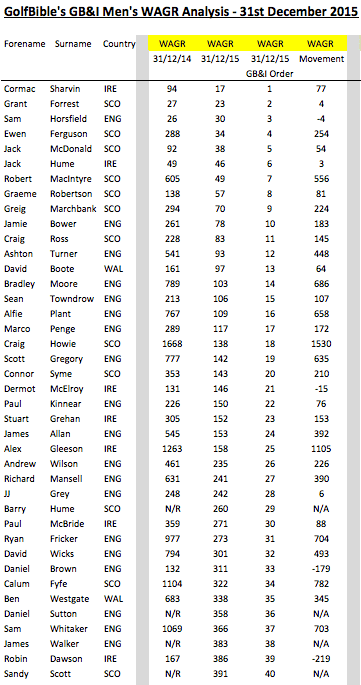
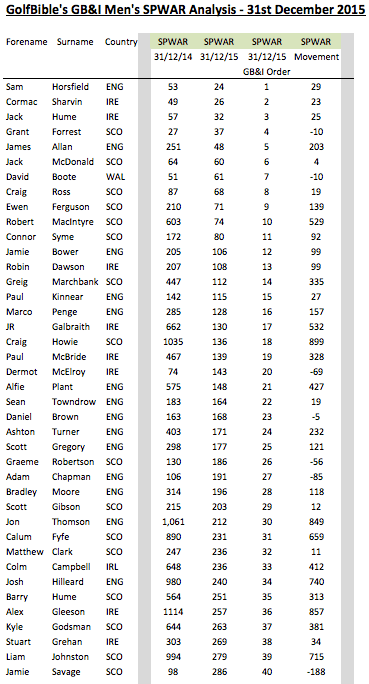
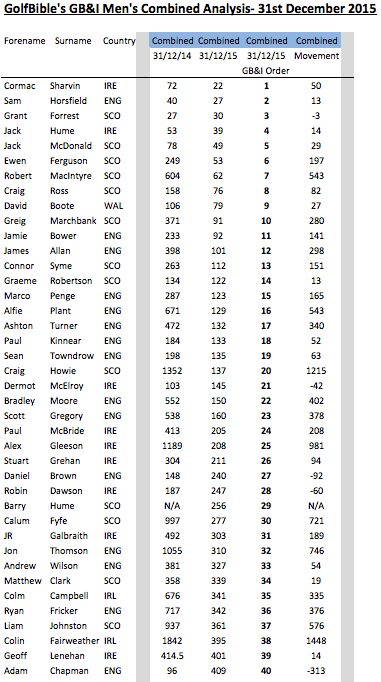
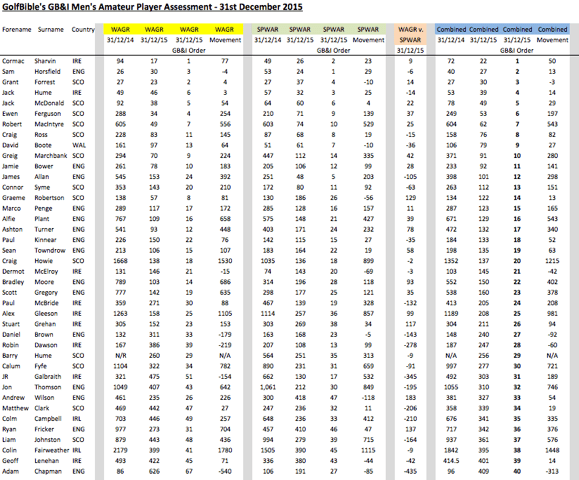
There are two main amateur rankings, the World Amateur Golf Ranking (WAGR) and the Scratch Players World Amateur Ranking (SPWAR).
The WAGR is run by The R&A and based in Allan Robertson House at Kingsbarns Golf Links near St. Andrews, Scotland.
The SPWAR is a labour of love for Fred Solomon, who lives in San Francisco, USA.
Both rankings can be viewed by clicking on these two links – the WAGR and the SPWAR.

In summary the WAGR has always enjoyed credibility through its association with golf’s main governing bodies, The R&A and the USGA, but has lacked the clarity and accuracy of the SPWAR.
The WAGR introduced a new approach in January 2020 – the ‘Power Method’ and tweaked it’s approach again in January 2022 in attempts to overcome its historic weaknesses. A redesigned website in March 2022 also gave it a much cleaner presentation.
However, even after allowing for these upgrades, in my view the WAGR remains inferior to the SPWAR for the following reasons: –
1. The new points ageing or amortisation in the WAGR is not as robust as the SPWAR. The ‘Power Method’ belatedly introduced ageing to the WAGR in 2020 but this is only applied after 12 months with points wasted daily over the remaining year of their life. In the SPWAR points have always held good for 30 days, then aged daily to 80% after 90 days, then aged in equal daily increments before being lost completely after two years.
2. The WAGR methodology is too complicated with Divisors the main culprit. The Divisor has seen players with few competitive results quickly become over ranked when the minimum has been achieved and worse still deliberately not playing to protect their inflated positions thereafter. The SPWAR is easier to follow with points simply allocated and aged over time. I do accept there is a lack of transparency around individual points from each event in the SPWAR as Mr. Soloman seeks to protect his exact ranking methodology.
3. The WAGR’s treatment of team matches is another key weakness in their ranking. The WAGR simply gives everyone the same ‘Participation Points’ for turning up to a team match regardless of the result and individual performances. Far more sensibly the SPWAR only awards points to those players who have contributed positively to the outcome of the match. Wins are weighted in favour of singles (+/- 2) over fourballs and foursomes (+/- 1) and then at the end of the match the total points won by each player are used to determine their SPWAR points allocation, if any.

4. The WAGR covers significantly fewer events than the SPWAR (2,900 v. 4,500 p.a.) and as a result is including fewer players (4,900 v. 17,500) and not tracking them as accurately. An obvious omission in the WAGR are all of the Qualifying Schools for the professional tours which are normally played over a minimum of 72 holes.
5. The WAGR only includes minimum 54-hole stroke play competitions. Therefore it ignores all 36-hole events. So if an amateur does well in say Final Qualifying for The Open or US Open Sectional Qualifying he doesn’t get rewarded by the WAGR for it. Amateur golf is varied and the SPWAR shows the necessary flexibility for such high profile competitions. Quickly looking through the player record of any member of the SPWAR’s Top 100 normally throws up a ‘short’ event entry where points have been earned. The WAGR’s approach has led to disparate 36 hole events pairing up to circumvent this rule and achieve WAGR recognition.
6. The WAGR are generally slower to remove new pros from their list but this area has been greatly improved in recent years. This is of course critical to the accuracy of any amateur ranking. Between September and February each year this takes time and means the players, the various qualifying schools and satellite tours need to be followed closely. The SPWAR has historically dealt with amateurs turning pro far more quickly thus maintaining the robustness of it’s listing.
7. Weekly announcements may be acceptable in the pro game where virtually every tournament finishes on a Sunday but in the amateur game it is anything but. Competitions finish on every day of the week. The WAGR is released at 12 noon every Wednesday, the weekly update including events that finish up to and including the previous Sunday. Therefore if an event finishes on a Monday we have to wait nine days for it to be reflected in the WAGR. Mr. Solomon normally updates his SPWAR for all significant events within 24 hours of them finishing. Smaller competitions are sometimes prioritised as less urgent, particularly in the busier summer season, but nearly always make it in before the Wednesday WAGR update.
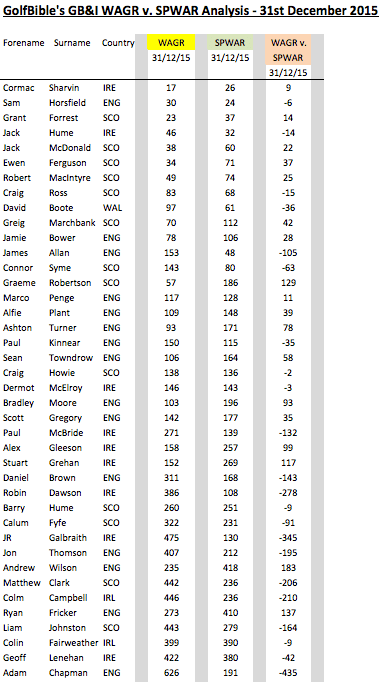
8. I often look at the WAGR and think ‘that ranking doesn’t look right’. I have never looked at the SPWAR and questioned a ranking – the list just makes sense – and I rarely hear it criticised. If you look down both lists you will find some glaring ranking differences. In my opinion they always favour the SPWAR when assessed objectively (and can be explained by one of the weaknesses listed above).
I know amateur rankings aren’t a major priority for either The R&A or the USGA but for people that play and follow amateur golf they are important.
For me, too many people are still quoting and using the WAGR without understanding how flawed it really is. I am now increasingly ignoring the WAGR and just concentrating on the SPWAR.
In their September 2018 Strategic Playbook The R&A stated they wish to ‘promote WAGR as the definitive world ranking in the amateur sport’. Whilst the recent updates represent positive steps forward in this regard the WAGR is still a clear second best to the SPWAR.
_________________________________________________
APPENDIX: A BRIEF HISTORY OF THE AMATEUR RANKINGS
The World Amateur Golf Ranking (WAGR) was launched on 23rd January 2007. It was established by David Moir, a member of staff in The R&A’s entries department.
Its origins lie in the handicap balloting out of the reigning Australian Amateur champion, Andrew Martin, at the 2004 Amateur Championship. It was clear that because of different handicapping systems around the world the adoption of lowest handicap as the primary entry criteria was no longer appropriate. A new approach or safety net was needed to ensure that such errors were not made again and that playing fields were always at their strongest.
Andy McDonald took over from Mr. Moir in 2008 and headed up the team within R&A Championships Ltd that manages he WAGR until late 2017 when he retired. Ian Scott replaced him but appears to have resigned in early 2021.
On 31st March 2021 The R&A paged the role of WAGR Manager “to oversee the successful delivery of the WAGR and World Rankings for Golfers with Disability (WR4GD) outcomes”. The role is responsible amongst other things for the “management and development of a team of four co-ordinators, responsible for processing events and liaising with event organisers and players”. Elizabeth Moser was appointed to this role in May 2021.
2011 was an important year for the WAGR. It started to produce a Women’s ranking and gained the endorsement of the USGA, giving it credibility around the world.
On 21st June 2018 the WAGR updated its website introducing some new features.
On 13th November 2018 WAGR announced that they would be launching a new world ranking for Golfers with Disability on 1st January 2019.
In 1999 Fred Solomon, a scratch golfer and pensions executive from San Francisco, established the Scratch Players Group with some friends. They planned to create a tour for elite golfers, amateur and pro, providing assistance with hosting tournaments ambitiously around the world.
In 2002 Mr. Solomon started to contemplate putting together a world amateur ranking to support their work. However, it was not until February 2004 that work started on the Scratch Players World Amateur Ranking (SPWAR).
After compiling and testing his list in 2005 and 2006 Mr. Solomon launched the SPWAR on the internet on 13th January 2007. This was 10 days before the WAGR so was the first to be released.
Mr. Solomon sought to gain the buy in of the USGA to his ranking which quickly became popular with event organisers in the United States. To his disappointment, but presumably not surprise, after some delay the USGA decided to endorse the WAGR at their annual meeting in February 2011. Mr. Solomon argues that the SPWAR was superior at all times prior to, at the time of and since this decision was made.
Fred Solomon worked on the SPWAR alone and with out recompense. His only reward being that the “Gold Standard”, as he calls it, male-only SPWAR is generally accepted as being superior to the WAGR. Interestingly despite the USGA’s support the majority of non-USGA events in the USA use the SPWAR exclusively or as their dominant entry criteria ranking.
Solomon, the founder and sole compiler of the Scratch Players World Amateur Ranking (SPWAR) sadly passed away on 16th April 2023. The SPWAR, which he last updated on 9th April 2023, will therefore no longer be available to us.
Please read my obituary of Fred here – Fred Solomon (1953-2023)
ME.
Copyright © 2014-2023, Mark Eley. All rights reserved.
 Golf Bible